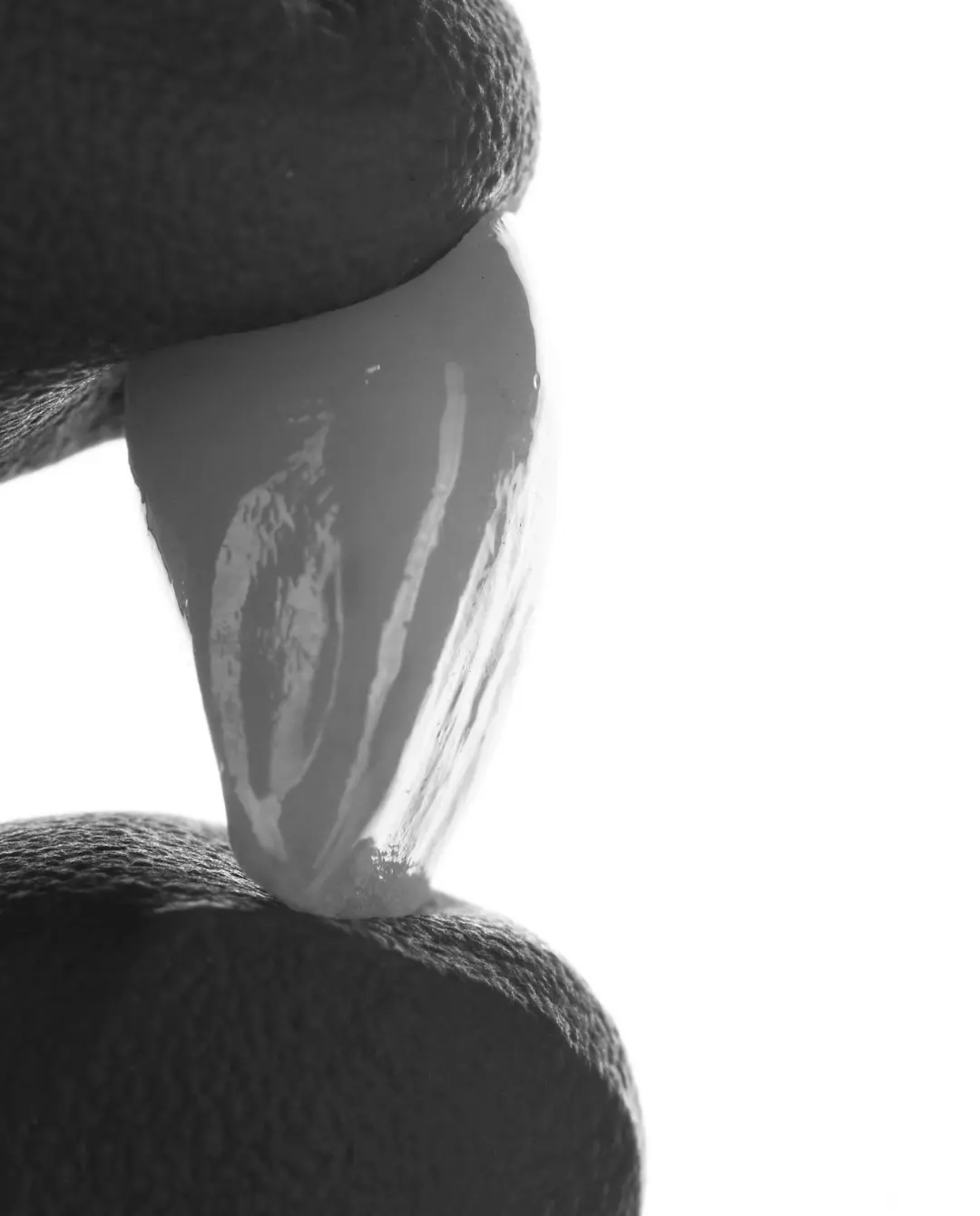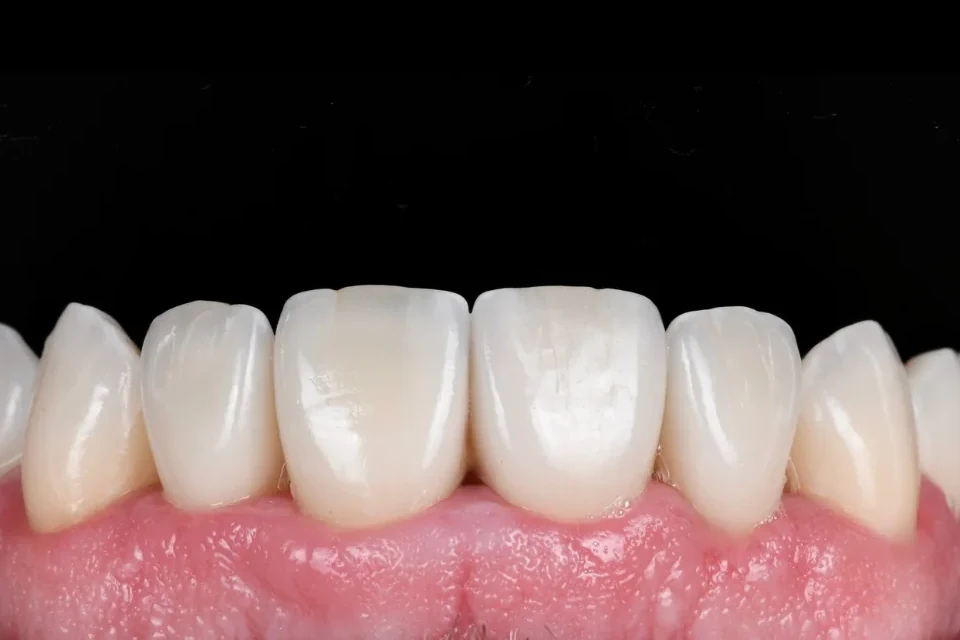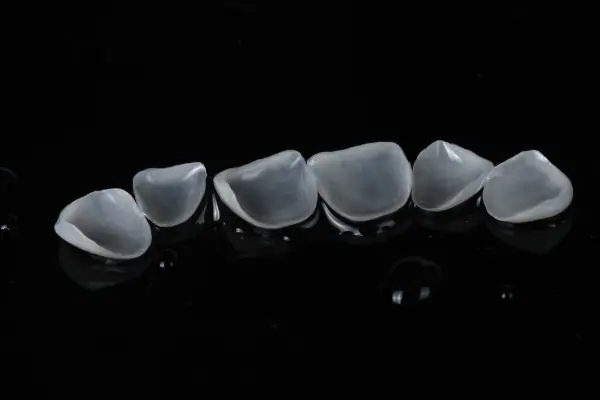
Six thin, translucent ceramic veneers side by side on a black background.

Ceramic veneers: correcting shape and shade.

A veneer corrects the shape, shade or proportions of a visible tooth. It is justified when a simpler solution is not enough.

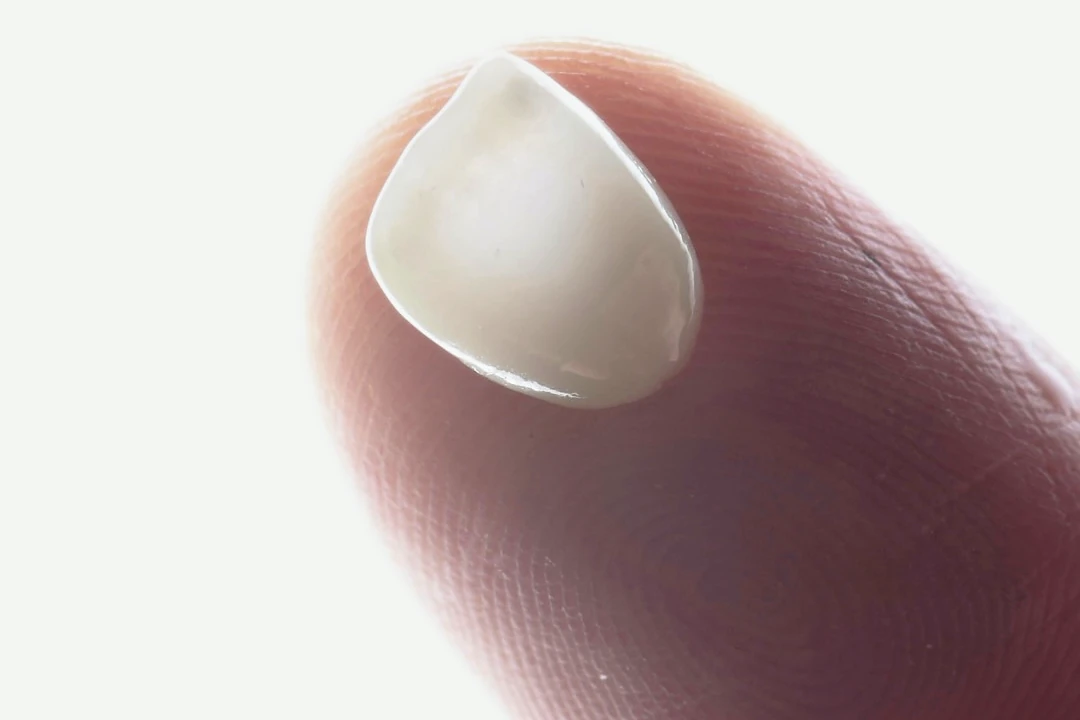
A ceramic veneer (also known as a porcelain veneer) is a thin piece of ceramic bonded to the visible surface of a tooth. It does not replace the tooth: it is added to it, covering neither the back nor, in most cases, the full volume of the tooth.

The decision matters more than the fitting: enamel removed before bonding does not grow back. The plan is therefore built before any preparation, taking into account the face, the gums and the bite, then tried in the mouth whenever possible.

Dr Jérémy Haccoun, dentist Updated

Key points

See a case: two veneers on the central incisors

Is it the right treatment?

A veneer is indicated when the shape, shade or proportions of a tooth cannot be corrected any other way.

The most common situations: discolouration that whitening alone cannot correct, a tooth that is too narrow or too short, a worn edge, a slight misalignment that does not on its own justify orthodontic treatment, and old composite restorations that have deteriorated.

Whether a veneer is indicated is decided at the examination: what the teeth show, and what the other solutions would not achieve. The aesthetic request matters, but on its own it is not enough.
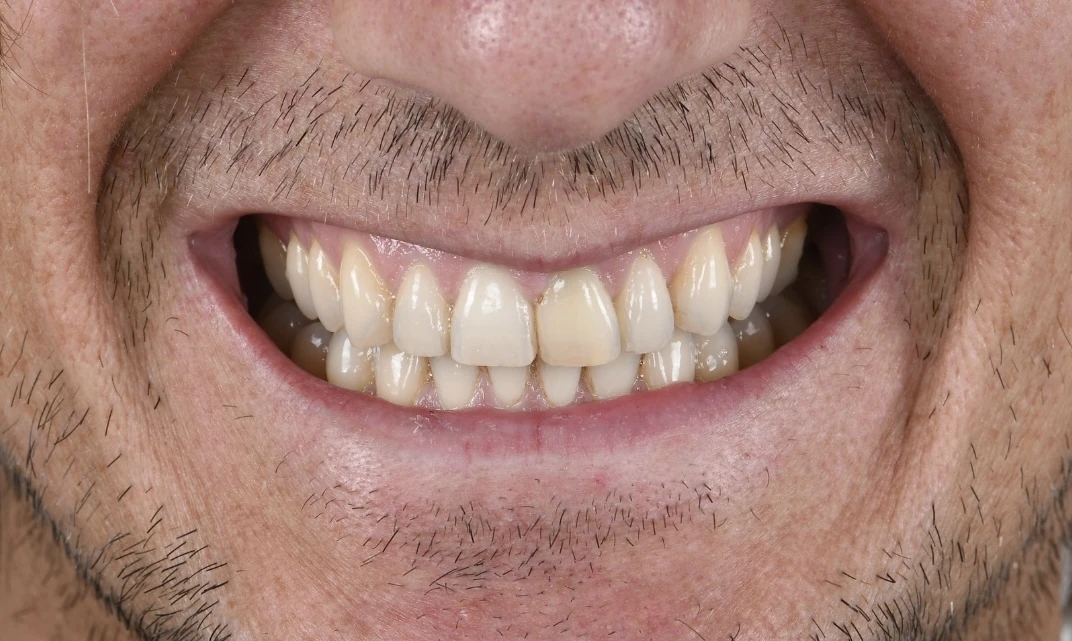
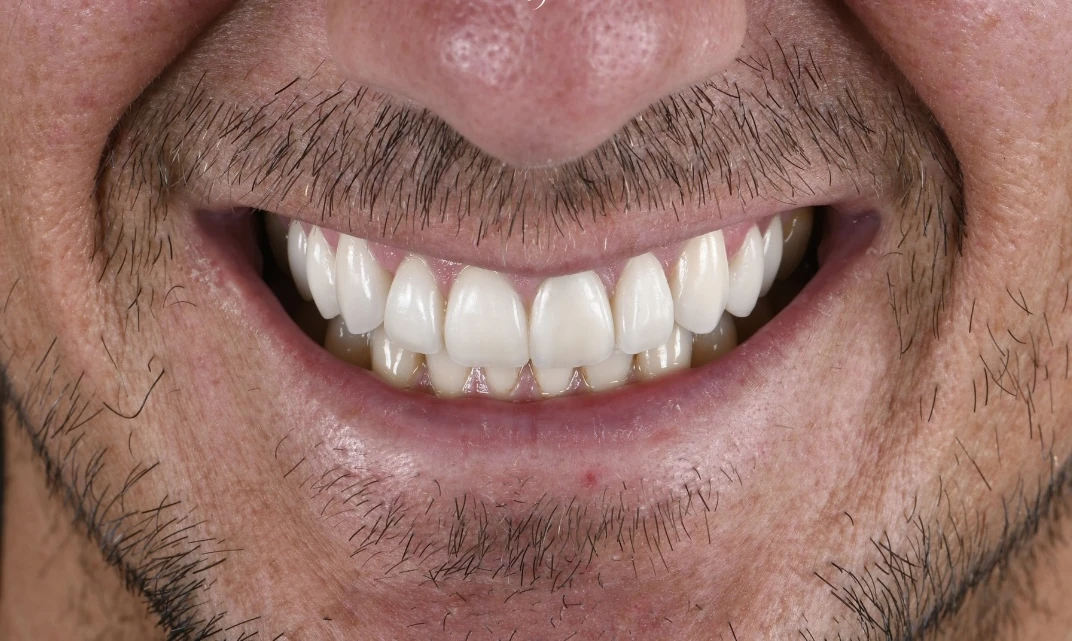
The smile, before and after

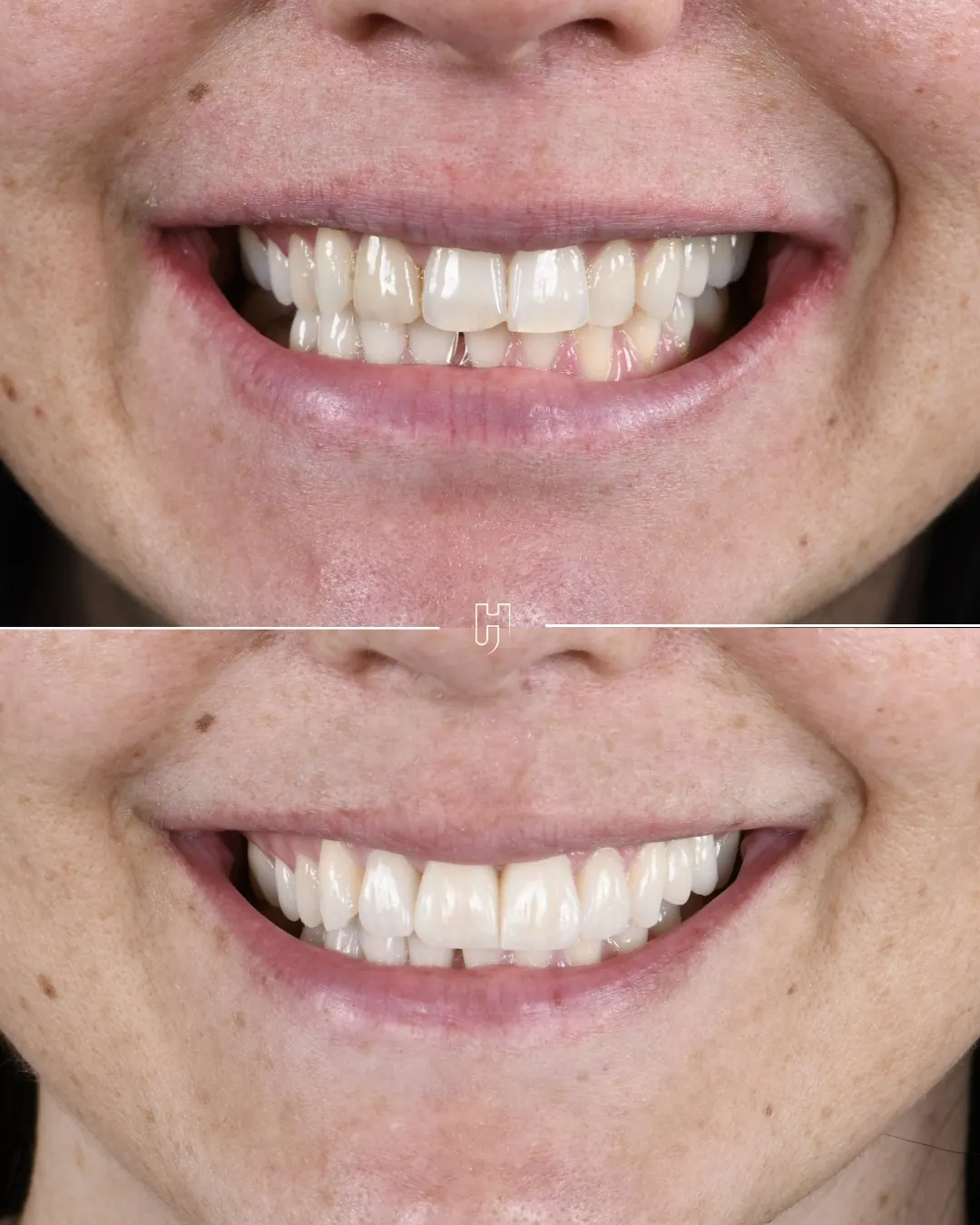
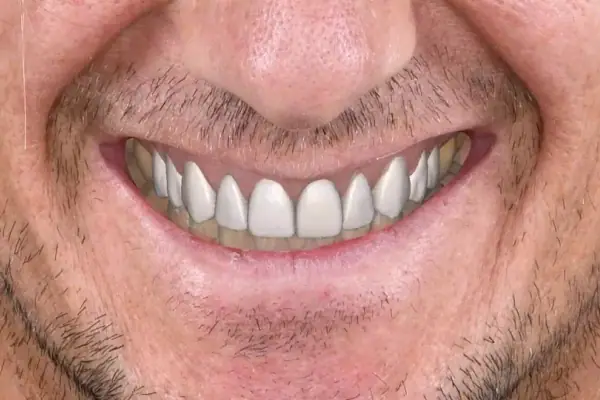
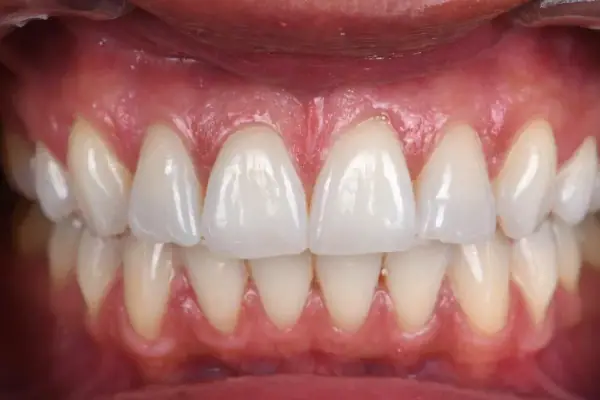
A patient photographed at the scale of the smile, before and after ten veneers were fitted to the upper teeth.

A patient’s smile before treatment: the upper teeth, yellower and irregular.
The same smile after ten veneers were fitted to the upper teeth.
BeforeAfter
The smile before and after ten veneers were fitted to the upper teeth. An individual result: it varies from one person to another. The case is described in detail in the clinical case gallery.

When it is not

In some situations, a veneer is not the right answer. Inflamed gums, active decay or a root that needs treatment come before any aesthetic consideration. Uncontrolled bruxism (clenching or grinding the teeth) subjects the ceramic to considerable stress, which the choice of material can only partly offset.

A request about shade alone calls for whitening. A badly broken-down tooth calls for a restoration that covers more of it. And when almost no enamel is left on the visible surface, bonding becomes less predictable, which takes away much of the point of the technique.

Before ceramic is considered, several options are compared. Each one addresses a different problem, and most remove less tooth tissue, or none at all.

Whitening
Works on the shade of the natural teeth, without removing anything.
Orthodontics
Repositions the teeth, even for a limited correction, and reduces the amount of correction needed. Sometimes to the point of making veneers unnecessary.
Injection-moulded composite
Adds material while removing little or no tissue, and can be touched up. Additive does not mean fully reversible.
Resin infiltration
Treats certain white spots without a restoration.

The choice is made after the examination, according to what needs to be corrected.

Preserving before restoring

Enamel, the foundation of the bond

As with any adhesive restoration, how well a veneer holds depends first of all on the tissue it is bonded to. Bonding to enamel is more stable and more durable than bonding to dentine, the layer underneath. The whole preparation is designed to stay within the enamel.

Keeping as much enamel as possible, particularly at the edges of the preparation, is what determines how the veneer behaves over time.

A veneer lasts not because of the ceramic, but because of the enamel that supports it.

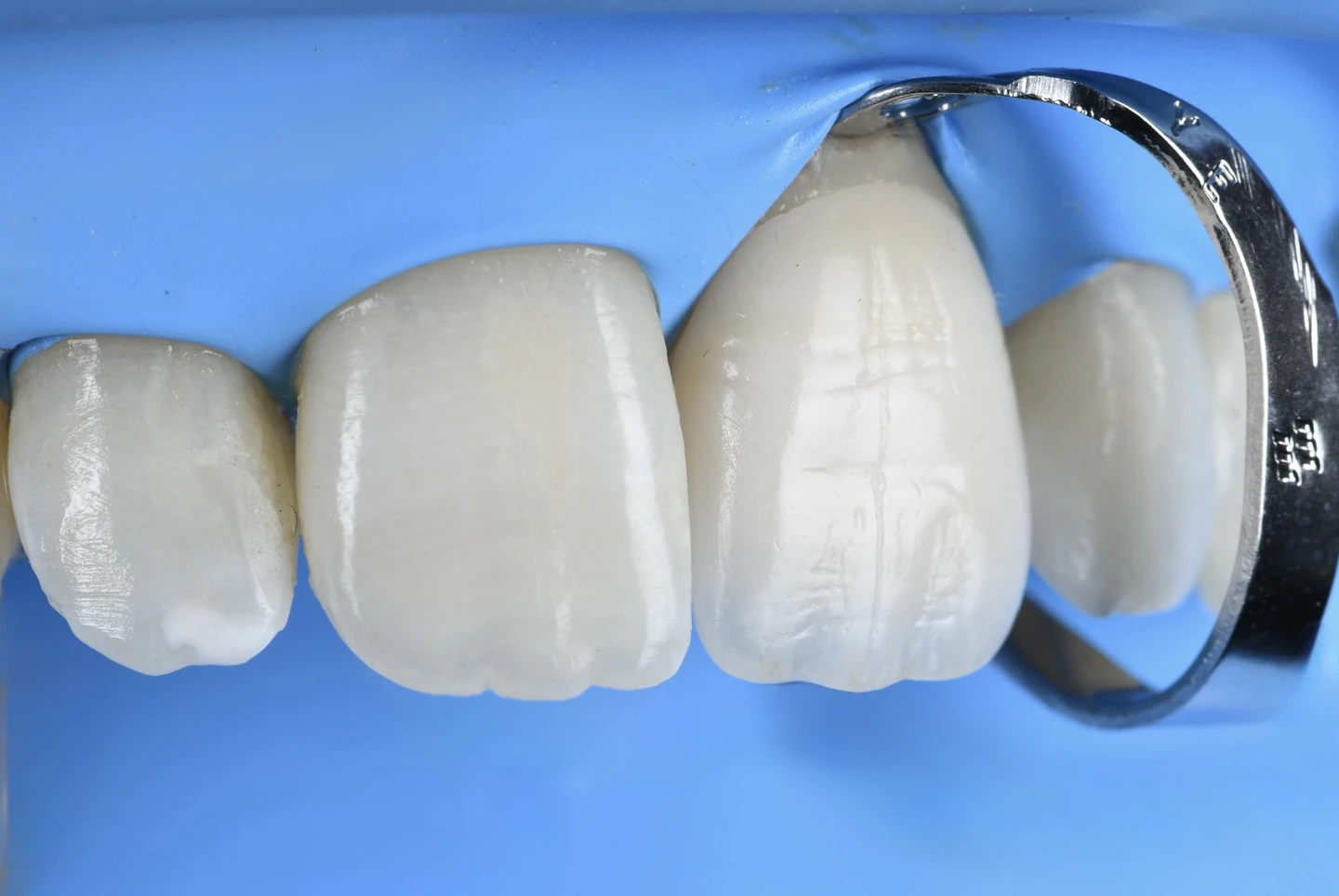
Under a blue rubber dam, a single veneer being bonded to a central incisor; a metal clamp holds the dam in place, on the right.
A single veneer being bonded to a central incisor under rubber dam: the blue sheet keeps saliva away from the teeth during bonding, and the neighbouring teeth are not touched. The same veneer, at the trial fitting that precedes this bonding, is photographed further down, in “A veneer that does not show”.

Trying it out with a mock-up

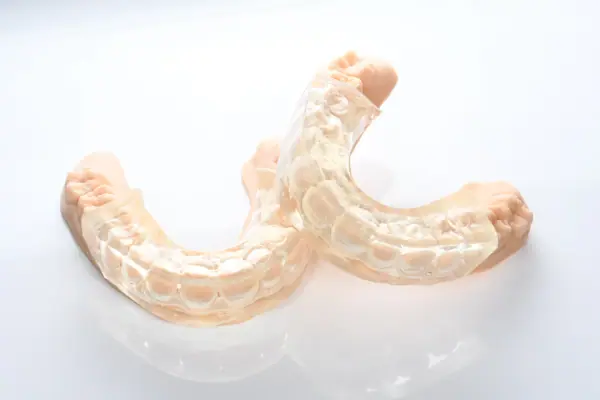
The mock-up is a temporary model placed over the teeth, without altering them, that reproduces the plan designed in advance. It lets you see, and show others, the future proportions, the support given to the lips and the smile line before any decision is made.

It also serves as a guide for the preparation. A tooth that is set back or too small sometimes needs very little reduction; a tooth that already sits forward needs more, to avoid a bulky result. The amount of enamel removed therefore depends on the final volume, never on a thickness fixed in advance.

Preservation Index

A minimal preparation, but a real one.

03 / 04

  1. 01No preparation
  2. 02Additive
  3. 03Minimal preparation
  4. 04Restorative

The index shows what a treatment removes from the tooth and what it leaves. The ceramic veneer sits at the third level: a small reduction of enamel, limited to the area to be corrected, but irreversible. A lower level does not mean a better treatment, only a different indication.

Building a natural result

Treatment takes place in separate stages, over several appointments. Up to the preparation, it is still possible to stop or to change the plan.

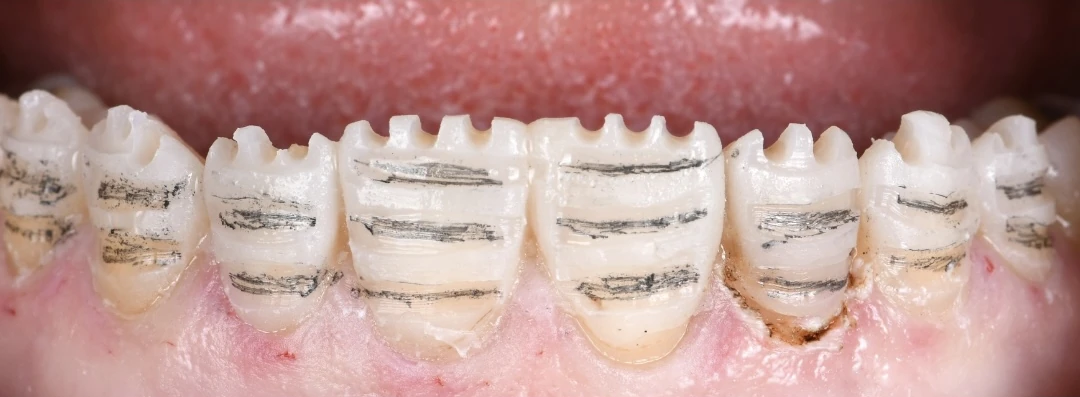
The upper teeth being prepared for veneers: depth grooves, marked in pencil, on each tooth.
Preparation calibrated to the design, in another patient: depth grooves are cut into the enamel, then marked in pencil. Reduction stops when the line disappears: the tooth is prepared to the planned thickness, and no further.
  1. The consultation establishes the diagnosis and compares the options.
  2. Photographs and a digital impression are used to build the plan.
  3. Where indicated, the mock-up lets you try the plan in the mouth.
  4. The preparation, where indicated, is calibrated against this plan.
  5. Temporary restorations let you live with the new shapes for a few days.
  6. The ceramic veneers are individually made in the laboratory, tried in place, then bonded.
  7. A check-up assesses the bite and the surrounding tissues.

Choosing the ceramic

Two families of ceramic predominate. Feldspathic ceramic is built up by hand, layer by layer: it is the more translucent of the two, and it can be made very thin when the underlying tooth allows.

Lithium disilicate, known by the trade name e.max, is pressed or milled, and is mechanically stronger. The choice depends on the tooth structure available, the starting shade and the functional context, that is, the way the teeth meet and the forces they are subjected to. This context can guide the choice of material, its thickness, the design of the restoration and sometimes the indication itself: a stronger ceramic does not, on its own, make up for unfavourable stresses. The journal article on feldspathic and e.max veneers sets out what separates these two materials.

Ceramic designed tooth by tooth

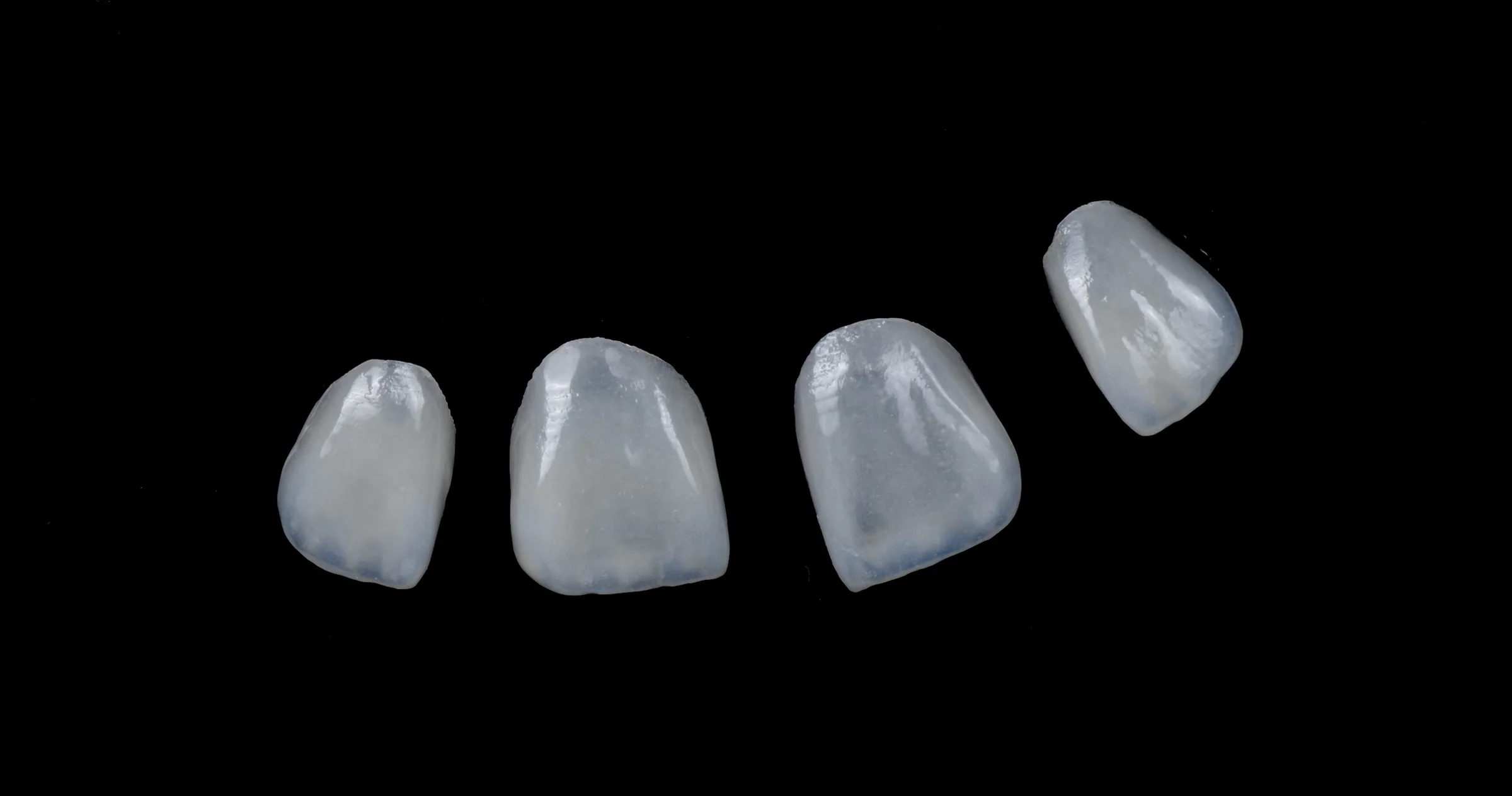
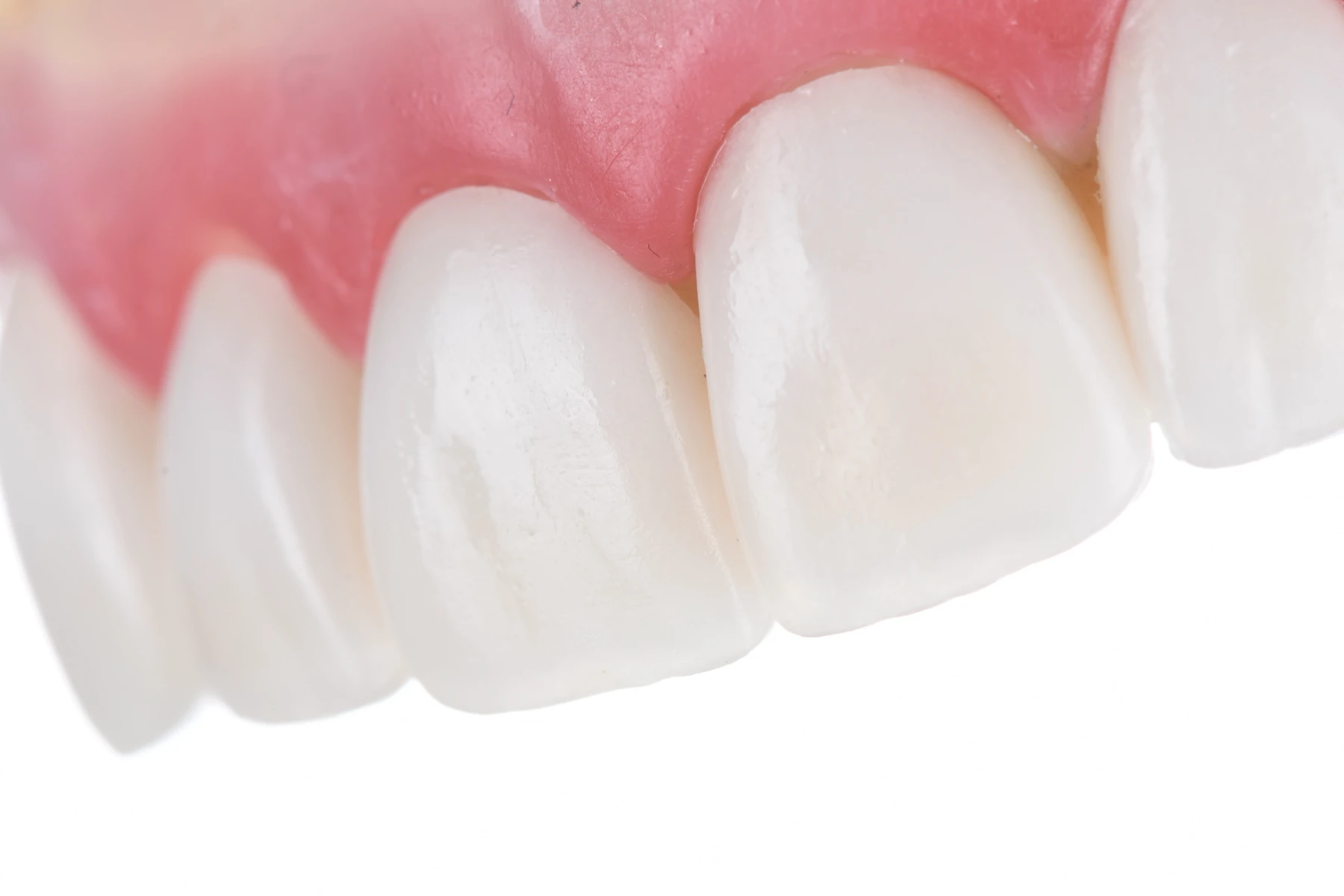
Each veneer is designed individually to reproduce the subtle shade variations, the translucency and the optical characteristics of a natural tooth.

Four feldspathic ceramic veneers showing their translucency
Feldspathic ceramic veneers, custom-made.

A veneer that does not show

A veneer is rarely noticed because it is white; it is noticed because it is too uniform. What makes it convincing: the surface texture, the translucency of the edge, the transition with the gum and the slight asymmetries that a real smile retains.

A tooth does not have the same shade near the gum as at the edge. A ceramic that ignores these nuances shows, whatever its quality.

A result is judged by the teeth that were left untouched.

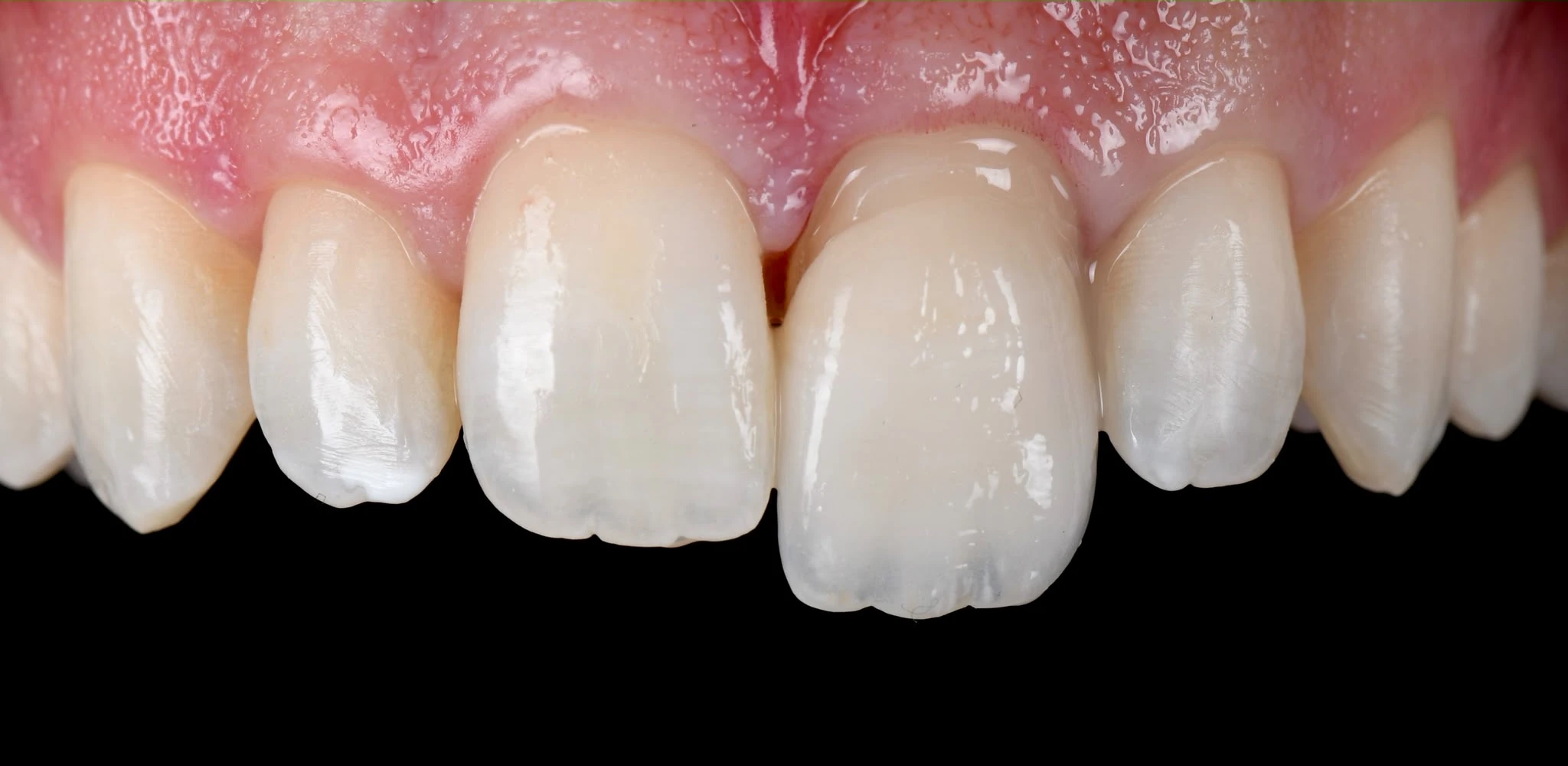
Side view of the upper teeth against a black background, at the trial fitting of a veneer on a central incisor, next to the natural teeth: surface texture, translucent edges, gums.
A single veneer on a central incisor, at the trial fitting (the “try-in”): placed on the tooth without being bonded, photographed from the side against a black contrastor, to check the aesthetics before final placement. Surface texture, translucency of the edge, transition to the gum: the veneer is judged next to the teeth that have not been touched.

How many teeth to treat

The number of veneers depends on what can be seen when the patient smiles: how wide the smile is, the shade of the neighbouring teeth and the point at which a transition between treated and untreated teeth would become visible.

Two veneers may be enough when only two teeth stand out from the rest. Treating the four incisors, or going as far as the premolars, is justified when the result cannot be achieved any other way. Making everything uniform on principle is not a clinical reason.

Clinical case

Preserving rather than multiplying

The number of veneers is not fixed in advance: the aesthetic plan determines the minimum treatment needed.

An old veneer on a lateral incisor was unbalancing the smile: it was too wide compared with the central incisors, and its shade was more saturated. The simplest response would have been to treat more teeth so that everything matched.

The aim was the opposite. Three weeks of at-home whitening first improved the shade of the surrounding teeth. After this step, the shade and shape of the canines blended in well enough for them to be left untouched. The digital aesthetic plan then confirmed that treating only the four incisors would be enough.

A targeted gingivectomy restored the balance of the gum line, then four feldspathic ceramic veneers corrected the proportions. Before any preparation, the shade was recorded using the eLAB protocol, a method of measuring colour from calibrated photographs, so as to give the laboratory as much information as possible and achieve continuity with the neighbouring natural teeth.

Smile before and after the replacement of a veneer and the placement of four feldspathic ceramic veneers on the incisors

In practice

No lifespan can be promised. Longevity depends on the bite, on habits such as clenching, on regular follow-up and above all on the quality of the bond, and therefore on the enamel available. Day to day, veneers are looked after like natural teeth: brushing, cleaning between the teeth, regular check-ups.

Over time, a veneer can crack, come loose or develop staining along its margin. Check-ups make it possible to monitor the veneers and to spot wear or a complication early.

Limits and reversibility

A veneer bonded to preserved enamel can, in most cases, be replaced on its own, without redoing the neighbouring teeth. This is the main argument for a limited treatment rather than an extensive one.

The preparation, however, is not reversible: a prepared tooth will remain a restored tooth.

That is why the steps before bonding exist. Diagnosis, the plan, the mock-up and the temporary restorations all leave room for adjustment, and as long as nothing has been removed, you can still decide not to go ahead.

A ceramic veneer, feldspathic or e.max, costs between €1,100 and €1,400 per tooth, depending on complexity. This covers the preliminary study, the plan, the trial in the mouth, the laboratory work and the fitting.

Treatment carried out for aesthetic reasons is not covered by the French national health insurance (Assurance Maladie), and a detailed written quote is provided before any decision. The table of fees sets out all the procedures and the factors that make each range vary.

Planning veneers in Levallois-Perret

The consultation takes place at the practice in Levallois-Perret, 119 rue du Président Wilson. It begins with a clinical examination: the condition of the enamel, the gums and the bite, before any aesthetic consideration.

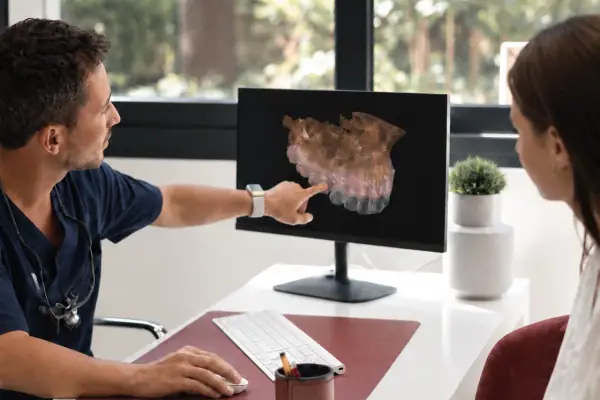
This is followed by photographs and an analysis of the smile, then, when the plan warrants it, a digital impression. The alternatives are compared, a mock-up is offered when it is useful, and the decision is made afterwards, never on the same day.

Understand before choosing.

Do veneers damage your teeth?

It all depends on what has been removed. A veneer bonded to preserved enamel does not weaken the tooth: it is added to it. An extensive preparation, on the other hand, removes tissue that does not grow back. What matters for the tooth is the amount of enamel removed, not the veneer itself.

Is having veneers fitted painful?

The photographs, the impression and the mock-up are not painful. When preparation is needed, it is carried out under local anaesthesia. After fitting, temporary sensitivity can sometimes occur; it usually remains limited and should be reassessed if it persists. Slight tenderness where the anaesthetic was injected can also last 24 to 48 hours.

Do teeth have to be filed down for veneers?

Not always, and never as much as for a crown. When preparation is needed, it is limited to a thin layer of enamel, calibrated against the mock-up. A tooth that is set back or too small may need very little reduction. It is the examination and the plan that determine this, not a general rule.

Every situation
needs its own diagnosis.

The information on this page is general. Only a clinical examination can establish whether a treatment is indicated, and clarify its benefits, limits and alternatives.

Message us