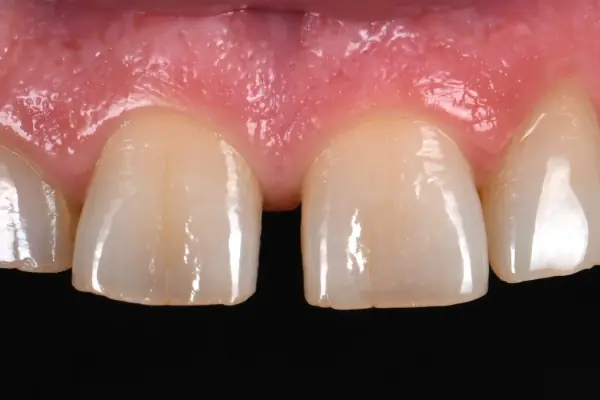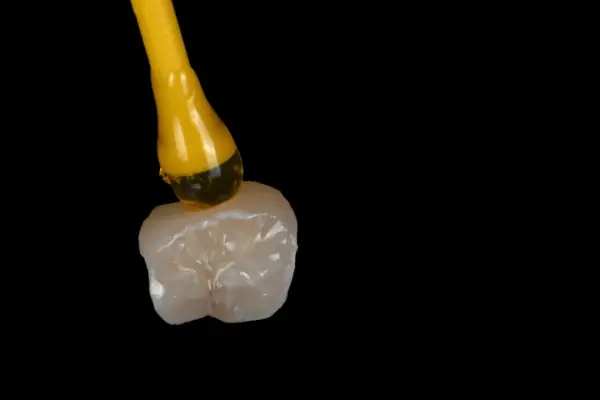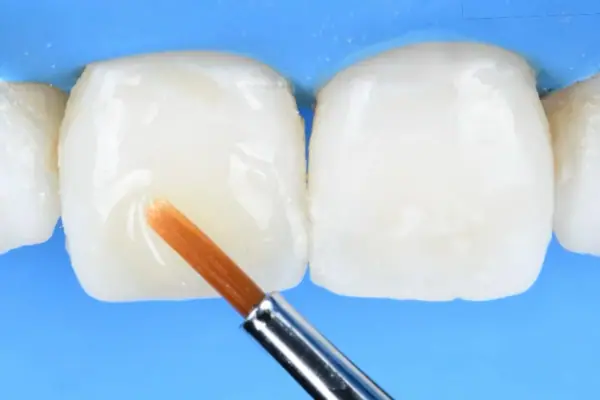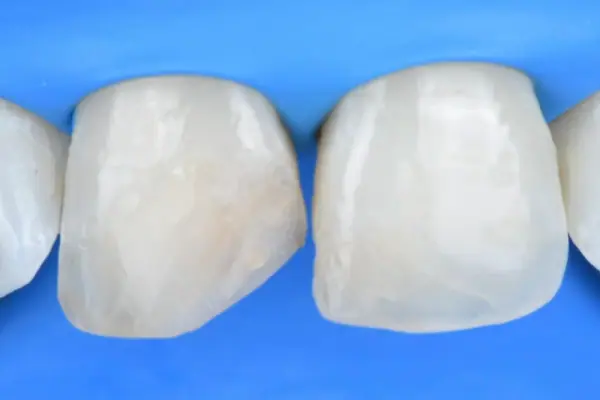
Two incisors isolated under a blue rubber dam, before a bonded restoration.

Adhesive restorations: rebuilding while preserving the tooth.

Repairing a weakened tooth by bonding a restoration to what remains sound, rather than covering it entirely with a crown.

What is removed from a tooth does not grow back, and replacing a restoration often means removing a little more healthy tissue. Preserving the tooth today keeps options open for it later on.

Bonding makes this possible. Composite placed chairside, inlay, onlay, overlay or veneer: each adhesive restoration suits a different situation, and the examination shows which one is appropriate.

Dr Jérémy Haccoun, dentist Updated

Key points

Broken front tooth: composite or ceramic?

Understanding bonding

What “bonding” means

Bonding a restoration means joining it to the tooth through a microscopic grip. The surface of the tooth is first prepared, most often with an acid gel applied for a few seconds and then rinsed off: it becomes finely roughened. An adhesive resin penetrates these tiny irregularities, then hardens: it links the tooth to the restoration.

Once bonded, the tooth and the restoration work as a single unit, close to the original tooth: this is the idea behind what is known as biomimetic dentistry. The restoration no longer needs a shape that holds it in place, like the walls of a crown. The preparation can therefore follow the outline of the defect, instead of imposing a standard shape that would remove healthy tissue.
Enamel and dentine, two different surfaces

Bonding is not equally reliable everywhere. On enamel, the hard, highly mineralised layer that covers the tooth, it is strong and well sealed. On dentine, the tissue beneath, which is wetter and richer in fibres, a lasting bond is harder to achieve.

That is why enamel is spared wherever possible, especially at the edges of the restoration, where its seal is at stake. When part of the bond relies on dentine, the protocol takes this into account.

A tooth kept dry

Bonding does not tolerate contamination by saliva or blood. While it is being done, the tooth is isolated, most often with a rubber dam: a thin, flexible sheet stretched around the teeth being treated, which keeps them dry.

A 2021 Cochrane review of the available trials concludes, with low-certainty evidence, that a rubber dam may reduce the failure of restorations made directly in the mouth, six months after placement; beyond that, the data do not allow a conclusion. What is not in question is that the bond must be protected from saliva while it is being made: a rubber dam is the usual way of achieving this.

When to consider it

The most common situations

An adhesive restoration is considered when a tooth has lost part of its structure or its shape, and enough of it remains to bond to. Four situations come up often.

A fractured tooth
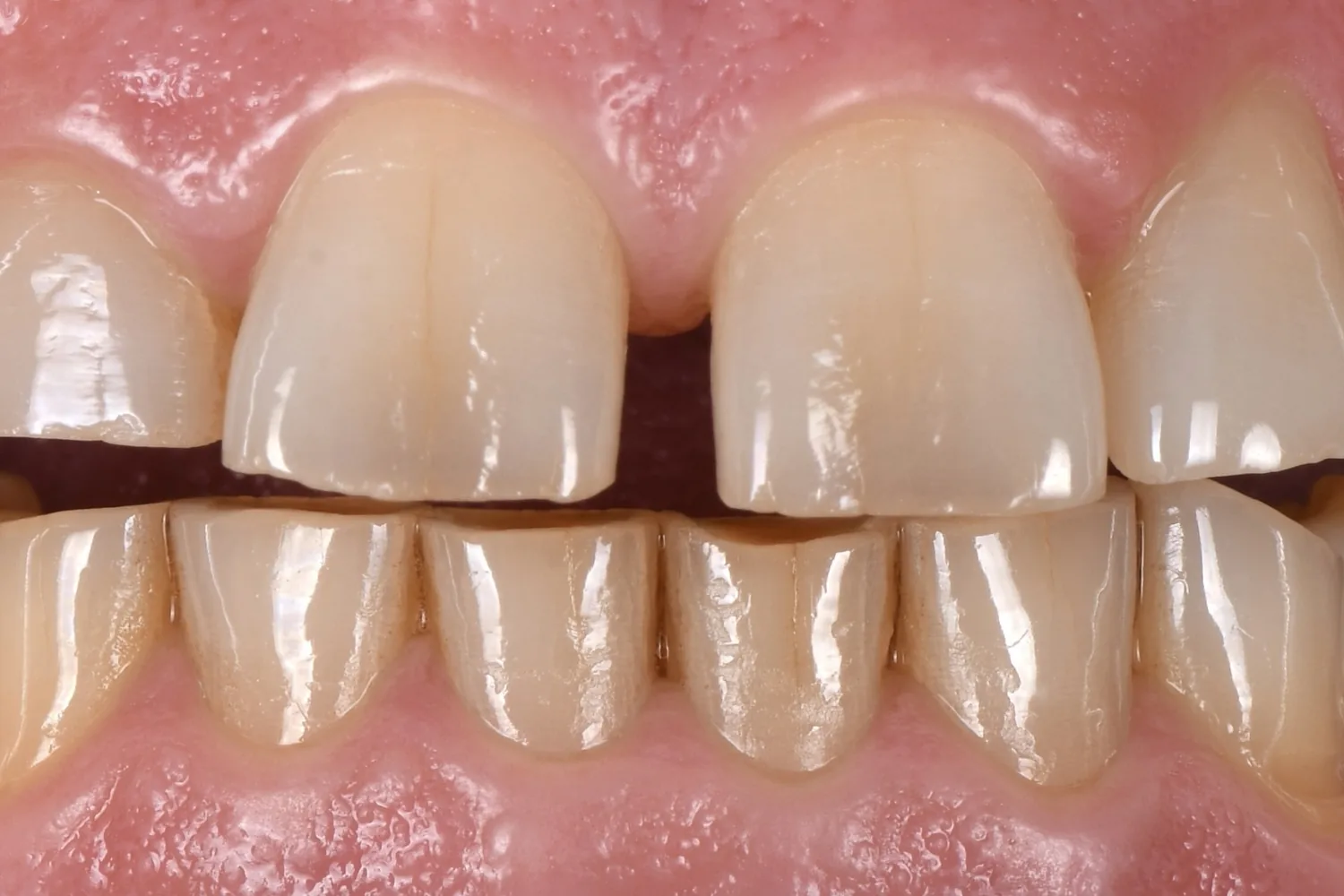
A broken corner of an incisor, a molar cusp (one of its points) that has cracked and then broken off. Depending on the extent, composite placed chairside or a custom-made bonded restoration rebuilds the missing part.
A large old restoration
An old amalgam, the grey metal filling, or a large composite, cracked or leaking. When the remaining walls are fragile, a custom-made bonded restoration that covers them can protect them without crowning the tooth.
A worn tooth
Shortened incisor edges, flattened chewing surfaces. Once the cause has been identified, the shape can often be restored by adding material rather than by reducing the tooth.
A shape to correct
An incisor that is too small, too short or out of balance with its neighbours. Composite or a ceramic veneer can correct its shape; the choice depends on what needs to change.

Each one is decided at the examination: the same appearance can hide different situations.

When bonding is not the right answer

Bonding requires a sufficiently sound foundation, and a tooth that can be kept dry. Active decay, inflamed gums or a root that needs treatment come first. Very extensive loss, margins lying deep below the gum or a tooth with almost no enamel left make bonding less predictable: a crown may then remain the safer solution.

Uncontrolled clenching or grinding also exposes any restoration to heavy forces. It is managed before rebuilding, whatever the technique.

Types of restoration

Direct or indirect

A direct restoration is made in the mouth, in a single appointment; an indirect restoration is made outside the mouth, then bonded at a later appointment. The main adhesive restorations are grouped as follows.

Layered composite
Direct. Rebuilds a tooth chairside, layer by layer, reproducing its natural shades: for a broken corner, decay or minor wear.
Injection-moulded composite
Direct. Transfers a shape designed in advance into the mouth, often on several front teeth.
Inlay, onlay or overlay
Indirect. A restoration bonded to a back tooth: inside the cavity (inlay), over one or more of the raised points of the chewing surface (onlay), or over that whole surface (overlay).
Veneer
Indirect. A thin ceramic shell bonded to the visible surface of a front tooth, to correct its shape or shade.

Composite, a resin filled with fine mineral particles, is placed layer by layer and then hardened with light. Indirect restorations are made in a laboratory or by milling, from an impression; they are most often ceramic, sometimes composite.

Composite has two strengths: it is added to the tooth, most often removing only what is damaged, and it can be repaired locally. It suits limited or moderate loss of tooth structure, and corrections of shape on the front teeth.

Its limits relate to volume and forces. A large rebuild on a heavily loaded molar, or heavy clenching, puts it to the test; its shade and gloss also change more than those of ceramic, and it can be re-polished. A literature review puts its failure rate at between 1 and 3% per year on back teeth, and between 1 and 5% on front teeth, with wide variations depending on the risk of decay, the chewing forces and the size of the restoration.

Custom-made bonded restorations: inlay, onlay, overlay

When a back tooth has lost more, or its remaining walls are fragile, it is rebuilt with a custom-made restoration that is then bonded. The restoration covers what needs protecting, without extending over the rest of the tooth. Measured in the laboratory, the preparation for a full crown removes between two thirds and three quarters of the part of the tooth above the gum; partial preparations remove considerably less.

In the studies gathered by the 2016 systematic review of Morimoto and colleagues, around 91% of ceramic inlays, onlays and overlays were still in place after ten years; the most frequent complications were fractures and chipping, followed by problems affecting the nerve of the tooth. These are averages: they do not tell you what will happen to any one tooth.

Where ceramic veneers fit in

An adhesive restoration for visible teeth

Ceramic veneers apply the same logic to the front teeth. A veneer is a thin ceramic shell bonded to the visible surface of a tooth: it is held by bonding, and it is the enamel that keeps it secure over time.

A veneer is considered when the shape, shade or proportions of a tooth cannot be corrected more simply: discolouration that whitening alone cannot correct, a tooth that is too short or too narrow, a worn edge, old composites that have become unstable. In another 2016 systematic review by Morimoto and colleagues, around 89% of ceramic veneers were still in place after a median follow-up of nine years.

Why the indication is discussed first

A veneer most often requires a preparation of the enamel that is slight and limited to the area being corrected, but irreversible. Before suggesting one, the examination checks that a simpler solution would not be enough: whitening, orthodontic tooth movement, or composite added while removing little or no tissue. It also checks the available enamel, the gums, the way the teeth meet and whether there is any clenching.

The plan is then designed and, where possible, tried in the mouth before any preparation. The detailed indications, the steps and cases treated at the practice are brought together on the page devoted to ceramic veneers.

Choosing, then treating

What guides the choice

No restoration is better in itself: the choice takes shape at the clinical examination, supplemented by X-rays if needed. Each option is presented with its benefits, limits, alternatives and cost; the fees for each restoration are listed in the table of fees.

Five factors guide this choice.

  1. What remains of the tooth: the thickness and strength of the walls, the presence of enamel.
  2. The location of the defect: a visible tooth or a back tooth, and whether the margins are close to the gum.
  3. The bonding conditions: the enamel available, and whether the tooth can be kept dry.
  4. The chewing forces: the way the teeth meet, any clenching or grinding.
  5. Your expectations: the look you want, the number of appointments, and the budget and maintenance you are prepared to accept.

The main steps

A direct restoration is most often completed in a single appointment. An indirect restoration needs at least two, with the restoration being made in between.

  1. The examination establishes the diagnosis and compares the options.
  2. What is damaged is removed: decay, an old restoration, walls too thin to be kept. The shape follows the defect.
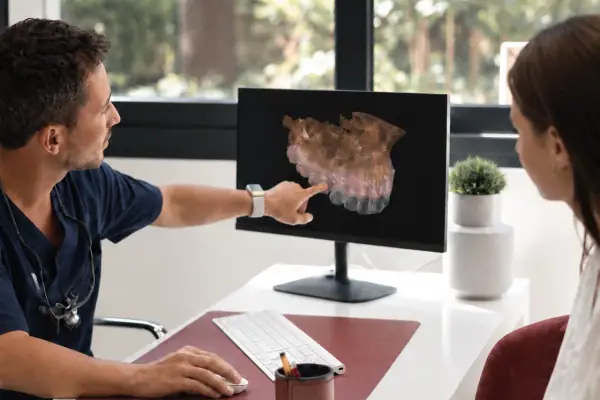
  3. For a custom-made restoration, an impression, often digital, is taken, and a temporary restoration protects the tooth.
  4. The tooth is isolated, then the restoration is placed or bonded.
  5. The bite is checked and the surfaces are polished.
  6. A check-up some time later assesses how the restoration has integrated.

Limits, follow-up and maintenance

What bonding cannot promise

No restoration lasts forever, and no lifespan can be promised. Over time, a restoration can wear, chip, come loose, develop a stained edge, or allow decay to form at its margin.

How long it lasts depends less on the material than on the situation: the risk of decay, chewing forces and clenching, the size of the restoration, whether or not the tooth is root-treated, the quality of the bond, and how regular the check-ups are.

Repairing before replacing

A damaged restoration does not always need to be completely redone. A composite can often be repaired locally, by adding material to the worn or chipped area; a ceramic restoration sometimes can be too, depending on the defect. Repairing avoids removing healthy tissue again, which a complete replacement often requires.

Studies comparing repair and replacement show no difference in failure between the two, with evidence that is still of very low certainty. When replacement is necessary, it follows the same logic: remove as little as possible, then bond.

Day-to-day care

A bonded restoration is cared for like a natural tooth: brushing twice a day, cleaning between the teeth with floss or interdental brushes, and regular check-ups at a frequency agreed with you. These check-ups make it possible to re-polish, touch up or repair early, before a small defect spreads.

If you clench or grind your teeth, a protective splint worn at night may be suggested to preserve the restorations.

Understand before choosing.

Is a bonded restoration stronger than a crown?

Not necessarily, and that is not its purpose. Over the first years of published follow-up, onlays and partial crowns perform as well as full crowns while removing considerably less tissue; long-term data are still lacking to tell them apart. When too little of the tooth remains to bond reliably, a crown is still the right answer.

How long does a bonded restoration last?

No lifespan can be promised. The published figures, given above, are averages across groups of patients and do not tell you what will happen to any one tooth. How long it lasts depends above all on the risk of decay, the chewing forces, the size of the restoration and how regular the check-ups are.

Does the tooth have to be prepared (reduced) for a bonded restoration?

Most often, only what is damaged is removed: decay, an old restoration, walls too thin to be kept. Composite added to a healthy tooth needs almost no preparation; a veneer generally requires a slight reduction of the enamel. What is removed does not grow back: how much to remove is decided on a plan, before the procedure.

Is it painful?

Treatment is carried out under local anaesthesia when the procedure requires it. After bonding, some temporary sensitivity may occur; it is usually limited, and should be reassessed if it persists.

References

  1. Perdigão J. Current perspectives on dental adhesion: (1) Dentin adhesion, not there yet. Jpn Dent Sci Rev. 2020;56(1):190-207. doi:10.1016/j.jdsr.2020.08.004
  2. Miao C, Yang X, Wong MCM, Zou J, Zhou X, Li C, et al. Rubber dam isolation for restorative treatment in dental patients. Cochrane Database Syst Rev. 2021;(5):CD009858. doi:10.1002/14651858.CD009858.pub3
  3. Edelhoff D, Sorensen JA. Tooth structure removal associated with various preparation designs for posterior teeth. Int J Periodontics Restorative Dent. 2002;22(3):241-249.
  4. Demarco FF, Collares K, Correa MB, Cenci MS, Moraes RR, Opdam NJ. Should my composite restorations last forever? Why are they failing? Braz Oral Res. 2017;31(suppl 1):e56. doi:10.1590/1807-3107BOR-2017.vol31.0056
  5. Morimoto S, Rebello de Sampaio FBW, Braga MM, Sesma N, Özcan M. Survival rate of resin and ceramic inlays, onlays, and overlays: a systematic review and meta-analysis. J Dent Res. 2016;95(9):985-994. doi:10.1177/0022034516652848
  6. Wang B, Fan J, Wang L, Xu B, Wang L, Chai L. Onlays/partial crowns versus full crowns in restoring posterior teeth: a systematic review and meta-analysis. Head Face Med. 2022;18:36. doi:10.1186/s13005-022-00337-y
  7. Morimoto S, Albanesi RB, Sesma N, Agra CM, Braga MM. Main clinical outcomes of feldspathic porcelain and glass-ceramic laminate veneers: a systematic review and meta-analysis of survival and complication rates. Int J Prosthodont. 2016;29(1):38-49. doi:10.11607/ijp.4315
  8. Mendes LT, Pedrotti D, Casagrande L, Lenzi TL. Risk of failure of repaired versus replaced defective direct restorations in permanent teeth: a systematic review and meta-analysis. Clin Oral Investig. 2022;26(7):4917-4927. doi:10.1007/s00784-022-04459-0
  9. Loomans B, Opdam N, Attin T, Bartlett D, Edelhoff D, Frankenberger R, et al. Severe tooth wear: European consensus statement on management guidelines. J Adhes Dent. 2017;19(2):111-119. doi:10.3290/j.jad.a38102

Every situation
needs its own diagnosis.

The information on this page is general. Only a clinical examination can establish whether a treatment is indicated, and clarify its benefits, limits and alternatives.

Message us