
Key points
- A veneer without preparation is possible when the tooth needs to gain volume: a tooth that is set back, small or worn at the edge, or a gap to close.
- On a tooth that already sits forward or is heavily discoloured, fitting a veneer without preparation results in a tooth that is too bulky and hard to clean, or a shade that is poorly masked.
- Studies on these veneers are encouraging but small; their very thin edge is more fragile.
Why does a veneer usually require preparation?
A ceramic veneer is a few tenths of a millimetre thick. Bonded to a tooth without anything being removed, it makes the tooth thicker by the same amount. On a well-positioned tooth, this extra thickness can be seen and felt: the tooth looks further forward, the lip is supported differently, and the edge near the gum forms a step.
The preparation removes the thickness needed, and only that, calibrated against the plan tried in the mouth.
When can preparation be avoided?
When the plan adds volume: a tooth that is set back from the others, a small or peg-shaped lateral incisor, a worn edge to lengthen, a gap to close between two teeth. The thickness of the veneer then serves the correction instead of getting in its way.
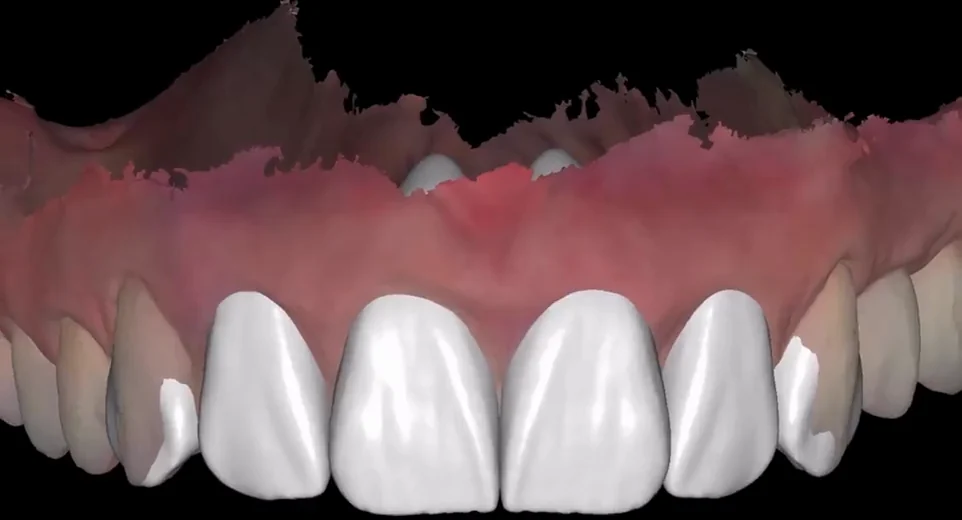
The plan tried in the mouth shows this: if the mock-up, placed without removing anything, gives teeth of the right volume, a veneer without preparation can be considered.
Even then, the enamel is sometimes very lightly polished, for bonding or to finish the edge; it is then more accurate to speak of minimal preparation.
When is it better to prepare the tooth?
When the tooth already sits forward or is of a good size: without preparation, it would become too bulky. When the shade is very dark: masking it takes thickness. When old restorations have to be removed: the surface needs to be reworked anyway.
Adding volume where none is needed is not a conservative choice: a veneer that is too thick at the gum line traps plaque and makes cleaning harder.
What do studies say about these veneers?
They are encouraging, but still limited. A prospective study followed 186 veneers in 35 patients for an average of nine years: veneers with no preparation or minimal preparation had fewer failures than conventional veneers. The two groups had not been randomised, and the starting situations differed.
A recent review, which brings together only four studies, describes the problems most often seen with them: small chips at the edge, and debonding. Their benefit is known as well: the enamel remains intact under the veneer.
What if a veneer is not needed?
When the aim is only to add a little volume, injection-moulded composite often achieves the same correction, likewise without preparation, and is easy to touch up. And if the tooth is out of position, orthodontic alignment can make the veneer unnecessary or reduce what it would require.
How can I tell, for my own teeth?
Through the examination and the plan: the position of the teeth, the shade, the enamel available and the bite, followed by a trial of the final volume in the mouth. The answer comes from this trial, not from a general rule.
Frequently asked questions
Are no-prep veneers reversible?
Partly: the enamel stays in place under the veneer, but removing the veneer is a delicate procedure, and the bonding can leave a trace. It is wiser to think of them as a lasting treatment.
Does a no-prep veneer cost less?
No, the fee is the same: the laboratory work and the planning stages do not change.
References
- Smielak B, Armata O, Bojar W. A prospective comparative analysis of the survival rates of conventional vs no-prep/minimally invasive veneers over a mean period of 9 years. Clin Oral Investig. 2022;26(3):3049-3059. doi:10.1007/s00784-021-04289-6
- Hameed FFS, Rajendran MR, Kalaiselvam R, Rajakumaran A, Ramesh SR, Kuzhanchinathan M. Clinical outcomes of no-prep veneers and conventional veneers: a systematic review. J Contemp Dent Pract. 2025;26(12):1245-1251. doi:10.5005/jp-journals-10024-3981
- Magne P, Magne M. Use of additive waxup and direct intraoral mock-up for enamel preservation with porcelain laminate veneers. Eur J Esthet Dent. 2006;1(1):10-19.