
Key points
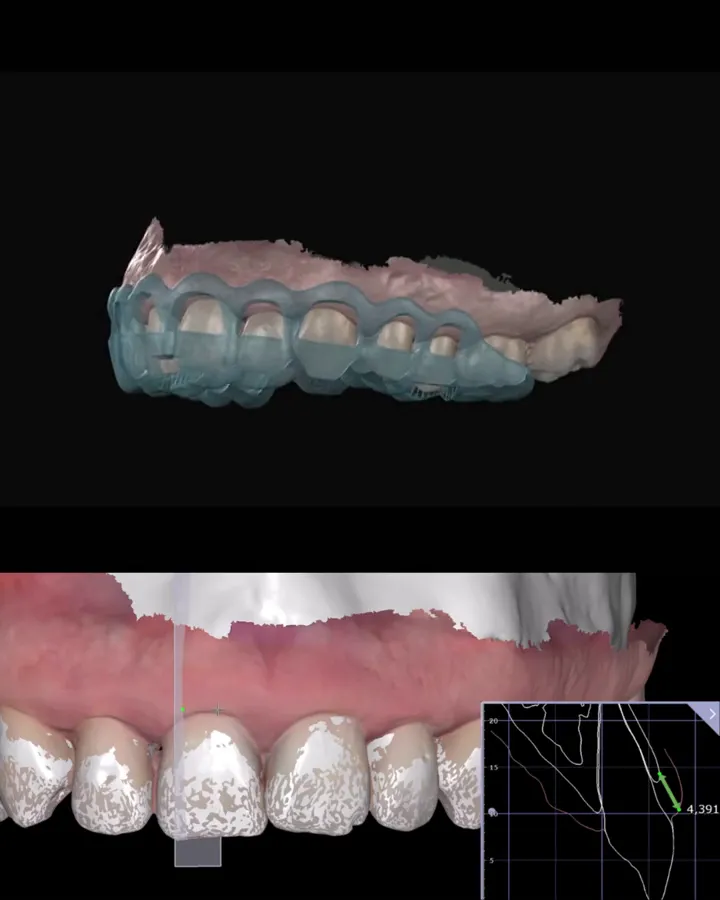
- The mock-up transfers the shapes designed in the plan to the mouth, using a silicone key filled with temporary resin. Nothing is removed and nothing is bonded: it comes off in a few minutes.
- It shows the proportions, the length of the teeth, the support given to the lips and the smile in movement. It shows neither the shade nor the translucency of the ceramic, and it is slightly thicker than the plan.
- Preparing “through” the mock-up means removing only the thickness that the final volume requires: in the largest published series using this method, more than 80% of preparations stayed within the enamel.
What exactly is a mock-up?
It is a layer of temporary resin, similar to the resin used for temporary restorations, moulded onto your teeth in the shape of the plan. It stays in place simply by fitting over them, with no adhesive and no preparation. You look at it, talk with it in place, smile and take photographs; then it is removed, and the teeth are exactly as they were before.
In everyday English, a mock-up is a full-size model, and dentistry uses the word in the same sense. It is also called an aesthetic trial, or a trial smile. Whatever the name, the principle is the same: making the plan visible before any irreversible decision.
How is it made?
Everything starts from the plan. Photographs of the face and smile, a digital impression and an analysis of the proportions are used to design the new shapes: this is the step described on the smile design page. This design is then turned into a volume, the wax-up, a model of the modified teeth, designed on a computer and then 3D-printed.
A silicone key is moulded on this wax-up: a kind of flexible tray that holds the shape of the future teeth in negative. At the practice, the key is filled with temporary resin and placed over the teeth; the resin sets in a few minutes, the key is removed, and the plan is in the mouth. The excess is removed and the edges are polished. The mock-up can also be printed directly from the digital plan and simply placed on the teeth.
It all fits into one appointment. The mock-up is part of the plan: it is not charged separately.
What does a mock-up show that a photograph does not?
The plan in real life. A simulation on a screen shows a frozen smile, from the front, under a given light. The mock-up can be looked at from every angle, at rest and while speaking: the length of the teeth when the lips are relaxed, the way they support the upper lip, what shows when you laugh, and how much room the wider teeth take up in the face.
It is also a way of listening: lengthening the incisors can change certain sounds, and the trial makes it possible to check this before rather than after.
Finally, it gives you a say. A tooth slightly too long, an edge too regular, shapes too alike: whatever bothers you is said in front of the mirror, and the plan is corrected on the spot or reworked in the laboratory. It is often at this point that the number of teeth to treat is decided, or that the choice is made not to treat.
What does a mock-up not show?
Colour. The mock-up resin is opaque and comes in a standard shade; the final ceramic will be more translucent and more nuanced, and its shade is chosen separately, using photographic measurement. A mock-up that looks too white or too matt says nothing about the final result.
The exact thickness. A mock-up moulded in a silicone key is slightly thicker than the plan it comes from: in the order of 0.2 to 0.4 mm, according to published measurements. It shows the shape and the length, not the thickness of the future ceramic.
The surface and the edges. The mock-up is not polished like ceramic, it does not extend under the gum, and it may be uneven at the neck of the tooth. What you are judging here is the volumes and the overall direction of the plan, not the finish.
How does it guide the preparation of the teeth?
A veneer needs a certain thickness, and that thickness must be measured from the final volume, not from the tooth as it is now. If the plan adds volume, part of the veneer’s thickness is already “available” in what has been added; only what still protrudes needs to be removed.
To do this, the preparation is carried out through the mock-up: small grooves of a known depth are cut into the resin, and the tooth is reduced only where these grooves reach it. Where the mock-up is thick, the tooth is not touched. This is what makes it possible to stay within the enamel, the layer that bonds most reliably.
One team, which followed 580 veneers for up to twelve years with this method, was able to keep more than 80% of the preparations within the enamel. In this subgroup, 99% of the veneers were still in place at the end of follow-up, compared with 94% when only the margins remained in enamel. Freehand preparation, without a guide, exposes the dentine far more often. A case from the practice shows this approach on two incisors.
Can you keep the mock-up?
No, not as it is: it is not bonded, it is fragile, and it is not made for eating with. It is removed at the end of the appointment. Once treatment is under way, temporary restorations made from the same plan take over between the preparation and the fitting.
With composite, the key takes on a different role: when the correction is made with injection-moulded composite, a transparent key moulded on the plan guides the material, which stays in the mouth once the appointment is over. It is no longer a trial, but the treatment itself.
What if you don’t like the mock-up?
That is exactly what it is for. The plan is adjusted, redone or abandoned, without a single tooth having been touched. Sometimes the trial shows that whitening would be enough, or that aligning the teeth would achieve more than a veneer: the article on the alternatives describes these situations. A mock-up that leads to doing nothing has done its job.
Frequently asked questions
Is the mock-up included in the price of veneers?
Yes. The fee for a veneer covers the study of the case, the plan and its trial in the mouth, as the article on the cost of veneers explains.
Is a mock-up needed for composite, or only for veneers?
The plan is useful whenever the shape of the teeth changes, whatever the material. For injection-moulded composite, a trial in temporary resin can come before treatment when it is indicated; the transparent key is then used to transfer the chosen shapes into composite. These are two separate steps.
Does the mock-up damage the teeth?
No. The resin fits over the teeth with no preparation or adhesive, and comes off in a few minutes. The teeth are then cleaned and polished.
Can you leave the practice wearing the mock-up, to show it to family and friends?
Sometimes, for a few hours, if it holds well enough, and as long as you do not eat with it. This is decided with the dentist depending on the case; a photograph and a short video taken at the practice often serve the same purpose.
References
- Magne P, Magne M. Use of additive waxup and direct intraoral mock-up for enamel preservation with porcelain laminate veneers. Eur J Esthet Dent. 2006;1(1):10-19.
- Gurel G, Morimoto S, Calamita MA, Coachman C, Sesma N. Clinical performance of porcelain laminate veneers: outcomes of the aesthetic pre-evaluative temporary (APT) technique. Int J Periodontics Restorative Dent. 2012;32(6):625-635.
- Gurel G, Sesma N, Calamita MA, Coachman C, Morimoto S. Influence of enamel preservation on failures rates of porcelain laminate veneers. Int J Periodontics Restorative Dent. 2013;33(1):31-39. doi:10.11607/prd.1488
- Coachman C, Calamita M. Digital Smile Design: a tool for treatment planning and communication in esthetic dentistry. Quintessence Dent Technol. 2012;35:103-111.
- Ntovas P, Ladia O, Barmak B, Spanopoulou M, Fehmer V, Sailer I. Predictability of diagnostic trial restorations fabricated as copies of diagnostic waxing using digital, analog, and hybrid workflows: a comparative in vitro study. J Prosthet Dent. 2026;135(3):577.e1-577.e9. doi:10.1016/j.prosdent.2025.10.027
- Sorrentino R, Ruggiero G, Borelli B, et al. Dentin exposure after tooth preparation for laminate veneers: a microscopical analysis to evaluate the influence of operators’ expertise. Materials (Basel). 2022;15(5):1763. doi:10.3390/ma15051763