Teeth whitening or bleaching: lighter teeth, without removing any enamel.

You say whitening, dentists often say bleaching: it is the same treatment. The shade of your teeth becomes lighter; it is not replaced by a uniform white.

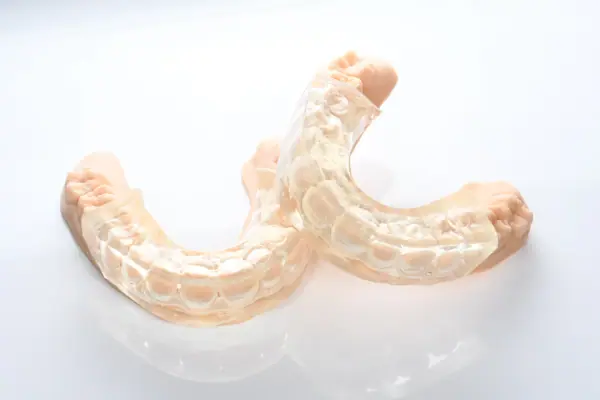
A whitened tooth keeps its natural variations in shade and its translucency: that is what keeps it looking like yours. The treatment is done at home, with trays custom-made at the practice and a prescribed gel, over a few weeks, with check-ups.

Whitening suits some types of discolouration and not others. This page starts there, then describes how the treatment works, the results you can expect and their limits.

Dr Jérémy Haccoun, dentist Updated

Key points

See a case of at-home whitening with trays

Understanding the treatment

A tooth is never truly white. Its colour comes mainly from the dentine, the naturally yellowish tissue beneath the enamel, which shows through it. This starting shade varies from one person to another, and it darkens over the years: the enamel becomes thinner while the dentine becomes more coloured.

On top of this base come surface stains, left by tea, coffee, red wine or tobacco. A scale and polish removes them, and sometimes that is all that is needed.

Finally, some discolouration lies within the tooth itself: an antibiotic taken in early childhood, too much fluoride while the teeth were forming, a tooth that has turned grey after an injury or a root canal treatment. These do not all respond to the gel in the same way, and the assessment starts by telling them apart.
What the treatment can change

Whitening acts on the underlying shade of natural teeth, the one you were born with as well as the one that has come with age. This is the most common situation, and the one where the result is clearest: teeth that you find too yellow or dull, with no other problem.

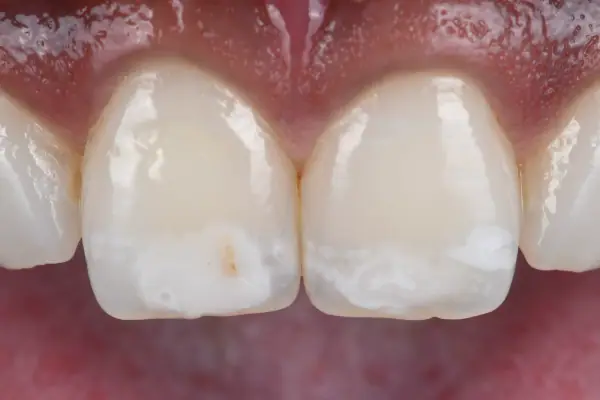
Other types of discolouration respond less, or differently. A grey or banded shade left by an antibiotic taken in childhood lightens slowly and only partly, over several months. A localised white spot does not disappear: the tooth lightens around it, which sometimes softens the contrast, or accentuates it at first; it needs to be assessed separately. A single tooth that has darkened is treated from the inside, with a different technique.

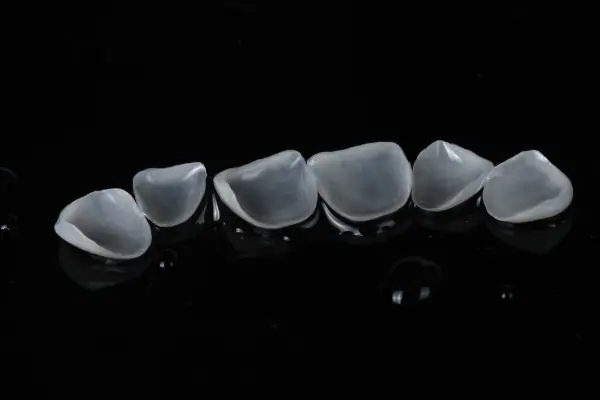
Finally, if what bothers you is a shape, a length or a position, changing the colour will not help. Injection-moulded composite and veneers address those requests; we discuss them at the assessment.

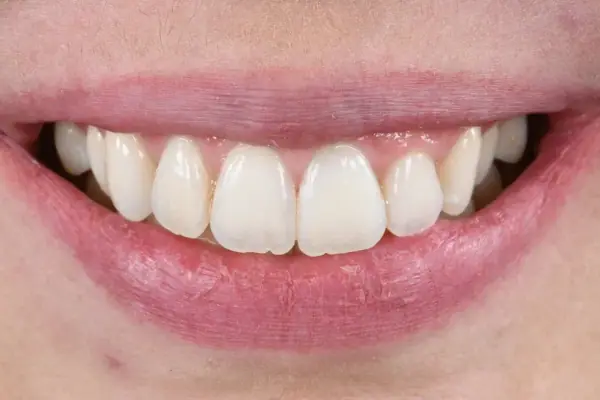
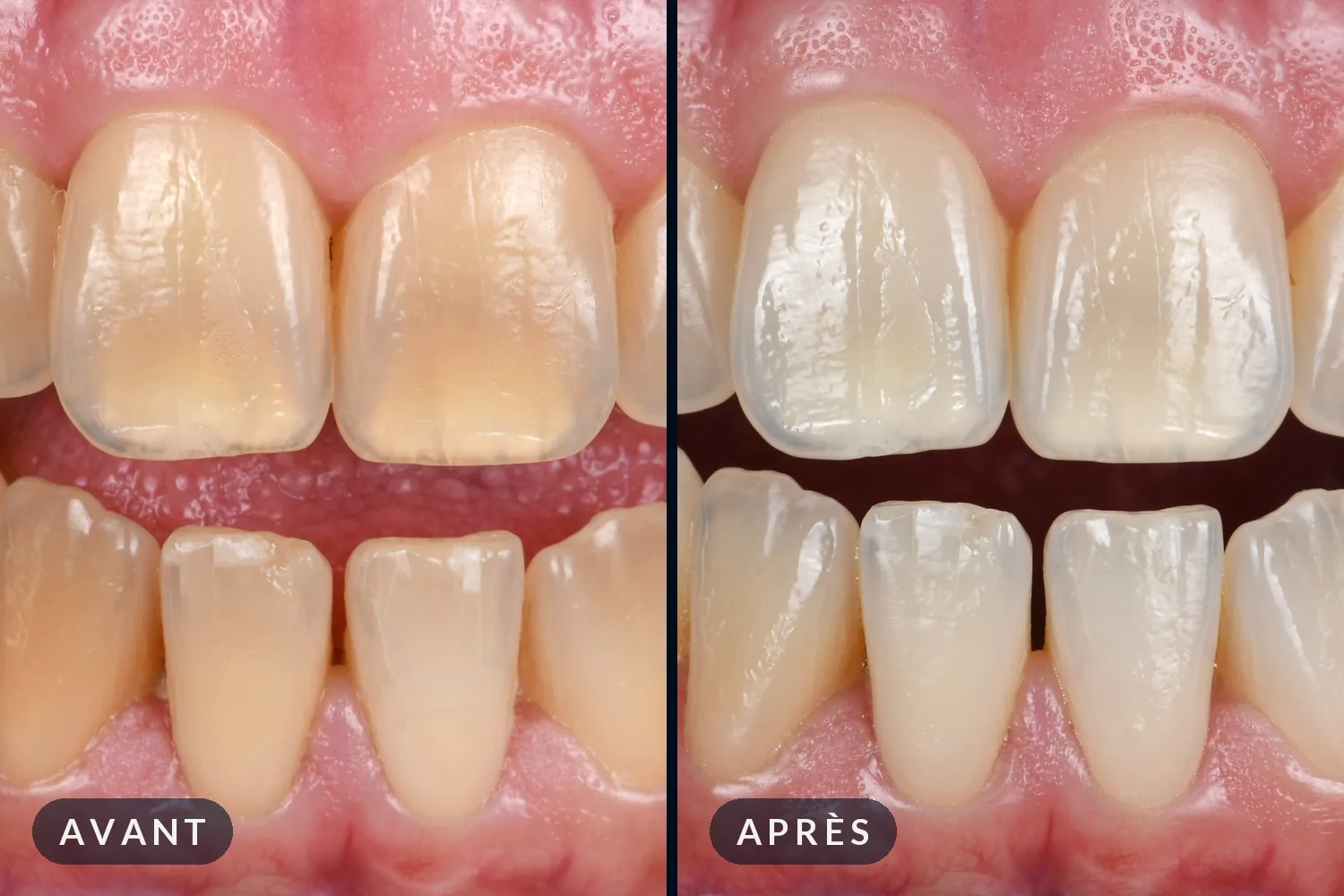
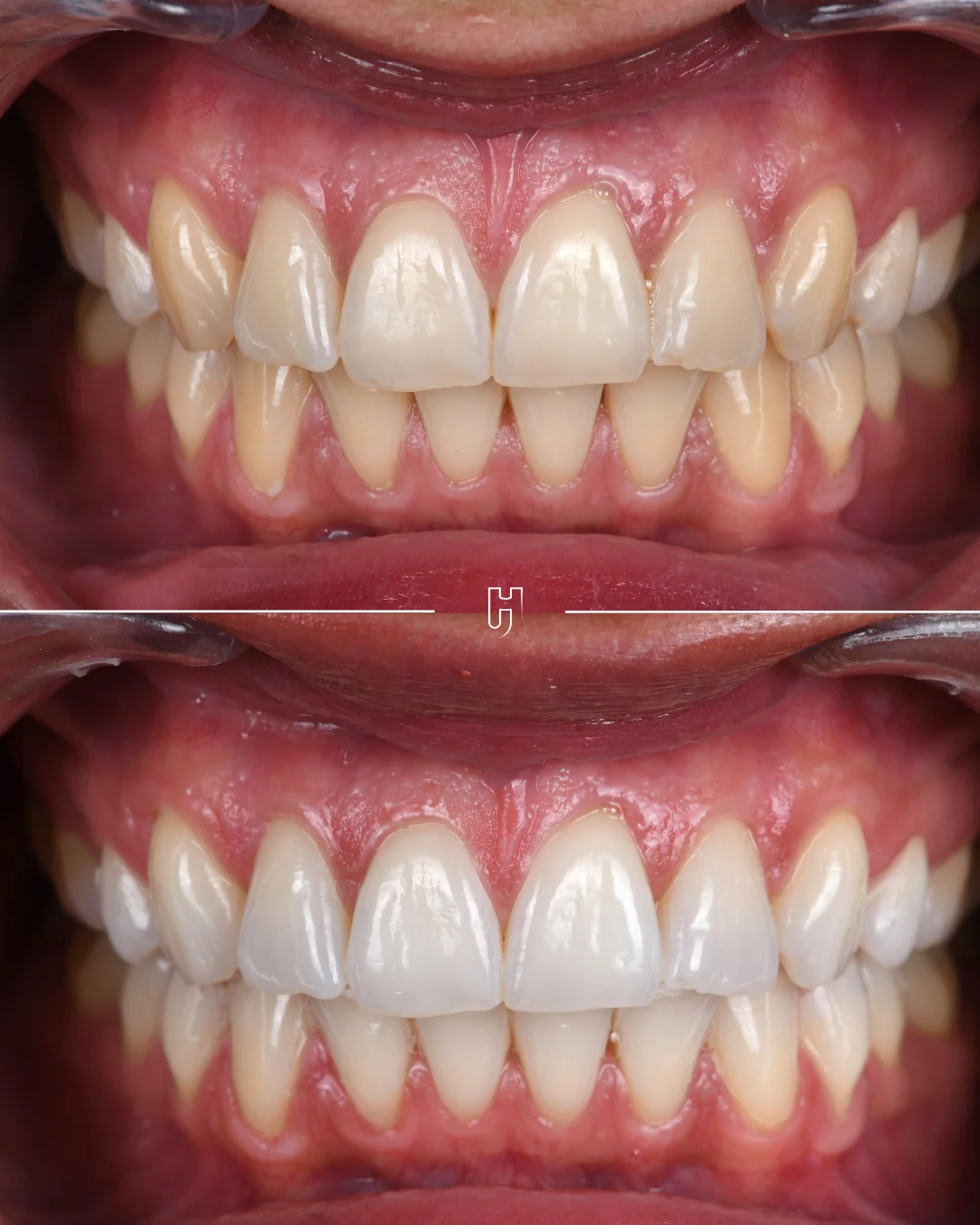
Before and after whitening: the same teeth, yellower at the top, lighter at the bottom.
Before and after three weeks of at-home whitening with trays. An individual result: it varies from one person to another.

Preservation Index

Nothing is removed from the tooth.

01 / 04

  1. 01No preparation
  2. 02Additive
  3. 03Minimal preparation
  4. 04Restorative

The index shows what a treatment takes away from the tooth and what it leaves. Whitening sits at the first level: the gel acts on the shade, through the enamel, without reducing or covering the tooth. If a veneer or bonding is discussed later, both remain possible; that is why whitening often comes before any other decision.

How it works, in four steps

The assessment at the practice

Everything starts with an assessment. We examine your teeth and gums, photograph your smile and record your starting shade: this is what the result will be compared with.

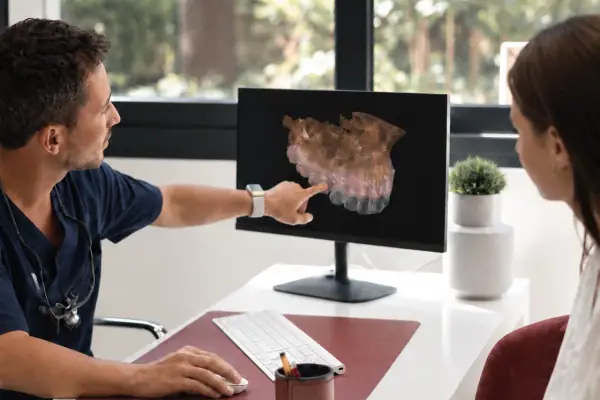
The examination then checks that nothing needs to come first. Decay, bleeding gums or an exposed root would let the gel reach what it should stay away from: these are dealt with first. It also notes any visible crowns, veneers or composite restorations, whose shade will not change. A digital impression (scan) of your upper and lower teeth is taken at this stage, without any impression paste: it will be used to make the trays.

If your request goes beyond colour, the aesthetic consultation places whitening within an overall plan. It is also where the order of treatment is decided.

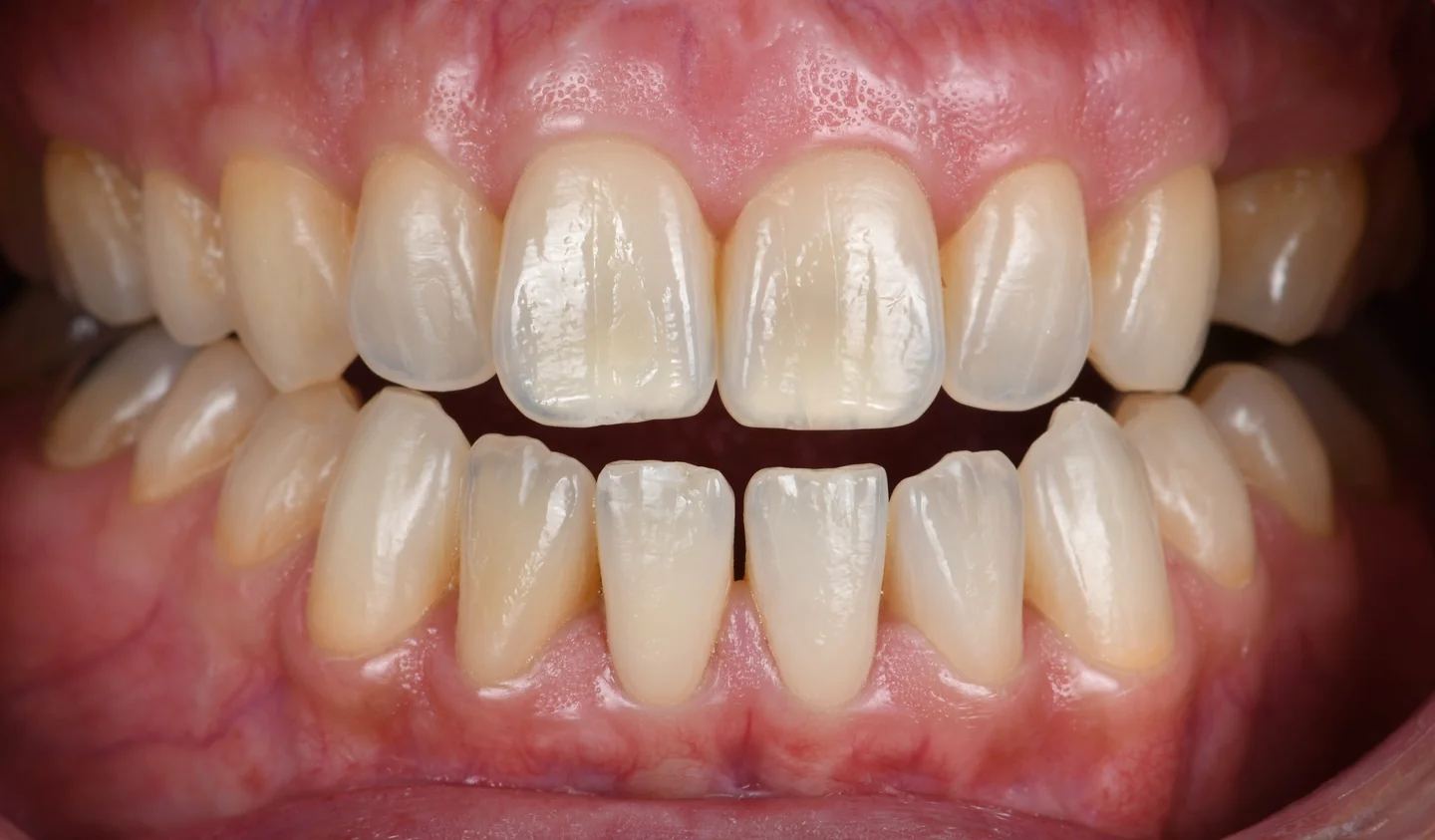
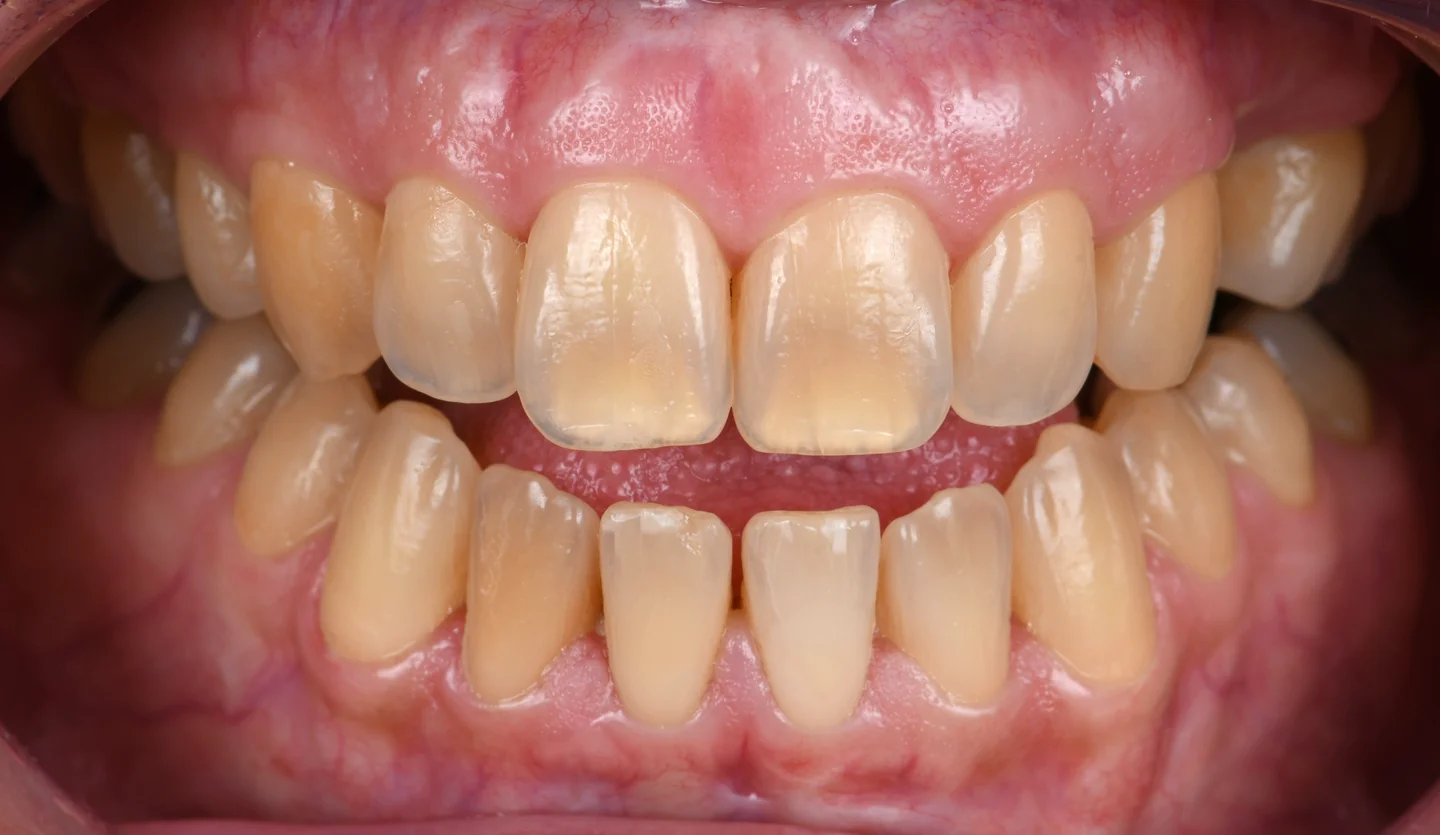
Front teeth before treatment, yellow in shade, seen from the front.
Before treatment: the starting shade, photographed at the assessment.

Custom-made trays

The trays are made from the impression. Thin and transparent, they fit each tooth closely, which keeps the gel in contact with the enamel and away from the gums: a ready-made tray cannot ensure this.

At the next appointment, we try them in together. You leave with your trays, their case and the gel in syringes, in the quantity planned for the length of treatment set for you. We show you how to apply it; the product leaflet specifies what depends on the product itself: the wearing time and how to store the gel. The cost of this treatment is listed on our fees page and confirmed after the assessment, as it depends on the length of treatment.

Treatment at home, with follow-up

The gel contains carbamide peroxide, which slowly releases hydrogen peroxide. This passes through the enamel without removing any of it and gradually breaks down the coloured molecules lodged in the tooth: the shade changes deep within the tooth, not on the surface.

Every evening, the routine is the same. After brushing, you place a drop of gel in the tray, in the space for each tooth that shows when you smile, top and bottom; you put the trays in, wipe away any gel that spills onto the gums and keep them in for the time specified for your product. When you take them out, you rinse your mouth and the trays with lukewarm water.

Most treatments last two to three weeks, sometimes a little longer, depending on the starting shade and what the follow-up shows. Sensitivity to cold is common during this period and usually goes away when treatment stops; if it bothers you, the applications can be spaced out or paused for a few days, and we adjust the pace together. Severe or persistent pain is not normal: let us know without waiting for the check-up. The article on the risks of whitening reviews what studies say about enamel, gums and sensitivity.

The check-up and the final shade

At the end of treatment, we compare the shade achieved with the starting shade, on the assessment photographs and under the same light. This is when we decide together whether to stop there or continue for a few more days.

What you see that day is not quite the final shade. The teeth have lost a little water during treatment, which makes them look lighter; they rehydrate within a few days, and the colour settles over the following weeks. Only then is the shade of any restoration chosen, and only then can anything be bonded to the enamel again: just after whitening, adhesives bond less well, and we generally wait two weeks.

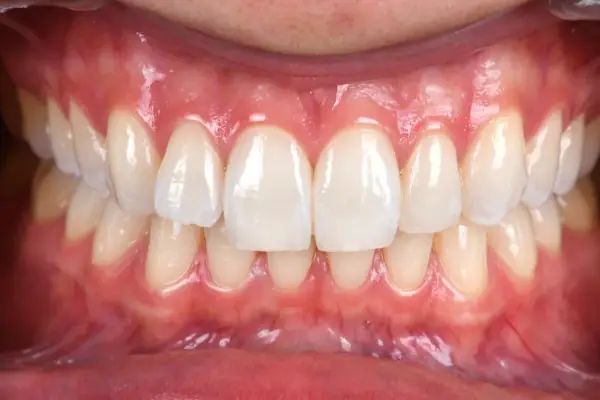
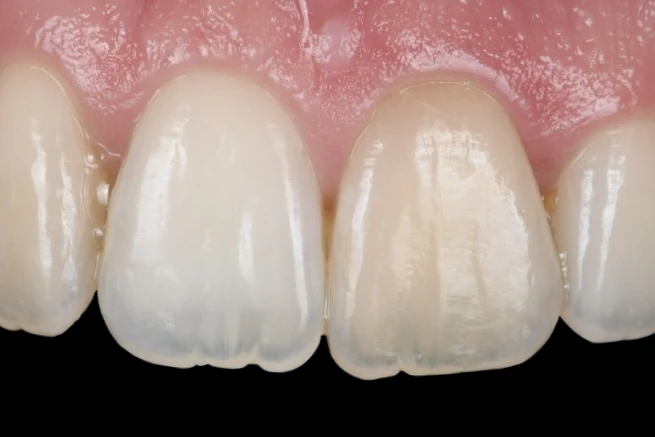
The same teeth after treatment, lighter, seen from the front.
After treatment, at the check-up: the same teeth, under the same light.

Limits, and maintaining the result

Results that vary

Two people treated in the same way do not get the same result. The starting shade, the thickness of the enamel and the origin of the discolouration make the difference; that is why no shade is promised in advance, and why the assessment matters as much as the gel.

In published follow-up studies, the result lasts several years, with wide differences from one person to another. The shade slowly drifts back towards where it started, with age and the same habits as before. A top-up of a few days, with the same trays and a little gel, is usually enough to bring it back. It is decided at a check-up, when you wish, not on a set date.

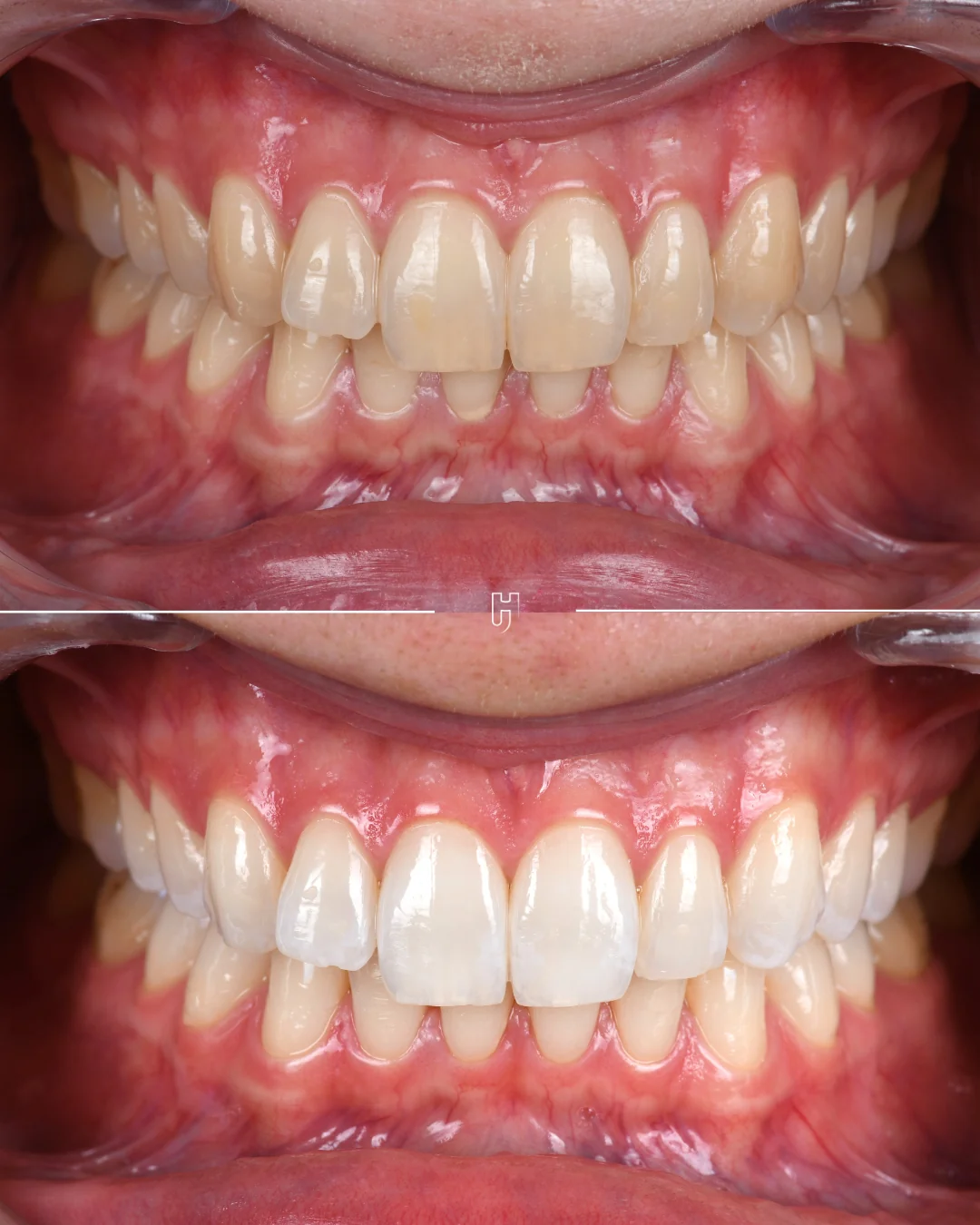
Before and after whitening in another patient: yellower teeth at the top, lighter at the bottom.
Another patient, after four weeks of treatment. Every result is individual.

Restorations and maintenance

Restorations do not change colour. A crown, a veneer or a composite restoration keeps the shade it was given on the day it was placed, and a tooth that lightens next to an old composite makes the difference more visible than before. This difference is anticipated at the assessment: if a restoration needs to be redone, it is redone after whitening, once the colour has stabilised. Whitening does not call for veneers; ceramic veneers address other situations: a shape to correct, wear, a heavily restored tooth.

Day to day, maintenance is simple: careful brushing twice a day with a soft brush, floss or interdental brushes, a scale and polish at the interval set at the assessment, and as little tobacco as possible. No special diet is needed: studies have not shown that avoiding coffee or tea during treatment changes the result.

Understand before choosing.

In-office whitening or whitening with trays: what is the difference?

Both rely on the same principle: a peroxide gel that works through the enamel. In the chair, a more concentrated gel is applied by the practitioner, in one or a few sessions; with trays, a milder gel works at home over a few weeks; the one we prescribe is 10% carbamide peroxide. Studies comparing the two find similar results and similar sensitivity. We offer trays because the treatment can be adjusted as the follow-up goes along, and because they can be used again afterwards for top-ups.

What about over-the-counter kits or strips?

In Europe, over-the-counter products may contain only a very low concentration of hydrogen peroxide. More concentrated gels are reserved for dentists, after an examination, and are prohibited for anyone under 18. The difference lies as much in the setting as in the concentration: an assessment beforehand, a tray made for your teeth and follow-up during treatment.

Can a single tooth that has turned grey be lightened?

Yes, in most cases. A root-treated tooth that has darkened is bleached from the inside (internal bleaching): the gel is placed inside the tooth, through the back, and renewed at the practice until the desired shade is reached, provided the root canal has been properly treated. It is a different technique from the trays; the Journal article on root-treated teeth describes it in detail.

Can I have my teeth whitened during pregnancy?

As a precaution, no. No harmful effect has been demonstrated, but no study has established that the treatment is safe during pregnancy or breastfeeding, and there is no hurry: it can wait.

Are whitening toothpastes enough?

They work on the surface, with mild abrasives that remove some of the stains left by tea, coffee or tobacco. They do not change the shade of the tooth itself. Only a peroxide gel, which passes through the enamel, can lighten the underlying colour.

References

  1. Kwon SR, Wertz PW. Review of the mechanism of tooth whitening. J Esthet Restor Dent. 2015;27(5):240-257. doi:10.1111/jerd.12152
  2. Rezende M, Loguercio AD, Reis A, Kossatz S. Clinical effects of exposure to coffee during at-home vital bleaching. Oper Dent. 2013;38(6):E229-E236. doi:10.2341/12-188-C
  3. Rezende M, Loguercio AD, Kossatz S, Reis A. Predictive factors on the efficacy and risk/intensity of tooth sensitivity of dental bleaching: a multi regression and logistic analysis. J Dent. 2016;45:1-6. doi:10.1016/j.jdent.2015.11.003
  4. Aidos M, Marto CM, Amaro I, et al. Comparison of in-office and at-home bleaching techniques: an umbrella review of efficacy and post-operative sensitivity. Heliyon. 2024;10(3):e25833. doi:10.1016/j.heliyon.2024.e25833
  5. Leonard RH, Bentley C, Eagle JC, Garland GE, Knight MC, Phillips C. Nightguard vital bleaching: a long-term study on efficacy, shade retention, side effects, and patients’ perceptions. J Esthet Restor Dent. 2001;13(6):357-369. doi:10.1111/j.1708-8240.2001.tb01021.x
  6. Joiner A. Tooth colour: a review of the literature. J Dent. 2004;32 Suppl 1:3-12. doi:10.1016/j.jdent.2003.10.013
  7. Leonard RH, Van Haywood B, Caplan DJ, Tart ND. Nightguard vital bleaching of tetracycline-stained teeth: 90 months post treatment. J Esthet Restor Dent. 2003;15(3):142-152. doi:10.1111/j.1708-8240.2003.tb00184.x
  8. Savian TG, Oling J, Soares F, Rocha RO. Vital bleaching influences the bond strength of adhesive systems to enamel and dentin: a systematic review and meta-analysis of in vitro studies. Oper Dent. 2021;46(2):E80-E97. doi:10.2341/20-035-LIT

Every situation
needs its own diagnosis.

The information on this page is general. Only a clinical examination can establish whether a treatment is indicated, and clarify its benefits, limits and alternatives.

Message us