
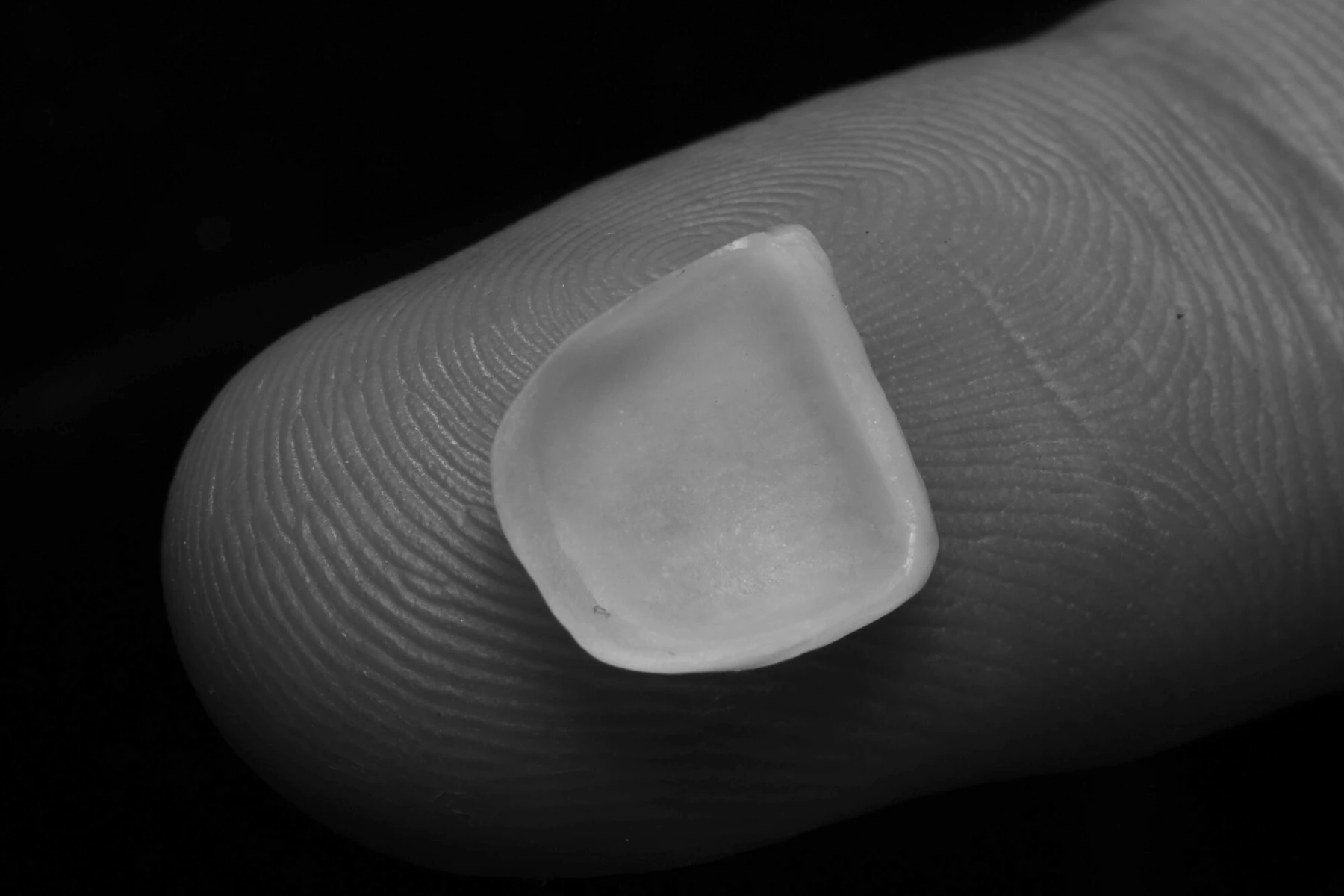
Key points
- A veneer on a single incisor can be considered when that tooth alone stands out from the smile and its neighbours do not need treatment.
- The neighbouring tooth is the model: its subtle shades, the translucency of its edge, the way its surface reflects light.
- A dark tooth has a strong influence on the result: the aim is often to lighten it before asking the ceramic to mask it.
- Composite, whitening or orthodontic alignment can sometimes address the problem better, while removing less.
Can a veneer be placed on just one tooth?
An incisor shorter than the other, a tooth that has darkened after a knock, a broken edge, an old restoration that has yellowed: sometimes a single tooth catches the eye. Can it be corrected without touching the others?
Yes, in some situations. A veneer is a thin piece of ceramic bonded to the visible surface of the tooth. Nothing requires veneers on the neighbouring teeth when they are healthy and in harmony with the smile. Treating them only to make the colour match easier would mean removing enamel from teeth that did not need it.
A difference in shape, a fracture or discolouration is not, on its own, enough to establish that a veneer is indicated. The examination looks at the tooth first: the enamel that remains, the restorations already in place, its position, the condition of the gum.
It also looks at the way the teeth meet, with the mouth closed and when the jaw moves. Some people clench or grind their teeth, often at night: this is bruxism. In a study that followed 318 veneers for up to twenty years, the risk of failure was almost eight times higher in these people. This does not rule a veneer out, but it is a factor that can guide the choice of material, the design of the veneer or the decision to opt for another solution.
Why is a natural tooth difficult to reproduce?
When several teeth are treated together, they are matched to one another. A single veneer does not have this freedom: its model, the tooth next to it, stays as it is. For a central incisor, this model sits in the middle of the smile, where the eye compares the most.
The colour of a tooth is not a single shade. First, it has a brightness, how light or dark it is, which often matters more than the hue. It is more intense near the gum and almost transparent at the edge, where the enamel lets light through: this is translucency. Sometimes there are also small whiter areas, fine streaks and a halo along the edge.
The surface matters just as much. Enamel is not smooth: fine undulations reflect light irregularly. A veneer of a very similar shade, but too smooth or too shiny, can look different as soon as the lighting changes. Two teeth can look alike on a shade guide and no longer look alike in a smile.
The eye picks up small differences. In a study of 175 observers, both dental professionals and lay people, slight colour differences between two ceramic samples were already noticed by half of them. These measurements were made in a viewing booth, not in the mouth.
Shape matters too. Two central incisors are almost never identical, and a smile does not need to be completely symmetrical to look harmonious. The aim is not to copy the neighbouring tooth to the millimetre, but for the two teeth to look as if they belong to the same person.
Why does the tooth under the veneer matter too?
A veneer is thin, often a few tenths of a millimetre. It therefore lets what lies beneath it partly show through. The result depends on the colour of the tooth, the material, its thickness and the glue that holds it in place, known as the resin cement.
On a light tooth, a thin, translucent ceramic can correct the shape without the original colour getting in the way. On a dark tooth, the colour has to be masked, and that involves trade-offs. A more opaque or thicker material covers better, but may look less bright than the neighbouring tooth, and often requires more preparation.
The cement comes in several shades and adjusts the result slightly, without correcting everything. In a laboratory study of lithium disilicate veneers, the colour of the underlying surface explained most of the colour differences measured (nearly 88%), far ahead of the ceramic and the cement. No combination masked severe discolouration acceptably. The study used resin surfaces, not teeth, but it is a reminder that it is often necessary to work on the tooth itself first.
A non-vital tooth, one whose nerve has been removed or has died, often after a knock, can darken over the years. It does not automatically call for a crown: if it has kept most of its structure, a more limited restoration is often possible. Nor is it certain to be suitable for a veneer: in the follow-up study mentioned above, veneers on non-vital teeth failed more often. What remains of the tooth, its discolouration and the condition of its root are what decide.
When the discolouration comes from inside the tooth, internal bleaching can be considered: the bleaching agent is placed inside the tooth, from the back, once the root canal treatment has been checked. It is not suitable for every situation; if it brings the shade closer to that of the neighbouring tooth, any veneer that follows has less to mask.
How is a single veneer prepared so that it blends in?
Everything starts with the analysis: photographs, and an examination of the gum, the bite and the tooth. At the practice, the colour of the neighbouring tooth is recorded using calibrated photography, following the eLAB protocol. This information is sent to the dental technician, who makes the ceramic, together with photographs showing the tooth’s subtle shades and its surface.
When the shape needs to change, a mock-up, a resin model placed over the teeth without altering them, lets you try the plan in the mouth. It is used to judge length and outline, not the final colour, and it does not promise an identical result: it is an intention that is checked and adjusted.
The preparation is decided on the basis of this final volume, staying as far as possible within the enamel, the outer layer of the tooth, which is where bonding is most reliable. In a study of 580 veneers followed for up to twelve years, those bonded to dentine, the layer beneath, were about ten times more likely to fail.
That said, there is no preparation thickness that applies to every tooth. A tooth that is set back may need very little; a dark tooth, or one that already sits forward, more. And a preparation, however slight, cannot be undone.
The material is chosen next. Feldspathic ceramic, built up by hand, is highly translucent and lends itself to thin layers on a light tooth. Lithium disilicate, which is stronger, comes in versions with greater masking power, useful on a dark tooth or one subject to heavy forces. Neither is more natural in every circumstance.
Before bonding, the veneer is tried in: this is the moment to judge how well it matches the neighbouring tooth under several types of lighting, and to have the laboratory rework it if needed.
Is a veneer always the most suitable solution?
No. It all depends on what bothers you.
If the tooth is still vital and has mainly changed colour, whitening may be enough, without removing anything. It acts on colour, not shape, and does not change the shade of restorations already in place.
For a broken edge, a small loss of volume or a shape that needs refining, composite, a tooth-coloured resin applied layer by layer, can rebuild the tooth directly, often without preparation. It is easy to repair, but loses some of its shine over the years and needs regular maintenance.
If the tooth is out of position, a veneer can mask a slight misalignment, but it does not move the tooth, and masking often means removing more of the tooth. Orthodontic alignment, entrusted to an orthodontist, may then make more sense.
Some white spots can be treated with resin infiltration, without preparation. And sometimes the right answer is to do nothing: a subtle difference, on a healthy tooth, can simply be monitored.
In every case, healthy neighbouring teeth stay as they are: that is the constraint of a single veneer, and also its advantage.
What can you reasonably expect from the result?
A tooth that no longer stands out: at conversational distance, in a photo, in the middle of the smile. Ceramic cannot match a natural tooth exactly under every kind of light; different lighting or a camera flash can reveal a slight difference in shade.
Time plays a part too. Natural teeth wear and darken slightly with age, while ceramic keeps its shade: a difference that was not there at the start can appear after some years. Clinical studies report that ceramic veneers hold up well. Most of them concern veneers placed in groups; they do not allow the case of a single veneer to be isolated, nor a lifespan to be promised for any given veneer. Hence the regular check-ups: the bond, the gum, wear and changes in shade.
So a single tooth can sometimes be restored with a veneer. It is neither a rule nor a default solution: the decision starts from what makes this tooth different, how much of it remains and its place in the smile. An examination makes it possible to judge this and to compare the options, including those that remove the least.
Frequently asked questions
If I have my teeth whitened after the veneer is fitted, will the veneer lighten too?
No: ceramic does not change colour. If whitening is being considered, it is done beforehand, and the shade is left to stabilise before the veneer’s shade is chosen. Whitening the neighbouring teeth after the veneer is fitted would create a mismatch.
If the veneer breaks one day, will the neighbouring teeth have to be treated?
Generally not. A veneer bonded to preserved enamel can usually be remade on its own. The shade of the neighbouring teeth will have to be reproduced again, as they are at the time of the replacement.
Does a single veneer mean fewer appointments?
Not necessarily. The steps are the same: examination, plan, preparation, try-in, bonding. Matching the colour of the neighbouring tooth may even require an extra try-in.
References
- Paravina RD, Ghinea R, Herrera LJ, et al. Color difference thresholds in dentistry. J Esthet Restor Dent. 2015;27 Suppl 1:S1-S9. Perception study of 175 observers, using ceramic samples. doi:10.1111/jerd.12149
- Wayakanon K, Kamiam C, Khamlue R, Daengla A, Naorungroj S. Masking discolored substrates with lithium disilicate veneers and resin cements: an in vitro quantitative analysis. J Dent. 2025;162:106038. Laboratory study. doi:10.1016/j.jdent.2025.106038
- Gurel G, Sesma N, Calamita MA, Coachman C, Morimoto S. Influence of enamel preservation on failure rates of porcelain laminate veneers. Int J Periodontics Restorative Dent. 2013;33(1):31-39. doi:10.11607/prd.1488
- Beier US, Kapferer I, Burtscher D, Dumfahrt H. Clinical performance of porcelain laminate veneers for up to 20 years. Int J Prosthodont. 2012;25(1):79-85.
- Plotino G, Buono L, Grande NM, Pameijer CH, Somma F. Nonvital tooth bleaching: a review of the literature and clinical procedures. J Endod. 2008;34(4):394-407. doi:10.1016/j.joen.2007.12.020
- Patel SR, Youngson C, Jarad F. Principles guiding the restoration of the root-filled tooth. Br Dent J. 2025;238(7):508-516. doi:10.1038/s41415-025-8401-4