
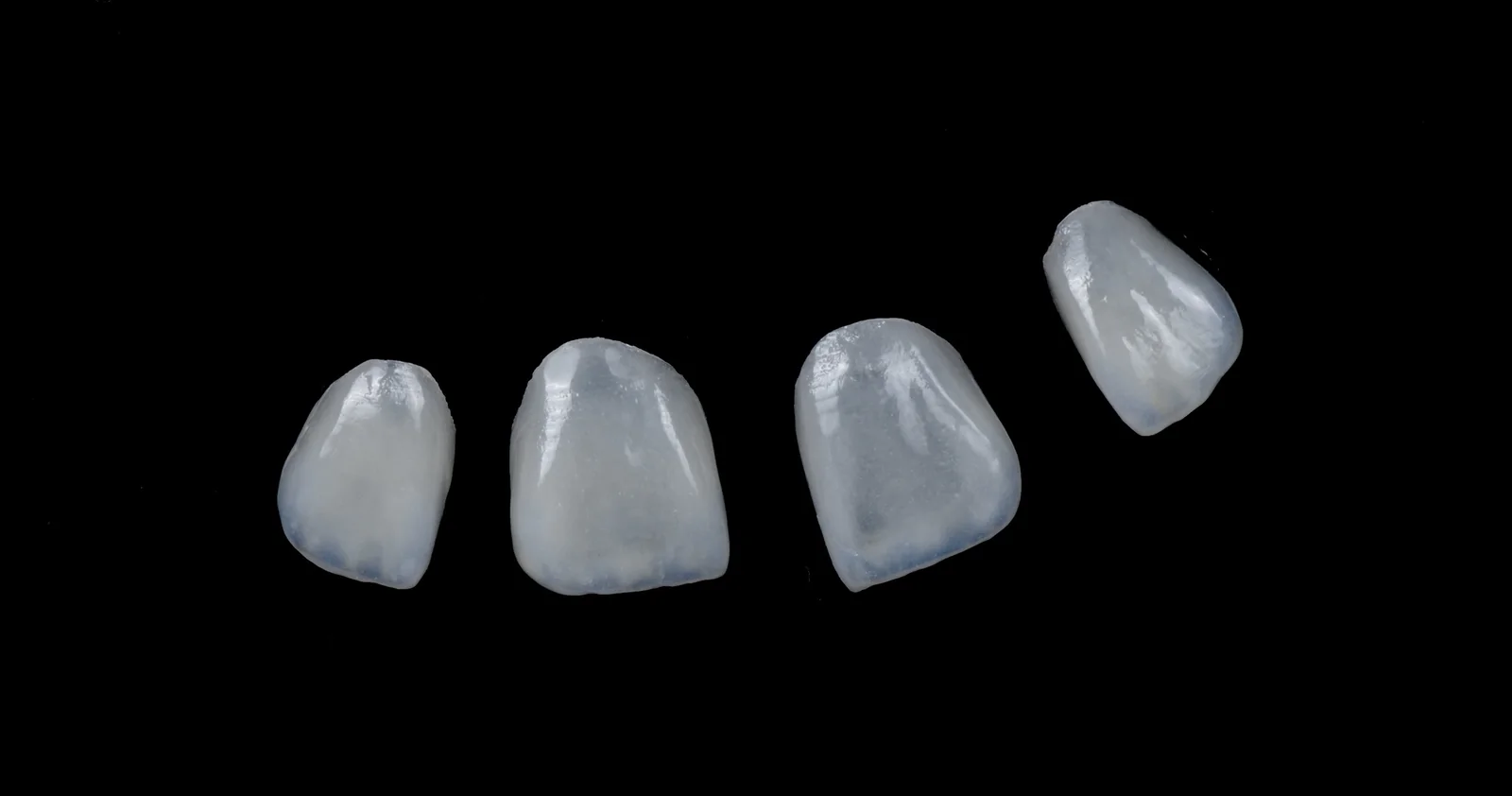
Key points
- Feldspathic ceramic is the more translucent of the two, but it does not mask a dark tooth.
- Lithium disilicate is stronger and better at masking; it is also more reproducible across several teeth.
- The underlying tooth (shade, enamel, forces) determines the material, not the other way round.
What sets the two ceramics apart?
Feldspathic ceramic is built up by hand, layer by layer, by the dental technician: powder and liquid are applied, then fired, several times over. It is the oldest and most handcrafted technique, and it is also the one most suited to very thin veneers, when the underlying tooth allows it.
Lithium disilicate, marketed in particular under the name e.max, is a ceramic block that is either pressed into a mould or milled by a machine from a digital file. The restoration comes out in a single piece, and can then be stained or partially layered on the surface.
What does each do better than the other?
Feldspathic ceramic is the more translucent of the two. It lets light through as natural enamel does, which is what allows it to blend into a smile. But translucency has a downside: it hides nothing. Whatever lies underneath shows through.
Lithium disilicate has a much higher flexural strength: of the order of 350 to 460 megapascals for pressed lithium disilicate, compared with around a hundred for a feldspathic ceramic, in laboratory measurements. It also comes in more opaque versions, able to mask a dark or root-treated tooth. Its manufacture is more reproducible, which matters when several teeth are treated together.
What determines the choice?
The choice rests on three factors: the shade of the tooth at the outset, the amount of enamel still available for bonding, and the stresses the tooth will have to withstand. A light-coloured tooth with little loss of structure and intact enamel around its edges allows a very thin feldspathic veneer. A dark tooth, one that has already been restored, or one subjected to heavy forces, points towards lithium disilicate.
This reasoning also explains why the question of material comes late. Until the indication, the plan and the extent of treatment have been settled, there is no right answer, only preferences.
Does the material determine how long a veneer lasts?
Both ceramics are held in place by bonding, and bonding relies on enamel. That is why the preparation, the amount of tissue preserved and the balance of the bite have more influence on lifespan than the name of the material.
A review of 25 studies found fewer failures with reinforced ceramics than with feldspathic ceramics. This is one more reason to reserve feldspathic ceramic for the situations that suit it: enamel available, moderate forces.
A patient who comes in asking for “e.max veneers” is really asking for a result. The role of the diagnosis is to check whether a veneer is indicated, then to choose what will serve that result most effectively, which sometimes means not placing a veneer at all.
References
- Alenezi A, Alsweed M, Alsidrani S, Chrcanovic BR. Long-term survival and complication rates of porcelain laminate veneers in clinical studies: a systematic review. J Clin Med. 2021;10(5):1074. doi:10.3390/jcm10051074
- Zarone F, Di Mauro MI, Ausiello P, Ruggiero G, Sorrentino R. Current status on lithium disilicate and zirconia: a narrative review. BMC Oral Health. 2019;19(1):134. doi:10.1186/s12903-019-0838-x
- Wendler M, Belli R, Petschelt A, et al. Chairside CAD/CAM materials. Part 2: flexural strength testing. Dent Mater. 2017;33(1):99-109. doi:10.1016/j.dental.2016.10.008