
Key points
- Two veneers are enough when the problem is limited to two teeth and the neighbouring teeth fit in with the plan.
- The difficulty is matching the untreated teeth: shade, translucency, shape and gums all have to blend in with them.
- Preparing the ground matters as much as the ceramic: the starting colour, the gum line, the trial of the plan.
When can two veneers be enough?
When what needs correcting is limited to two teeth: two central incisors that are too short, discoloured or damaged, while the other teeth in the smile are fine. The number of veneers is decided by what shows when the person smiles, not by a figure fixed in advance.
Why is it more demanding than treating more teeth?
When several teeth are treated together, they are matched to one another. With two veneers, the reference is the neighbouring teeth: their shade, their translucency and their small irregularities have to be reproduced, and the two veneers must also look alike.
Matching is all the more delicate when the two teeth do not start out the same colour, for example when one has been root-treated and has darkened.
How was a case at the practice handled?
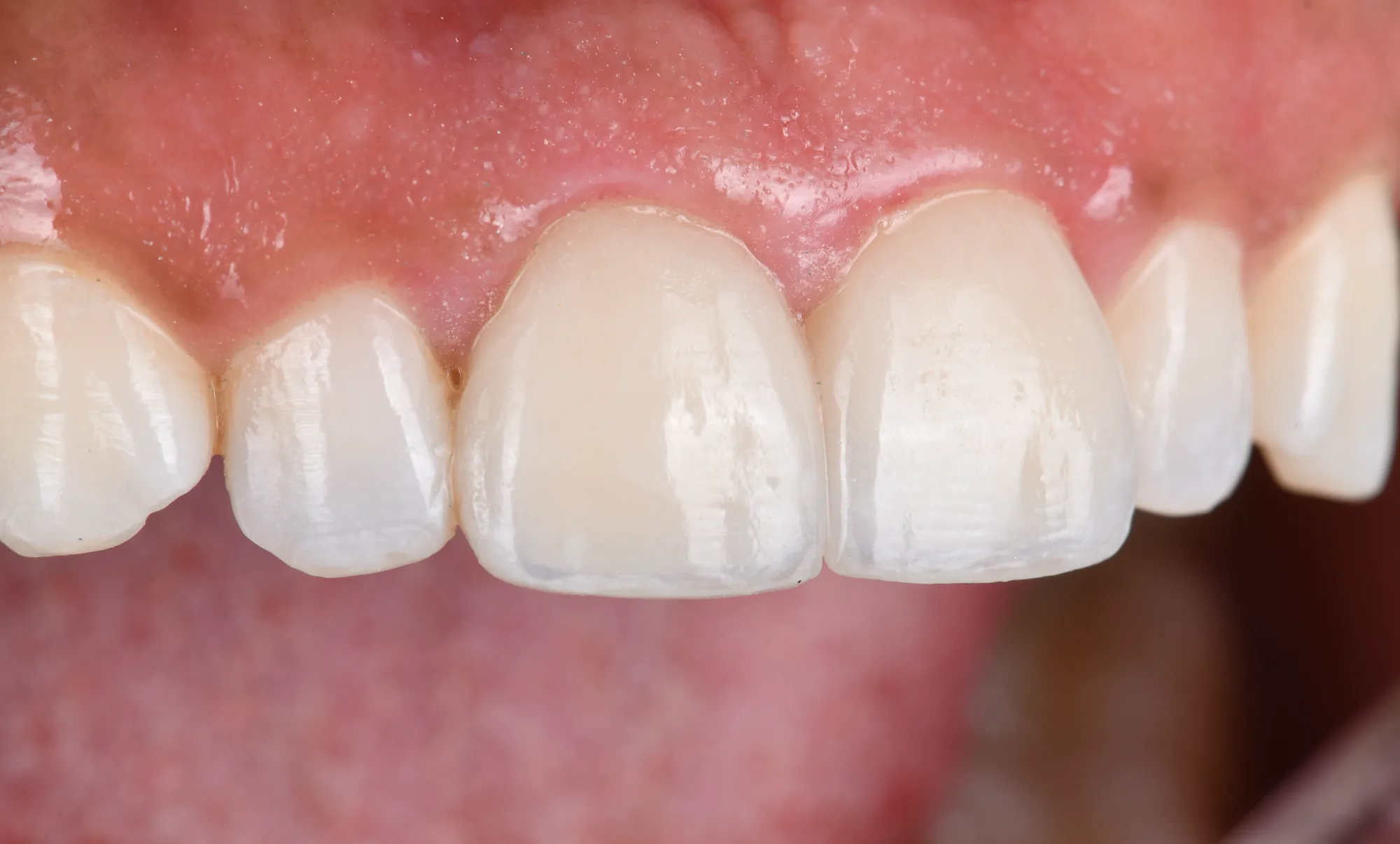
The request concerned the colour and proportions of the two central incisors, which were considered not prominent enough in the smile. One of them, which had been root-treated, was markedly discoloured.
Bringing the starting colours together: internal bleaching of the root-treated incisor brought its shade closer to its neighbour’s, so that the whole correction would not depend on the masking power of the ceramic.
Trying it out: the plan was tested in the mouth with a mock-up, to judge the new proportions within the smile.
Balancing the gums: a localised gingivectomy on one of the two incisors harmonised the gum line.
Preparing through the plan, then bonding: the preparations were made through the mock-up, so as to remove only what the final volume required. Two lithium disilicate veneers were then bonded.
This case shows a line of reasoning, not a rule: different neighbouring teeth, different gums or a different starting shade could have led to treating more teeth, or to choosing another ceramic.
Why this ceramic?
Here, two lithium disilicate veneers were chosen, on the basis of thickness and mechanical stresses: feldspathic ceramic is more fragile, and lengthening a tooth by a large amount with it can be difficult.
On two light-coloured teeth, when the lengthening remains moderate and the stresses allow it, a highly translucent feldspathic ceramic may be chosen.
When do more teeth need treating?
When the neighbouring teeth do not fit in with the new plan: a shade that is too different, a shape that would look out of place next to the new teeth, a transition that would fall right in the middle of the smile. Whitening beforehand is sometimes enough to avoid treating additional teeth.
Frequently asked questions
Can you have just one veneer?
Yes, in some cases, on a single incisor for example. It is the most delicate situation for the shade: one tooth has to match all the others.
Will the two veneers be exactly the same colour as the other teeth?
The aim is for them to come close enough not to be noticed. An exact match in every kind of light is not possible between a ceramic and a natural tooth.
Do two veneers cost less?
The cost depends on the number of teeth and the complexity of the case.
References
- Hein S, Tapia J, Bazos P. eLABor_aid: a new approach to digital shade management. Int J Esthet Dent. 2017;12(2):186-202.