
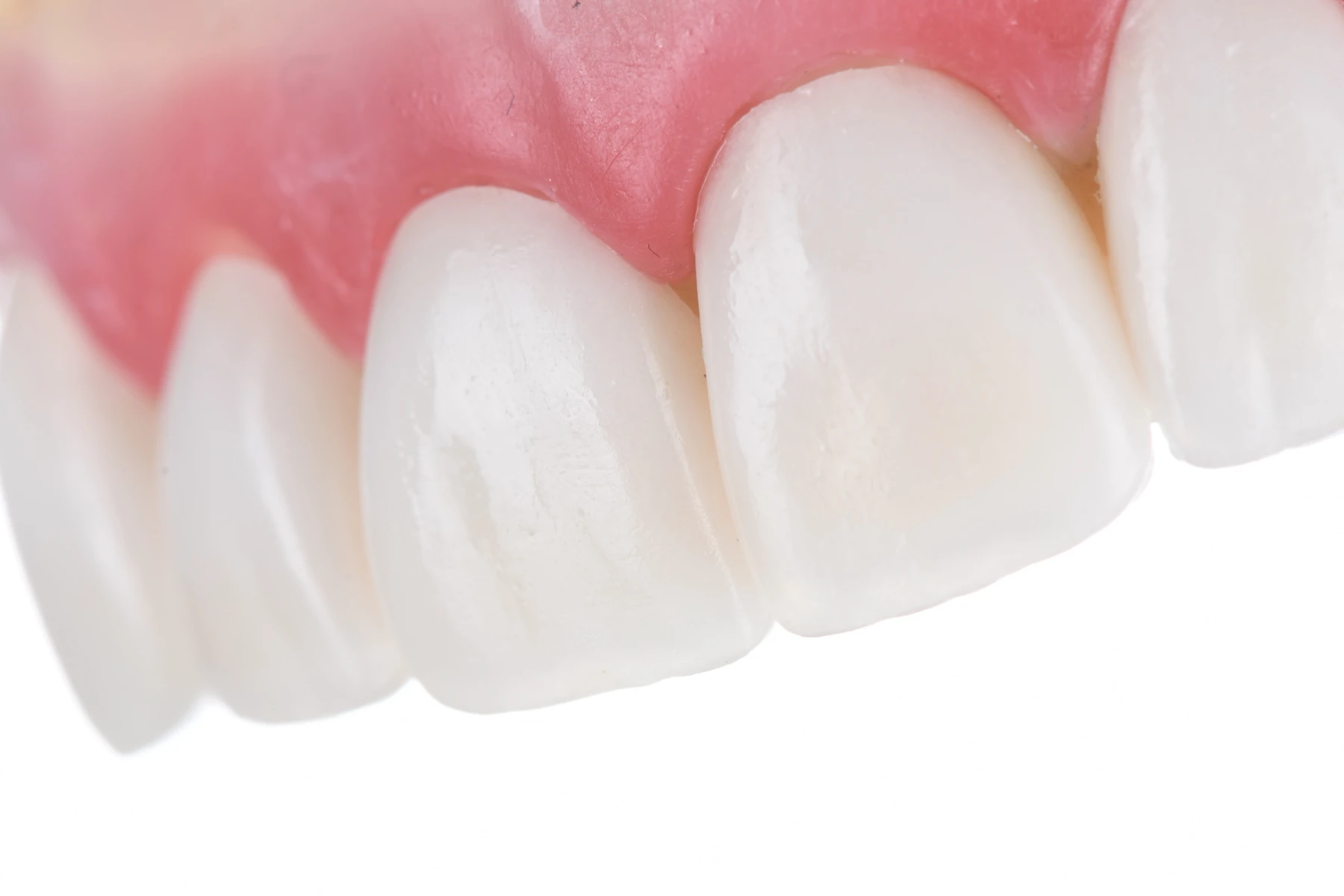
Key points
- The preparation for a veneer removes a thin layer of enamel, far less than for a crown. This layer does not grow back.
- As long as the preparation stays within the enamel, bonding is more reliable: the cases of debonding reported occur mainly when the dentine is exposed.
- Serious complications for the tooth are rare in studies. A veneer can, however, crack, come loose or need to be redone one day.
What is removed from the tooth?
So that a veneer does not make the tooth thicker, a thin layer of enamel, the outer layer of the tooth, is usually removed. This thickness is not fixed in advance: it depends on the final volume set out in the plan, and sometimes nothing needs to be removed at all.
A laboratory study measured how much different preparations remove: about 3 to 30% of the visible part of the tooth for veneers, depending on their design, compared with 63 to 72% for a full crown. The measurements were made on resin model teeth, not on patients, but they show the gap between the two procedures.
What is removed does not grow back. A tooth prepared for a veneer will remain a restored tooth: that is why the decision is made before the preparation, never during it.
Why does it matter so much where the preparation stops?
Enamel is the most reliable surface to bond to. Dentine, which lies beneath it and contains more water and organic material, gives a less predictable bond.
A series of 580 veneers followed for up to twelve years illustrates this: the twelve cases of debonding observed all occurred on teeth whose preparation had exposed the dentine right up to the margin. None occurred when the preparation had stayed within the enamel.
This is why the preparation is calibrated against the plan tried in the mouth, the mock-up: only what the final volume requires is removed, staying within the enamel as far as possible.
What can happen to the tooth afterwards?
A review of 25 studies, covering 6,500 ceramic veneers, estimates that at ten years about 95 veneers in 100 had been free of fracture, debonding and decay, and had not needed root canal treatment.
Taken one by one, the events that affect the tooth itself remain rare: decay at the edge of the veneer affects fewer than one veneer in a hundred at ten years, and root canal treatment about one in a hundred. The most frequent complication involves the ceramic: cracking or fracture, followed by debonding, mostly in the first few years.
These figures come from published studies, often conducted by experienced teams, on patients who were followed up over time. They give an order of magnitude, not a promise for any particular tooth.
Sensitivity to cold can appear after fitting. It is usually temporary, and should be reported if it persists.
What if a veneer needs to be redone?
Over the years, a veneer can crack, come loose or develop staining along its edge. When it was bonded to preserved enamel, it can in most cases be redone on its own, without touching the neighbouring teeth.
Removing an old veneer and preparing the tooth for a new one does, however, remove a little tooth structure each time. This is one more reason to treat only the teeth that warrant it.
What increases or reduces the risk?
Three factors count for more than the material: the amount of enamel preserved, the way the teeth meet, and habits such as clenching or grinding the teeth. In one of the longest cohorts, 318 veneers followed for an average of almost ten years and for up to twenty, failures were almost eight times more frequent in patients who clenched or ground their teeth.
Healthy gums, careful cleaning along the edges of the veneers and regular check-ups do the rest. When clenching is identified, a protective night guard may be discussed.
When is it better not to have a veneer?
When a solution that removes little or nothing is enough: whitening for a question of colour, composite added for a small increase in volume, resin infiltration for certain white spots, orthodontic alignment for a tooth that is out of position.
And when the conditions are not right, or not yet right: inflamed gums, active decay, uncontrolled clenching, or very little enamel left, which makes bonding less predictable.
Frequently asked questions
Are teeth more fragile under a veneer?
A veneer bonded to enamel forms a strong unit with the tooth. What weakens a tooth is an extensive preparation, especially one that exposes a large area of dentine. That is why the amount removed is decided on the basis of the plan, tooth by tooth.
Can you go back after having veneers?
Not if the enamel has been prepared: the tooth will remain a restored tooth, and the veneer can be redone one day. With veneers placed without preparation, the original tooth is largely preserved underneath, but removing a bonded veneer is still a delicate procedure.
Do veneers cause tooth decay?
Not in themselves. Decay can develop at the edge of a veneer, as at the edge of any restoration, if plaque is left there. In studies, this is rare: fewer than one veneer in a hundred at ten years.
References
- Edelhoff D, Sorensen JA. Tooth structure removal associated with various preparation designs for anterior teeth. J Prosthet Dent. 2002;87(5):503-509. doi:10.1067/mpr.2002.124094
- Gurel G, Morimoto S, Calamita MA, Coachman C, Sesma N. Clinical performance of porcelain laminate veneers: outcomes of the aesthetic pre-evaluative temporary (APT) technique. Int J Periodontics Restorative Dent. 2012;32(6):625-635.
- Alenezi A, Alsweed M, Alsidrani S, Chrcanovic BR. Long-term survival and complication rates of porcelain laminate veneers in clinical studies: a systematic review. J Clin Med. 2021;10(5):1074. doi:10.3390/jcm10051074
- Beier US, Kapferer I, Burtscher D, Dumfahrt H. Clinical performance of porcelain laminate veneers for up to 20 years. Int J Prosthodont. 2012;25:79-85. Data as cited in reference 3.