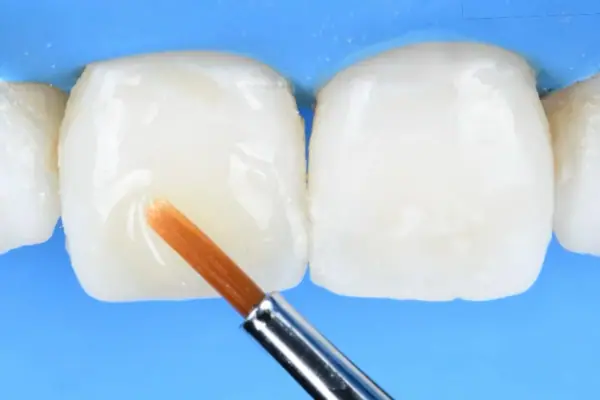
A fine brush applying composite to an incisor under a blue rubber dam.

Layered composite: repairing and harmonising front teeth.

A chipped tooth, an irregular shape or a small gap can often be corrected with composite, sculpted layer by layer.

Layered composite bonding rebuilds a front tooth directly in the dental chair, with a tooth-coloured resin applied in thin layers. It is mainly used for localised defects, on one tooth or a few, and is most often done in a single appointment, removing little or no healthy tissue.

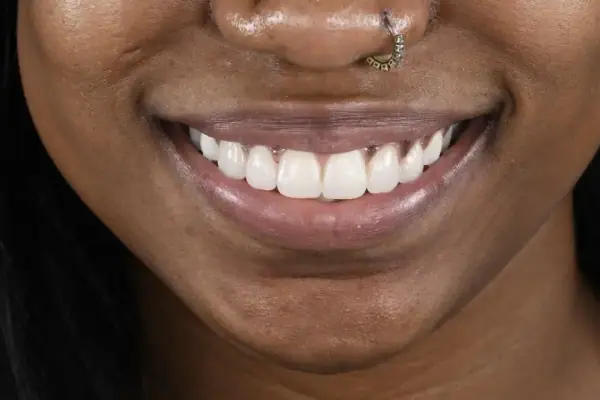
The aim is not a flawless tooth, but one that blends in with its neighbours through its shade, its light and its shape. Like any restoration, composite needs maintenance and changes over time.

Dr Jérémy Haccoun, dentist Updated

Key points

See a case: rebalancing proportions with composite

What is layered composite bonding?

Composite is a resin filled with fine mineral particles, which is bonded to the enamel and dentine. Layering it means applying it in several layers rather than as a single block: a more opaque shade at the core, in place of the dentine, then a more translucent shade on the surface, like enamel. Each layer is hardened with light before the next, then the tooth is shaped and polished.

The model is the neighbouring tooth. Its shade, the translucency of its edge, its reflections and its texture guide the choice of layers and the final shape: it is this work of observation that helps the restoration blend into the smile.
When can composite be used on a front tooth?

Before restoring, the examination looks for the cause of the defect. After a knock, it first checks what the break does not show (the nerve and the root), as the article on the fractured incisor explains. When several teeth are worn, the first step is to find out what is causing the tooth wear.

The most common situations, on one or a few front teeth:

  1. A chipped tooth, or a small piece broken off after a knock or while biting.
  2. An irregular edge or a blunted corner that breaks the line of the smile.
  3. A tooth that is smaller than its neighbour, or a different shape.
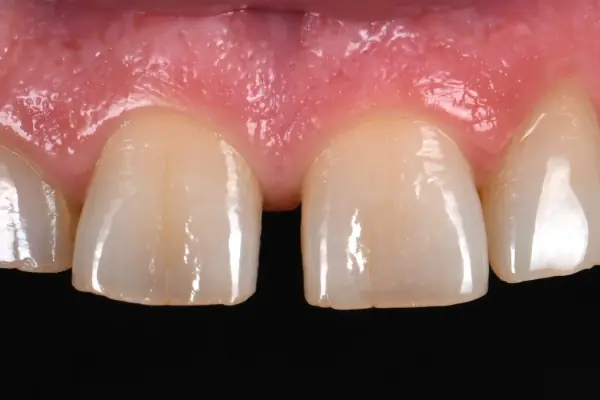
  4. A small gap between two teeth, known as a diastema.
  5. An old repair that shows: a mismatched shade, a stained edge, a shape that no longer fits in.

Preservation Index

Preserving the tooth as far as possible

02 / 04

  1. 01No preparation
  2. 02Additive
  3. 03Minimal preparation
  4. 04Restorative

The index shows what a treatment removes from the tooth and what it leaves. Layered composite sits at the second level: it adds material where some is missing. Most often there is no preparation, or only a limited one: a slight bevel at the edge of the enamel, or the removal of an old restoration or of decay when present. The composite can later be repolished, touched up or repaired without taking anything more from the tooth.

What happens during the treatment?

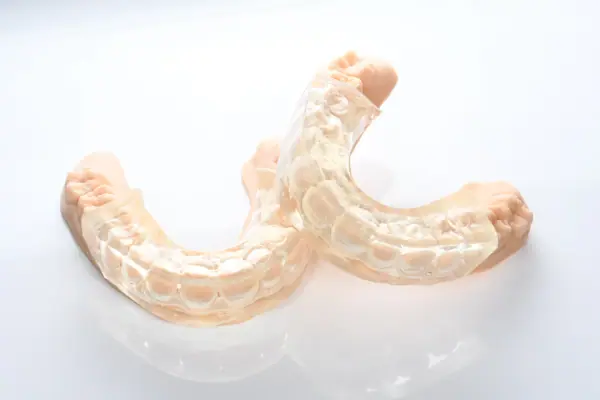
For one or two teeth, treatment is most often done in a single appointment. When the shape to be rebuilt is more extensive, a plan can be prepared from an impression: a silicone key then guides the build-up of the back surface of the tooth.

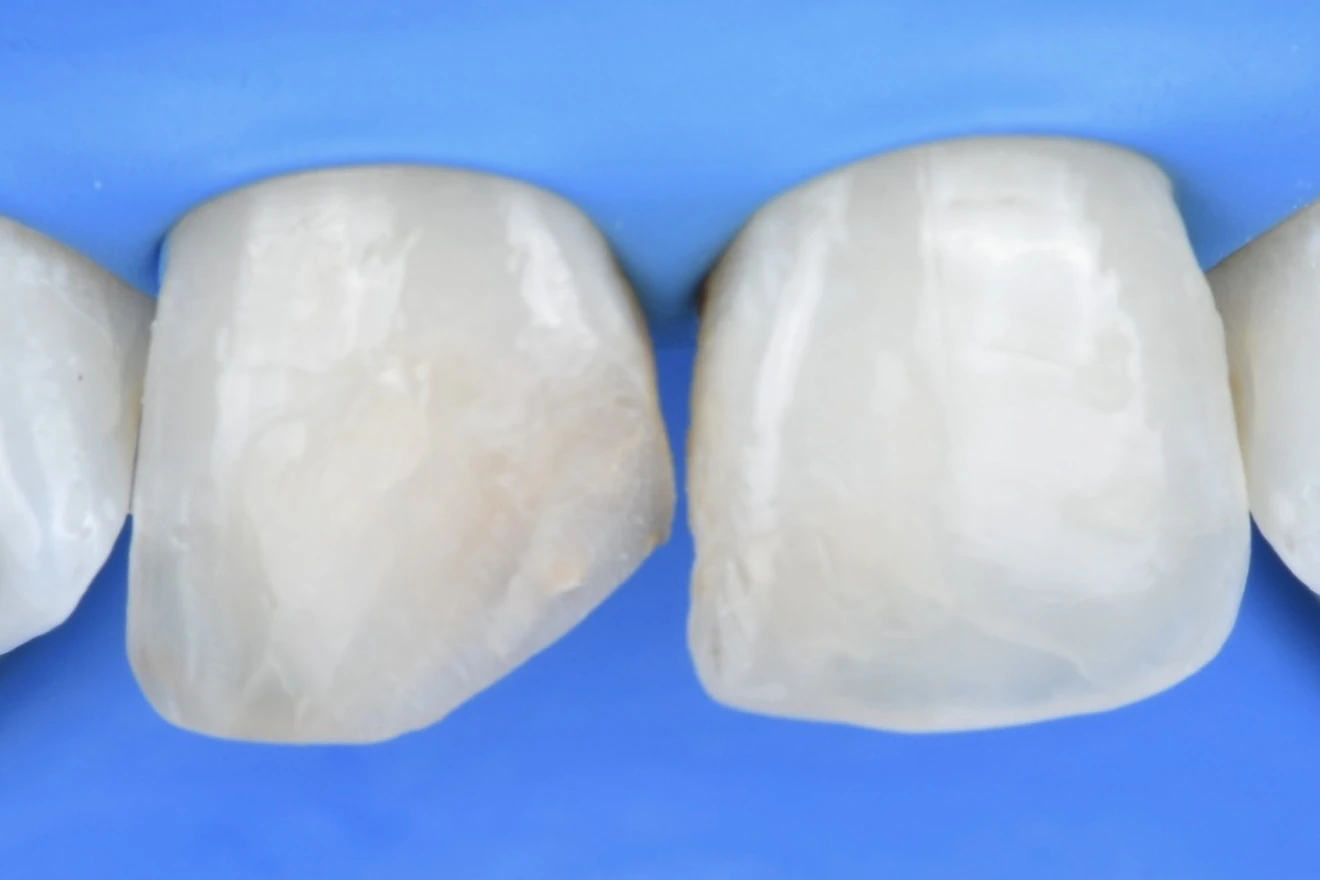
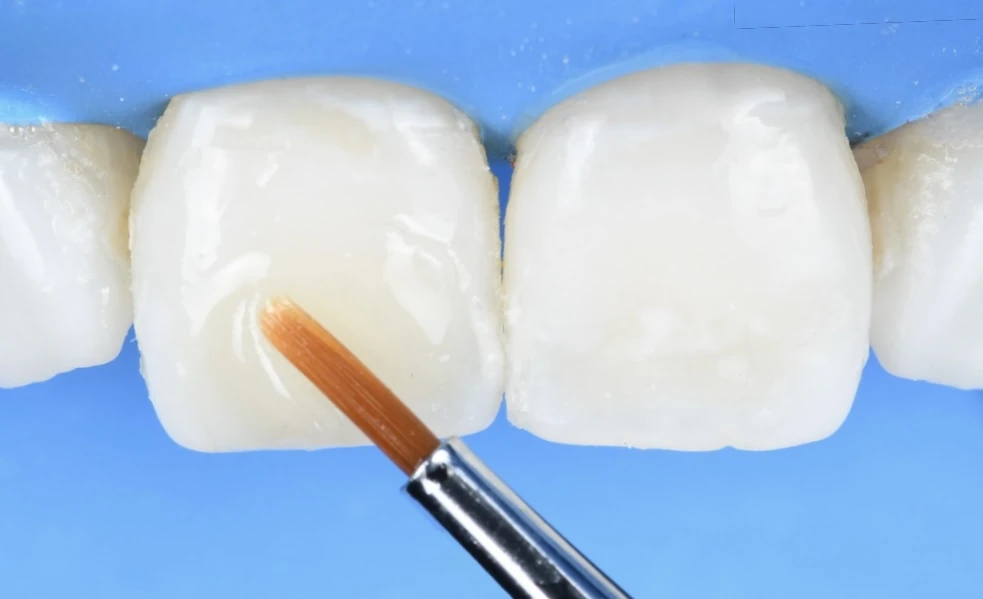
Under a blue rubber dam, a fine brush shaping a layer of composite on a central incisor.
The layering technique: a thin layer of composite, shaped with a brush before being hardened with light. Photograph taken at the practice, during the micro-layering that followed the infiltration of white spots.

The same technique, in a very thin layer, sometimes completes another treatment: in this white spot case, micro-layering restored the volume of two central incisors after resin infiltration.

The steps, in order:

  1. Choosing the shades while the tooth is still moist, and taking photographs.
  2. Isolating the tooth, often with a rubber dam, so that bonding takes place away from saliva.
  3. Preparing for bonding: cleaning, a slight bevel if needed, then the adhesive.
  4. Building up the tooth in layers, each one hardened with light.
  5. Shaping, polishing and adjusting the bite. The shade can be judged once the tooth has rehydrated, a few hours later.

Layered composite, injection-moulded composite or ceramic veneer?

All three correct the shape of the front teeth, but they do not suit the same situations. None is better in itself: the choice depends on the extent of the correction, the number of teeth and the shade.

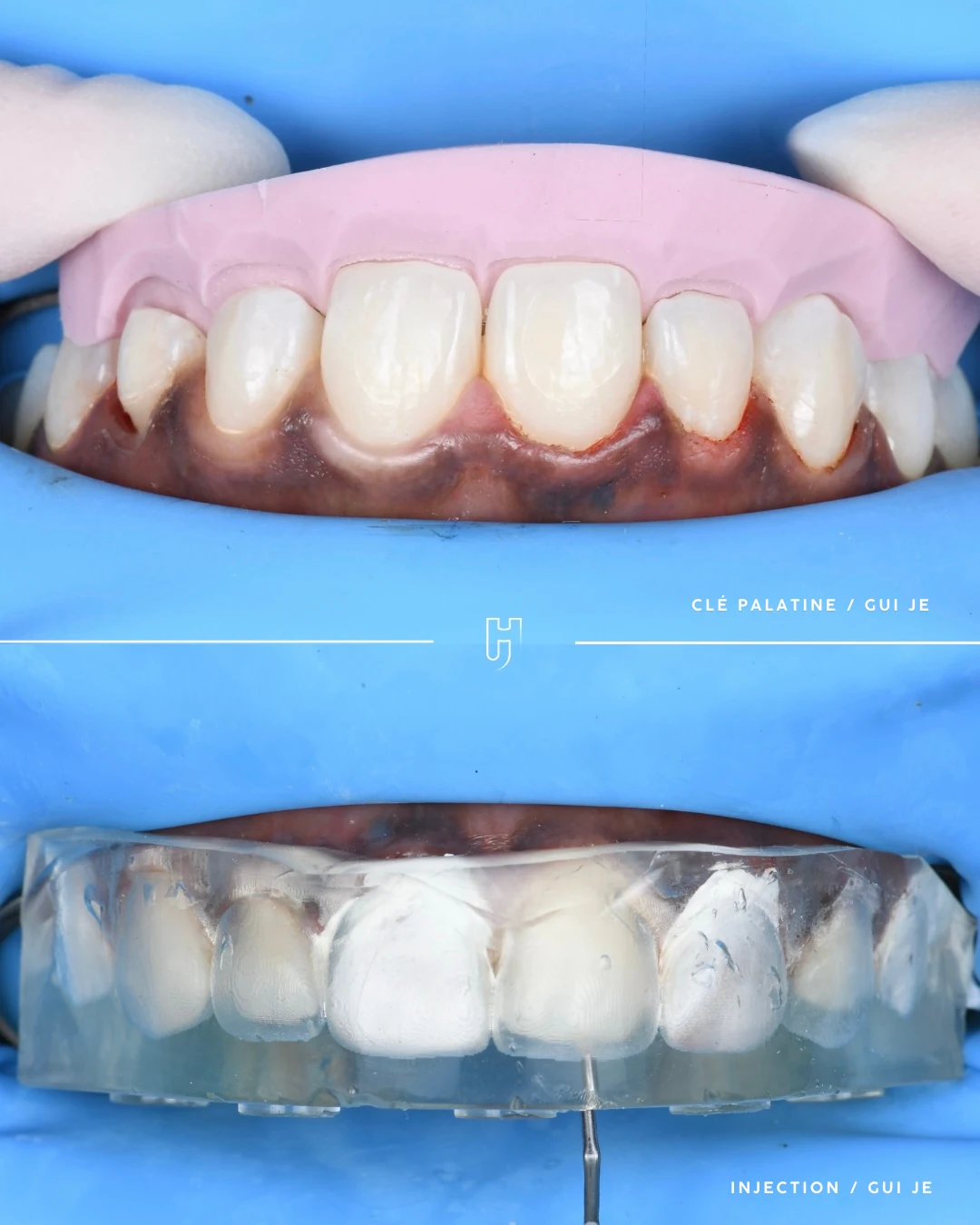
Two views under a blue rubber dam: at the top, a pink silicone key placed behind the upper teeth; at the bottom, a clear guide placed over the teeth for injecting the composite.
Within a single treatment, the two techniques follow one another. At the top, the palatal key, which guides the building of the back surface of the teeth before layering; at the bottom, the clear guide through which the composite is then injected. The case is described in detail in the clinical case gallery.
Layered composite
One or a few teeth, a localised loss: the shape is sculpted directly on the tooth, following its neighbour.
Injection-moulded composite
Several teeth whose shape or proportions are being changed: the plan is designed in advance, then reproduced in the mouth through a transparent key.
Ceramic veneer
A ceramic piece, made and then bonded, that keeps its shade and shine better; it most often requires some preparation of the enamel and several appointments.

The techniques can be combined: in this case from the practice, a smile with a lateral incisor missing from birth, and proportions that needed rebalancing, was treated first by layering, then by injection. Other requests are better met by a different treatment: whitening when it is the shade of all the teeth that bothers you, orthodontics when the teeth are out of position or the gaps too wide. On a back tooth, or when the loss is extensive, other adhesive restorations take over.

How long does composite bonding last?

No lifespan can be promised: it depends on the extent of the restoration, the way the teeth meet, habits such as clenching, and maintenance. In a systematic review of 17 studies, which followed 1,821 front-tooth restorations for 3 to 17 years, the annual failure rate ranged from 0 to 4.1% depending on the study. A more recent review, covering 25 studies, finds much wider variations.

In both, fracture is the primary cause of failure, and appearance is among the main reasons for redoing a restoration. A restoration that rebuilds a corner is more exposed than one between two teeth: according to a meta-analysis, around 90% of the former last ten years without being redone, compared with 95% of the latter.

Composite can be repaired: a chip can be filled and a dulled surface repolished, often without redoing everything. Regular check-ups, and a night guard if you clench or grind your teeth, help it last.

Layered composite bonding in Levallois-Perret

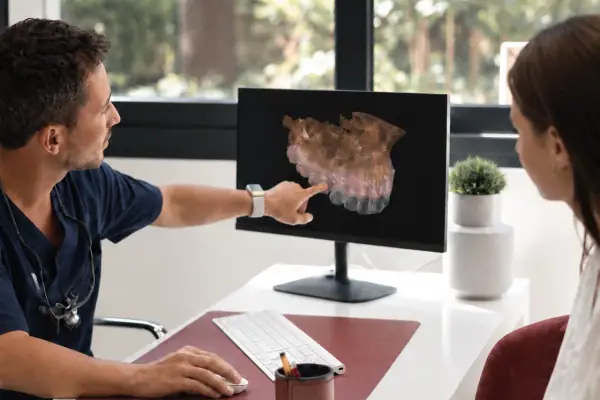
At Dr Jérémy Haccoun’s practice in Levallois-Perret, a composite restoration begins with an examination: the tooth, its neighbours, the gum, the way the teeth meet, and what you would like to change. The options are presented with their limits, their alternatives and their cost, before any decision is made.

Understand before choosing.

Can composite look like a natural tooth?

It can come very close. Several shades, a more translucent edge, and a shape and texture copied from the neighbouring tooth allow it to blend in naturally at conversational distance. Very close up, under certain lighting or over the years, a difference may show: the result depends on the starting tooth, and an identical match cannot be promised.

Does the tooth need to be prepared?

Most often very little, or not at all: the composite is added where part of the tooth is missing. A slight bevel of the enamel, for a stronger and less visible junction, or the removal of an old restoration or of decay may be needed. So the tooth is not always left untouched, but this bears no comparison with preparing a tooth for a crown.

Can a gap between two teeth be closed with composite?

Yes, when the gap is small and the teeth are well positioned: composite is added to the sides of the two neighbouring teeth, most often without preparing them. The limit lies in the proportions, because closing a gap that is too wide would make the teeth too wide; orthodontic treatment may then be suggested, on its own or before the composite. The gum matters too: it does not always fill the space below the contact point, which the examination helps to anticipate.

Does composite change colour?

A little, over time. Its surface can lose some of its shine and pick up stains, particularly from coffee, tea, wine or tobacco, and a line can appear at its edge. Polishing at check-ups reduces some of this, and a restoration that has become too visible can be redone. Composite does not whiten the way enamel does: if whitening is being considered, it is done first, and the shade of the composite is chosen afterwards.

How much does layered composite cost?

At the practice, an aesthetic composite on a front tooth is charged at between €63 and €1,500, depending on the number of teeth to be restored and on complexity: a small repair and the rebuilding of a corner do not involve the same work. Treatment with an aesthetic purpose is not covered by the French national health insurance (Assurance Maladie). A detailed written quote is given after the examination, before any decision.

References

  1. Demarco FF, Collares K, Coelho-de-Souza FH, Correa MB, Cenci MS, Moraes RR, Opdam NJ. Anterior composite restorations: a systematic review on long-term survival and reasons for failure. Dent Mater. 2015;31(10):1214-1224. doi:10.1016/j.dental.2015.07.005
  2. Shah YR, Shiraguppi VL, Deosarkar BA, Shelke UR. Long-term survival and reasons for failure in direct anterior composite restorations: a systematic review. J Conserv Dent. 2021;24(5):415-420 (published online in 2022). doi:10.4103/jcd.jcd_527_21
  3. Heintze SD, Rousson V, Hickel R. Clinical effectiveness of direct anterior restorations: a meta-analysis. Dent Mater. 2015;31(5):481-495. doi:10.1016/j.dental.2015.01.015

Every situation
needs its own diagnosis.

The information on this page is general. Only a clinical examination can establish whether a treatment is indicated, and clarify its benefits, limits and alternatives.

Message us