
Key points
- How the veneers will look is decided before they are fitted: on the plan tried in the mouth, then in the shade measurement sent to the laboratory.
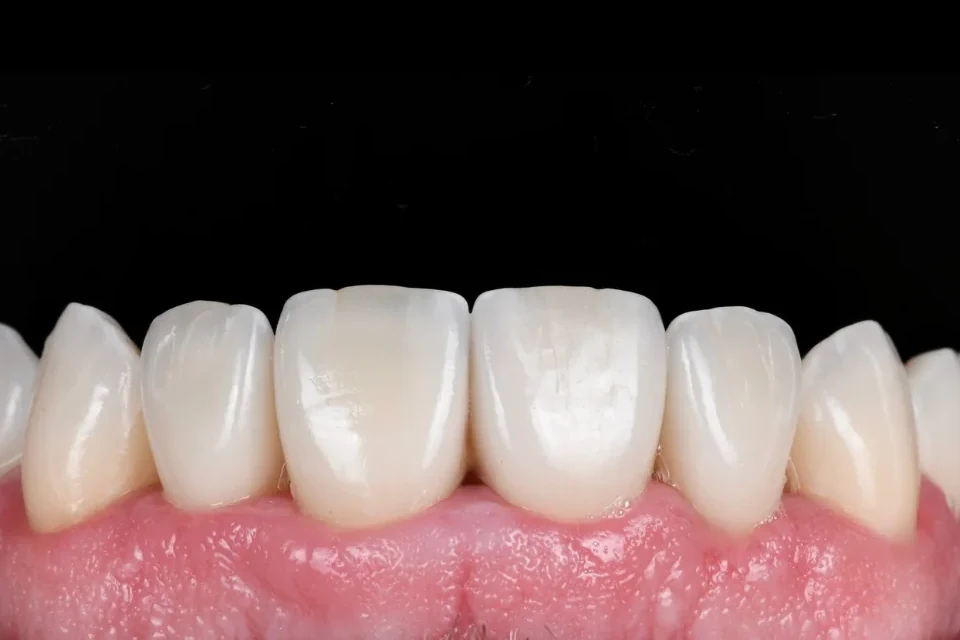
- An inconspicuous veneer keeps subtle variations: more translucent at the edge, more saturated near the gum, with a surface that catches the light like enamel.
- The untreated teeth are the reference: the result is judged by its continuity with them.
What makes a veneer noticeable?
Four flaws come up again and again: a shade too white or too opaque for the face, shapes identical from one tooth to the next, added volume that brings the teeth forward, a visible edge near the gum. None of them comes down to the material alone: they come down to the decisions made beforehand.
Why try the plan before preparing the teeth?
The mock-up uses temporary resin to reproduce in the mouth the shapes set out in the plan, without altering the teeth. It is used to judge the proportions within the face, at rest, when speaking and when smiling, and to correct whatever is not right.
It also serves as a guide for the preparation: the depth of reduction is measured from the planned final shape rather than from the tooth as it is, which limits enamel reduction. This approach, described notably in 2006, remains the basis of guided preparation.
The mock-up does not show the final colour: its material and translucency differ from those of ceramic. It validates the volumes and the direction of the plan.
How is the shade chosen?
By eye, with a shade guide, perception varies with the lighting and from one person to another. At the practice, the shade is recorded by calibrated photography, following the eLAB protocol: a photograph taken in polarised light, which eliminates reflections, and a reference grey card make it possible to translate the colour of the tooth into numerical values, which are sent to the dental technician.
Even once measured, the colour of a ceramic can stop matching that of a tooth when the lighting changes; the authors of the method say so themselves. Hence the trial of the veneers in the mouth before bonding.
What part does the ceramic play?
A tooth does not have the same shade throughout: more saturated near the gum, more translucent towards the edge. Feldspathic ceramic, built up by hand layer by layer, makes it possible to reproduce these variations; it is the most translucent of the ceramics used for veneers. Lithium disilicate is better at masking a dark tooth.
The surface matters as much as the colour: fine undulations, similar to those of enamel, reflect light the way a tooth does. A surface that is too smooth looks artificial.
Why are the gums part of the result?
The gum line frames the teeth. If the gum margins sit at irregular heights, even well-made veneers will look uneven. A localised gum correction is sometimes carried out before the veneers to rebalance this outline: this is what was done, from the second premolar on the right to the second premolar on the left, in the case of the eight feldspathic veneers.
Do all the visible teeth need treating?
No. The more teeth are treated, the easier it is to match them to one another, but the further the result moves from the original smile. Treating only the teeth that stand out from the rest, by contrast, means matching the neighbouring teeth: it is more demanding, and it keeps the person’s own smile.
A case presented on the ceramic veneers page follows this logic: after whitening, the canines blended in well enough to be left untreated, and four veneers were sufficient.
What cannot be promised?
An exact match in every kind of light, for the reason given above. A shade that follows the ageing of the neighbouring teeth: natural teeth darken a little with age, ceramic does not. And a result identical to a reference photograph: the plan is an intention, discussed and tried out, not a copy.
Frequently asked questions
Can you choose a very light shade?
That can be discussed. The plan shows the effect within your face, next to the untreated teeth; that is often what helps you decide how far to go.
Can veneers be seen up close?
A well-integrated veneer is hard to pick out at conversational distance. Very close up, a trained eye may spot a margin or a difference in surface.
How long does it take to reach the final result?
Several appointments over a few weeks: examination, plan and mock-up, preparation and temporaries, trial, then bonding.
References
- Magne P, Magne M. Use of additive waxup and direct intraoral mock-up for enamel preservation with porcelain laminate veneers. Eur J Esthet Dent. 2006;1(1):10-19.
- Hein S, Tapia J, Bazos P. eLABor_aid: a new approach to digital shade management. Int J Esthet Dent. 2017;12(2):186-202.