
Key points
- A root-treated tooth darkens because residues of blood and nerve tissue, or certain materials, seep into the dentine. A past injury to the tooth is the most common cause.
- Internal bleaching involves two to four applications of a gel placed inside the tooth, renewed every one to two weeks, once the root canal treatment has been checked and a sealing barrier placed.
- The result is good in nearly nine cases out of ten; it can fade over the years and can be touched up. The complication people worry about, root resorption, has become rare with current protocols.
Why does a root-treated tooth darken?
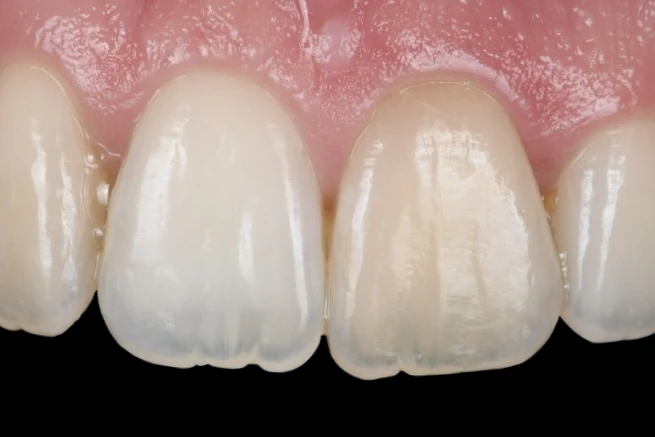
A non-vital, or “dead”, tooth is one whose nerve has died or has been removed. When the nerve dies, often after a knock, the blood that supplied it breaks down in the pulp chamber, the cavity at the centre of the tooth. Its pigments seep into the dentine, the layer beneath the enamel, and the tooth turns grey, brown or dark yellow. The dentine, no longer nourished, also becomes more opaque over the years.
Materials play a part too. Remnants of nerve tissue left in the chamber, an old amalgam filling or certain filling cements can stain the tooth from the inside. In a series of 255 teeth treated for this kind of discolouration, trauma was the cause in 59% of cases, previous dental treatment in 24%, and death of the nerve with no identified injury in 14%.
This discolouration comes from inside the tooth. Conventional whitening, applied to the outside of the tooth, reaches it poorly; that is why these teeth are treated from the inside.
What is checked before treatment?
First, the root. An X-ray shows whether the root canal treatment is complete and well sealed, whether there is an infection at the tip of the root, and whether there is resorption, that is, an area where the root is being eaten away. An incomplete treatment or an infection is dealt with before any bleaching; otherwise the gel has no safe place in which to work.
Next, the tooth itself: what remains of its crown (the visible part of the tooth), the restorations already in place, and how sound the remaining structure is. And finally, the colour: that of the tooth, that of its neighbours, and what you are hoping for. A photograph at the start will make it possible to measure the progress made.
A tooth that darkened after a knock deserves a further word: the injury itself increases the risk of resorption, regardless of bleaching. The initial X-ray also serves as a point of comparison for later.
How is internal bleaching carried out?
Everything is done through the back of the tooth. The access to the pulp chamber is reopened, anything that could stain is cleaned out, and the top few millimetres of the root filling are removed, down to just below the neck of the tooth. A sealing barrier is then placed over the filling: it is this barrier that protects the root and the bone from the gel.
A carbamide peroxide gel is placed in the chamber, then the tooth is closed with a temporary filling. The gel works for one to two weeks, at home, with nothing for you to do. Two to four applications are usually needed in all, with the shade checked at each appointment. Internal bleaching is sometimes combined with external whitening of the same tooth, or of the neighbouring teeth if they also need lightening. A clinical case of internal bleaching shows this combination, before and after.
Once the shade is right, the chamber is rinsed and closed with composite, after a wait of a few days so that the bond is reliable. The outside of the tooth is not prepared, and no tissue is removed from it.
What result can you expect?
In most cases, a clear move towards the shade of the neighbouring teeth. A systematic review of eight clinical trials puts the average gain at more than six shade guide units, and each of the products studied had a significant lightening effect. In the series of 255 teeth mentioned above, the result was judged good in 87% of cases and acceptable in the rest.
Grey and light yellow teeth respond better; dark yellow or black teeth need more applications. No result can be promised for a given tooth, and an exact match with the neighbouring teeth is not always achieved.
Over the years, the tooth may darken again slightly. In one series followed for sixteen years, the shade had remained stable in 63% of teeth; another, followed for twenty-five years, reports 85% of results maintained. A touch-up using the same method remains possible, provided the tooth is still healthy.
What are the risks?
The main risk is called external cervical resorption: the root is eaten away at the neck of the tooth, below the gum, without any pain at first. It was described with older protocols, which used 30% hydrogen peroxide heated inside the tooth, and above all in teeth that had suffered a knock. With a low-concentration gel, no heat and a sealing barrier over the root, large recent series report no cases; it remains a known risk, which can be monitored with X-ray check-ups.
In Europe, sodium perborate, long used for this treatment, is no longer permitted in cosmetic products. The gels used today are based on carbamide or hydrogen peroxide and are reserved for dentists.
The other drawbacks are minor: a shade that ends up slightly lighter than the neighbouring teeth, avoided by stopping earlier; a temporary filling that comes loose, which should be redone without delay; and, rarely, no result at all, which leads on to the solutions below.
What if bleaching is not enough?
The colour is then masked, with the solution that removes the least tissue. Composite placed on the visible surface can cover a shade that is still slightly dark. A ceramic veneer does this better and lasts longer; on a dark tooth, a more opaque ceramic is then chosen, as the article on choosing the ceramic explains in detail. A crown, which covers the whole tooth, comes last.
The order matters. A root-treated tooth is not fragile in itself: what weakens it is the amount of tissue removed. In extracted teeth, root canal treatment alone reduces the stiffness of the tooth by only 5%, compared with 63% for a large cavity. Bleaching first means that a thinner veneer can then be placed if needed, and so less preparation is required.
This is the approach followed in a case from the practice: the root-treated incisor was first bleached from the inside to bring it closer to its neighbour, then two thin veneers could be placed, without leaving the whole correction to the ceramic.
What follow-up is needed afterwards?
A follow-up X-ray some time later, to check the root; a look at the shade at each visit; and a touch-up if the tooth darkens again over the years. A root-treated tooth remains a tooth to keep an eye on, bleached or not: pain, swelling or new looseness should be reported without delay.
Frequently asked questions
Can this tooth and the others be lightened at the same time?
Yes: the root-treated tooth is treated from the inside, the others with trays. Both treatments are adjusted to reach a consistent overall shade, and we wait for it to be stable before any restoration. The article on whitening describes how living teeth are whitened.
How many appointments are needed?
Usually three to five: the examination and placement of the first gel, one or more renewals one to two weeks apart, then the final closure of the tooth. It depends on the starting shade.
Is the tooth at risk of breaking?
The bleaching itself does not make this more likely. What weakens a root-treated tooth is what has been removed from it. The opening at the back is closed with bonded composite, and nothing is touched on the visible surface.
Can a tooth that darkened after an old injury still be lightened?
Often, yes, even years later, provided the root is healthy and has been treated. Old, very dark discolouration sometimes needs more applications, and the result is less predictable.
References
- Plotino G, Buono L, Grande NM, Pameijer CH, Somma F. Nonvital tooth bleaching: a review of the literature and clinical procedures. J Endod. 2008;34(4):394-407. doi:10.1016/j.joen.2007.12.020
- Abbott P, Heah SY. Internal bleaching of teeth: an analysis of 255 teeth. Aust Dent J. 2009;54(4):326-333. doi:10.1111/j.1834-7819.2009.01158.x
- Frank AC, Kanzow P, Rödig T, Wiegand A. Comparison of the bleaching efficacy of different agents used for internal bleaching: a systematic review and meta-analysis. J Endod. 2022;48(2):171-178. doi:10.1016/j.joen.2021.10.011
- Amato M, Scaravilli MS, Farella M, Riccitiello F. Bleaching teeth treated endodontically: long-term evaluation of a case series. J Endod. 2006;32(4):376-378. doi:10.1016/j.joen.2005.08.018
- Amato A, Caggiano M, Pantaleo G, Amato M. In-office and walking bleach dental treatments on endodontically-treated teeth: 25 years follow-up. Minerva Stomatol. 2018;67(6):225-230. doi:10.23736/S0026-4970.18.04190-0
- Kahler B. Present status and future directions: managing discoloured teeth. Int Endod J. 2022;55 Suppl 4:922-950. doi:10.1111/iej.13711
- Heithersay GS. Invasive cervical resorption: an analysis of potential predisposing factors. Quintessence Int. 1999;30(2):83-95.
- Reeh ES, Messer HH, Douglas WH. Reduction in tooth stiffness as a result of endodontic and restorative procedures. J Endod. 1989;15(11):512-516. doi:10.1016/S0099-2399(89)80191-8
- Krastl G, Camilleri J, Day P, et al. Prevention and management of tooth discolouration of endodontic origin (DEO): a state-of-the-art review. Int Endod J. 2026, published online 16 September 2026. doi:10.1111/iej.70263