
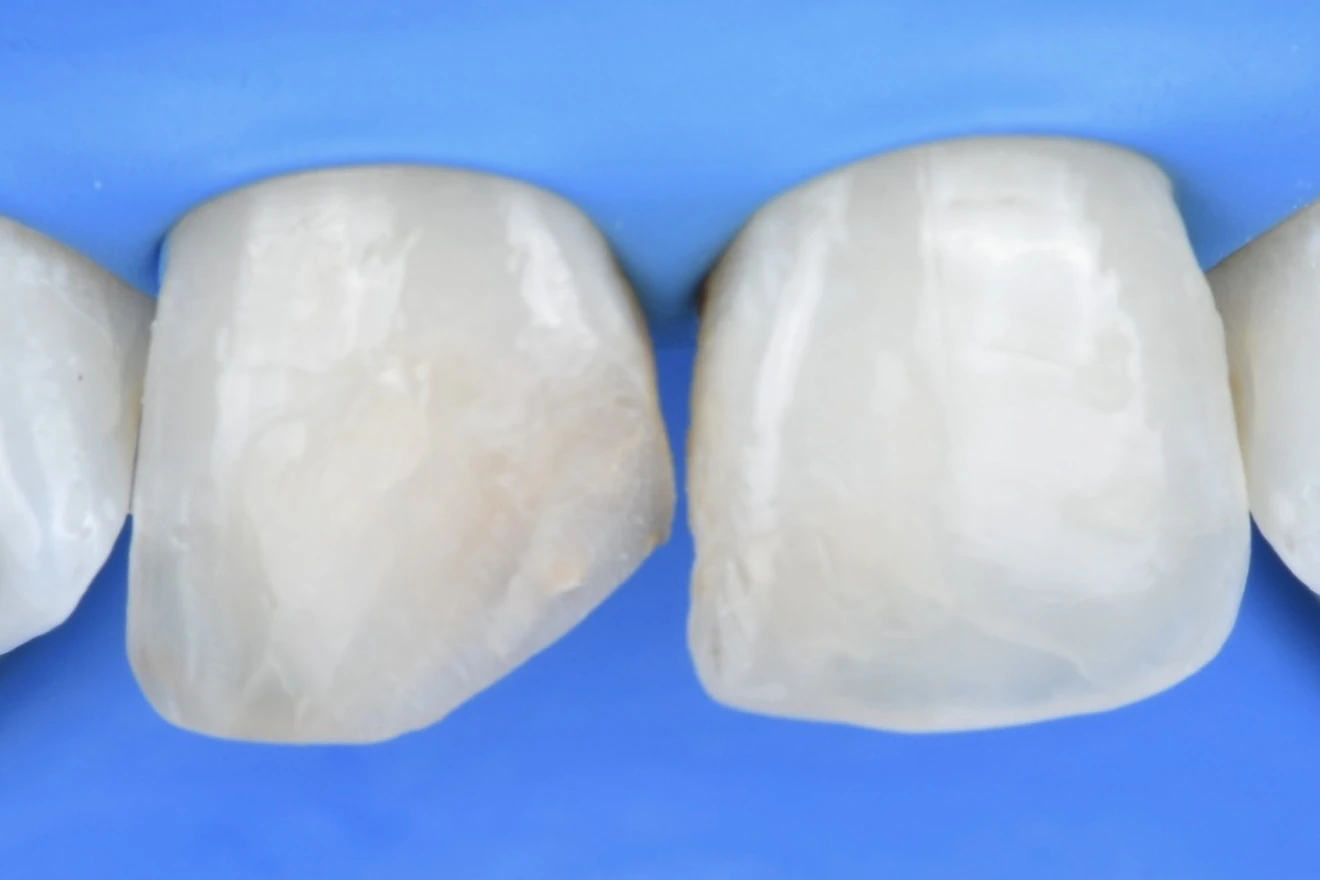
Key points
- Find the broken piece, keep it in water or saline solution, and see a dentist promptly. If it is intact, it can often be bonded back on: its shape, shade and texture are those of the tooth.
- An incisor that has not moved in the bone keeps a living nerve in almost every case; a knock that has displaced it changes the outlook, hence the X-ray and the check-ups at six weeks and at one year.
- Composite rebuilds an incisor in a single appointment and can be repaired; around 9 in 10 are still in place after ten years. Ceramic is mainly kept for extensive loss or for teeth that are already heavily restored.
What should you do in the first few hours?
Look for the piece: on the floor, or sometimes inside the lip. Do not rub it or dry it: put it in a small container with water or saline solution. A fragment that has dried out can be rehydrated at the practice, but one that has been kept moist bonds back better. See a dentist the same day if you can.
Some signs mean you should not wait: the tooth has moved or been pushed in, it is bleeding at the gum, it hurts sharply when touched or with cold, or a pink or red dot appears in the centre of the break, a sign that the nerve is exposed. In these situations, how quickly treatment is given changes the outlook for the nerve.
Avoid biting with the tooth, eat soft, lukewarm food, and take a photograph of the tooth if you can: it will serve as a reference.
What does the examination look for?
First, the depth of the break. A fracture may involve only the enamel, the outer layer; reach the dentine, the more sensitive layer beneath it; or expose the pulp, the nerve of the tooth, at its centre. Each level is treated differently.
Next, what cannot be seen. The knock that broke the crown of the tooth may also have displaced the tooth, cracked the root or injured the bone. The examination tests mobility, sensitivity to cold and the response to tapping; an X-ray looks for a root fracture or another injury. If the piece is missing and the lip is injured, the lip is X-rayed too: the fragment is sometimes lodged there.
A tooth that does not respond to cold just after a knock is not necessarily a tooth whose nerve has died: the nerve can be stunned for weeks. This is one of the reasons for checking the tooth again later.
Can the broken piece be bonded back on?
Yes, if it is intact and still fits the tooth. It is rehydrated for about twenty minutes, then bonded with the same adhesive and composite used for a restoration, often reinforced along the join with a slight bevel filled with composite. Nothing reproduces the shape, shade and wear of a tooth better than its own fragment.
It holds well, but not indefinitely. In a series of 75 fractured incisors followed for up to fifteen years, the fragment was still in place in 84% of cases at two years, 75% at five years and 56% at ten years, with better results when the nerve had not been exposed. A meta-analysis puts the risk of losing the fragment at around one case in five, slightly higher than with composite. If it comes off, it can be bonded back or replaced with composite: nothing is lost.
Composite: rebuilding the tooth directly
When the piece is missing or no longer fits, the tooth is rebuilt in composite during the same appointment, removing little or nothing of what remains. The technique, described on the layered composite page, builds up layers of different shades and translucencies to reproduce the dentine and enamel, then the surface is sculpted and polished.
Its lifespan is well documented. In a study of 667 composite build-ups on incisors and canines, 92% were still in place at ten years and 78% at fifteen years; counting minor repairs, the tooth remained restored in 99% of cases. Across tens of thousands of front-tooth composites followed in general dental practices, an average of 4.6% a year need further treatment, with wide differences from one practitioner to another. The most common reason is a small chip, which can be repaired without redoing everything.
Composite can be touched up, re-polished and repaired; it loses a little of its shine over the years, and its edge can become stained. What it needs afterwards is set out in the article on the lifespan and care of composite.
When is a veneer or a crown preferable?
When the loss of tooth structure is extensive, when the tooth already has several old composites, or when the shade needs correcting at the same time as the shape. A ceramic veneer covers the visible surface of the tooth; a crown covers the whole tooth, which is mainly justified on a tooth that is badly broken down or root-treated. Ceramic keeps its shade and surface finish, whereas composite changes; in return, it requires preparation of the tooth and several appointments. The article comparing composite and ceramic goes through this choice in detail.
After a more serious accident, with several teeth affected, the reconstruction is planned in stages: a case from the practice shows an example.
And if the nerve is exposed?
The first aim is to keep it alive. When the pulp is visible in the break, its surface layer can be removed, to a depth of one or two millimetres, and protected with a suitable cement: this is a partial pulpotomy. It is now preferred to root canal treatment, even in an adult tooth, and reviews report success rates of 83 to 100% depending on the series, clearly higher than with a simple dressing placed on the nerve. The tooth is then restored with the fragment or with composite, like any other fractured tooth.
Root canal treatment is still needed when the nerve cannot be saved, or when the tooth is too badly broken down to be restored without a post. A tooth that has lost its nerve after a knock can darken over the years; the article on root-treated teeth explains how it can be lightened.
Why check the tooth at six weeks, then at one year?
Because the nerve does not show straight away how it has withstood the knock. In a series of 455 fractured incisors, the nerve survived in 99% of cases when the tooth had not moved, and in only 70% of cases when displacement was also involved. International guidelines therefore recommend a clinical and X-ray check-up at six to eight weeks, then at one year, with closer follow-up if the nerve was exposed or the tooth displaced.
Between check-ups, three signs should prompt you to come back: a tooth that changes colour, pain that appears or persists, or swelling of the gum above the tooth.
Frequently asked questions
Does a reattached fragment last as long as composite?
A little less, according to the studies: around three fragments in four are still in place at five years, and the risk of debonding is slightly higher than with composite. In return, the shape and shade are the tooth’s own, and a fragment that comes off can be bonded back or replaced.
Can a broken incisor be repaired on the same day?
Most often, yes, with the fragment or with composite. If the nerve is exposed or the tooth has moved, the treatment on the day deals with that first, and the tooth can be rebuilt in the same appointment or shortly afterwards.
Will the tooth change colour?
Not if the nerve stays alive, which is the most common outcome. A tooth that turns grey in the following months often signals that the nerve has not survived: it is one of the signs watched for at check-ups, and this can be treated.
Should the piece be kept in milk?
Milk is recommended for a whole tooth that has been knocked out. For a piece of the crown, the visible part of the tooth, international guidelines advise water or saline solution; what matters is that it does not dry out.
References
- Bourguignon C, Cohenca N, Lauridsen E, et al. International Association of Dental Traumatology guidelines for the management of traumatic dental injuries: 1. Fractures and luxations. Dent Traumatol. 2020;36(4):314-330. doi:10.1111/edt.12578
- Sung L, Ku H, Shin Y, Swaid S, Kim D, Roh BD. Prognosis of fragment reattachment in anterior crown fractures: a retrospective study. J Esthet Restor Dent. 2025;37(6):1557-1566. doi:10.1111/jerd.13429
- Tewari N, Cehreli Z, Haldar P, Atif M, Alani A, Rahul M. The risk of bonded fragment loss in crown-fractured anterior teeth managed by fragment reattachment: a systematic review and meta-analysis. Evid Based Dent. 2024;25(3):167. doi:10.1038/s41432-024-01003-9
- Frese C, Wohlrab T, Soliman S, et al. A multicenter trial on the long-term performance of direct composite buildups in the anterior dentition: survival and quality outcome. J Adhes Dent. 2020;22(6):573-580. doi:10.3290/j.jad.a45514
- Collares K, Opdam NJM, Laske M, et al. Longevity of anterior composite restorations in a general dental practice-based network. J Dent Res. 2017;96(10):1092-1099. doi:10.1177/0022034517717681
- Robertson A, Andreasen FM, Andreasen JO, Norén JG. Long-term prognosis of crown-fractured permanent incisors. The effect of stage of root development and associated luxation injury. Int J Paediatr Dent. 2000;10(3):191-199. doi:10.1046/j.1365-263x.2000.00191.x
- Matoug-Elwerfelli M, ElSheshtawy AS, Duggal M, Tong HJ, Nazzal H. Vital pulp treatment for traumatized permanent teeth: a systematic review. Int Endod J. 2022;55(6):613-629. doi:10.1111/iej.13741
- Paulina, Dhawan P, Jain N. Treatment modalities of uncomplicated crown fracture in anterior maxillary permanent teeth: a systematic review. J Esthet Restor Dent. 2025;37(2):400-411. doi:10.1111/jerd.13340