
Key points
- Peroxide passes through the enamel and breaks down the coloured molecules responsible for the shade; it does not sand down the surface. In the laboratory, enamel loses a little hardness; in the mouth, saliva remineralises it, and long-term follow-up studies show no deterioration.
- Sensitivity to cold affects about one person in two during treatment, more often with the concentrated gels used in the dental chair; it goes away within a few days of stopping.
- In Europe, gels containing between 0.1% and 6% hydrogen peroxide are reserved for dentists, for use after an examination, and are prohibited for anyone under 18. Charcoal toothpastes do not lighten the teeth: they abrade them.
How does whitening work on the tooth?
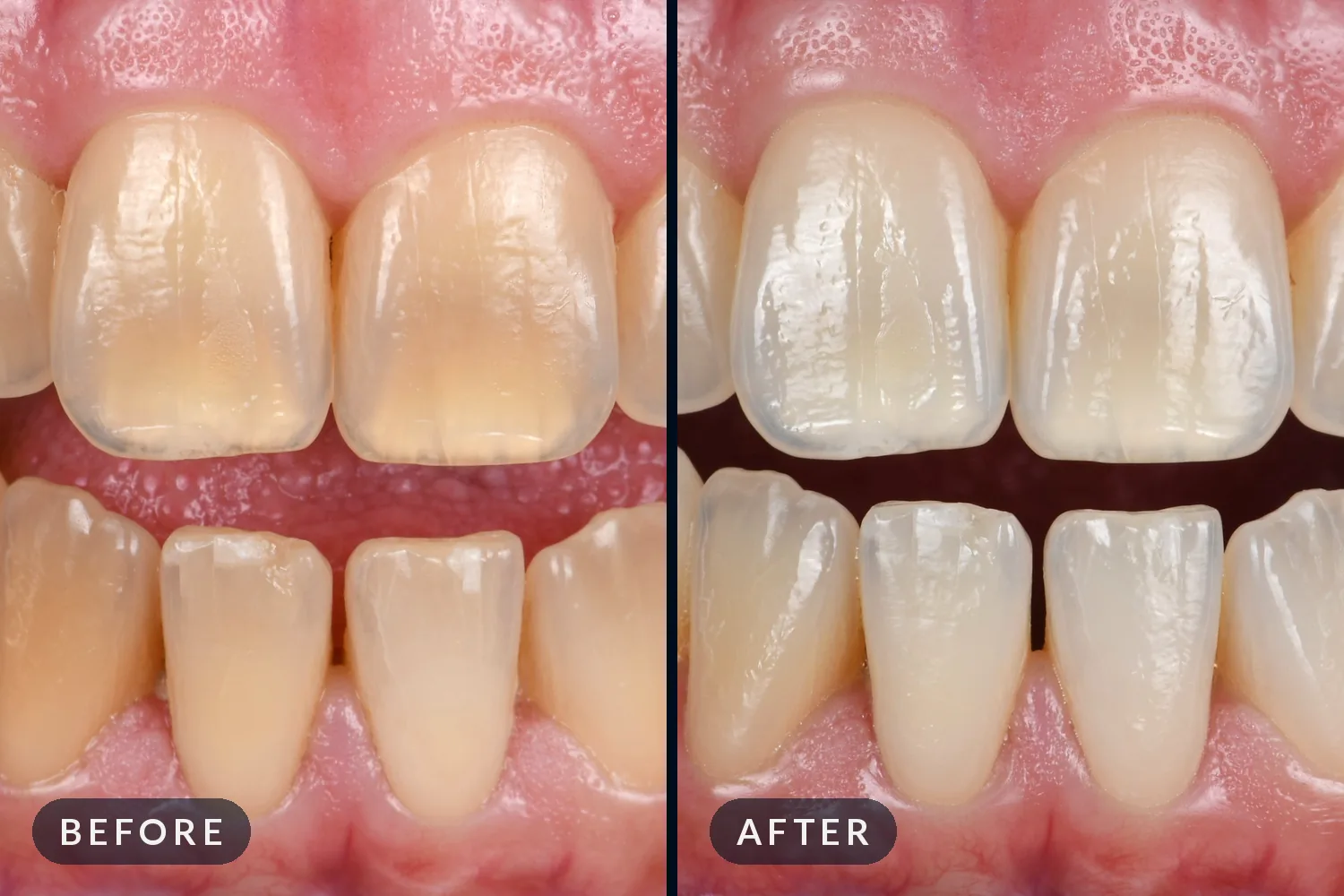
Whitening gels contain hydrogen peroxide, or carbamide peroxide, which releases it slowly. The peroxide passes through the enamel, the outer layer of the tooth, and reaches the dentine, the layer beneath it, where most of the pigments are found. There, it breaks the coloured molecules down into smaller, less coloured fragments. The tooth looks lighter because what was colouring it has been altered, not because a layer has been removed.
This is what separates whitening from the so-called “whitening” products sold in supermarkets. Most of them work by abrasion: they rub away surface stains, such as those left by coffee or tea, but do not change the shade of the tooth itself. Whitening, on the other hand, acts on that shade, without rubbing.
At the practice, treatment is carried out with trays worn at home, after an examination. The teeth whitening page describes the treatment step by step.
Does whitening weaken the enamel, the gums or the nerve?
This is the most studied question. In the laboratory, on extracted teeth, a slight drop in the surface hardness of the enamel is sometimes measured after whitening. A recent meta-analysis bringing this work together puts the drop at around 10% and judges it too small to have any clinical consequence when the protocol is followed. For 10% carbamide peroxide, the product most widely used with trays, another review finds no significant change in hardness over three weeks of use.
These measurements are made without saliva. In the mouth, saliva constantly redeposits calcium and phosphate on the enamel, which restores this hardness. One team re-examined patients nine to twelve years after whitening with trays and looked at their enamel under an electron microscope: no notable difference between treated and untreated surfaces, and no root resorption.
What can really damage enamel are abrasive products used repeatedly, and gels that are too concentrated or applied for too long without any supervision.
The gums can become irritated if the gel touches them: a poorly fitting tray, too much product. The irritation is mild and stops when treatment stops. This is one more reason for custom-made trays, which hold the gel against the teeth and not on the gums.
The nerve, or pulp, reacts too. With the highly concentrated gels used in the chair, applied for long periods, studies on human teeth have observed inflammation, sometimes marked, in the lower incisors, which are thin. It was not found in thicker teeth, and the tooth then lays down a protective layer of dentine. With the low-concentration gels worn in trays, follow-up studies of ten years and more show neither lesions at the tips of the roots nor any loss of vitality attributable to the treatment.
These observations explain why concentrations are limited by law, why the lower incisors call for caution, and why an examination always comes before treatment.
Why do teeth become sensitive during treatment?
The peroxide passes through the tooth as far as the nerve, which explains the sensitivity to cold that many patients feel during treatment. In an analysis pooling eleven clinical trials, it affected 51% of people treated at home with trays and 63% of those treated in the chair with concentrated gels. It is usually mild, appears in the first few days and goes away a few days after the end of treatment.
It can be prevented and managed: a less concentrated gel, shorter wearing times or wearing the trays every other day, and a desensitising toothpaste during treatment. Severe pain, or pain that persists after stopping, is not normal and should be reported.
Putting up with more sensitivity does not buy a better result: a review of systematic reviews finds no difference in effectiveness between treatment in the chair and treatment with trays. Concentrated gels get there faster; they do not go further.
What happens to composite restorations, veneers and crowns?
They do not lighten. A composite, a veneer or a crown keeps the shade it had before whitening. After treatment, a visible restoration may therefore look darker than the teeth around it, and may need to be redone to match the new shade. This is something to plan for before starting, not to discover afterwards.
In the laboratory, peroxide can slightly alter the surface of some materials. No clinical study has shown that whitening makes it necessary to replace a restoration in good condition for this reason.
There is, however, a rule about timing: just after whitening, adhesives bond less well to enamel. We generally wait two weeks before bonding a veneer or placing a composite, and the shade of a restoration is chosen once the colour has stabilised. The article on the order of treatment explains how these steps fit together.
How long does the result last?
Several years, with differences from one person to another. In a follow-up of patients treated with trays and 10% carbamide peroxide, 82% felt that their shade had held four years after treatment. Ten years on, about six patients in ten had never repeated the treatment.
The shade slowly drifts back towards where it started, as a result of age, coffee, tea, red wine and tobacco. A top-up of a few days, with the same trays, is usually enough to bring it back. Most published trials measure the result at two weeks or a few months; independent long-term studies remain rare, which is worth bearing in mind when reading the figures.
Who is allowed to whiten teeth, and with which products?
The rule is European, and it is precise. Over-the-counter products may not contain more than 0.1% hydrogen peroxide: at that level, the effect on the shade is very small. Gels containing 0.1% to 6% may be sold only to dentists; the first application of each treatment cycle must be carried out by the dentist or under their direct supervision; and these gels may not be used on anyone under 18. Above 6%, the product is prohibited as a cosmetic.
These thresholds also apply to carbamide peroxide, which releases hydrogen peroxide as it breaks down: a 16% carbamide peroxide gel releases just under 6%.
A “smile bar” or a beauty salon therefore cannot apply a gel in the mouth or use a product containing more than 0.1%, as the French authorities point out. Offers outside a dental practice that promise several shades lighter in an hour rely either on a product that does not work or on one that is illegal.
Whitening toothpastes, charcoal, bicarbonate of soda: how useful are they?
They remove surface stains by friction. That is useful after a coffee, useless against the shade of the tooth, and risky when the abrasive is harsh. A literature review on charcoal toothpastes found no clinical study demonstrating a whitening effect, and reports cases of enamel wear; a third of the products examined contained clay, which is also abrasive.
Enamel worn away by an abrasive does not grow back, and the dentine that shows through underneath is yellower: the harder you try to whiten, the darker the teeth get. An ordinary fluoride toothpaste, a soft toothbrush and a regular scale and polish do better, without wearing anything away.
When is it better not to whiten, or to wait?
Under 18, the law settles the matter. During pregnancy and breastfeeding, treatment is postponed as a precaution: no data establish a risk, none rule it out, and the treatment is never urgent.
The examination beforehand is used to identify what needs treating first: decay, inflamed gums, a crack or an exposed root, any of which would let the gel through to where it should not go. It is also used to understand where the discolouration comes from. A single tooth that has turned grey after a knock responds poorly to conventional whitening: it is treated from the inside. White or brown spots in the enamel call for other treatments. And when veneers or crowns are visible in the smile, the result has to be planned around them.
Finally, whitening corrects a shade, not a shape or a position. If what bothers you is something else, the article on the alternatives helps you see which treatment addresses which concern.
Frequently asked questions
Is whitening in a single in-office session more effective?
No. Reviews comparing the two methods find no difference in the result. In-office treatment is quicker, with a more concentrated gel and slightly more sensitivity; trays take one to three weeks and allow the pace to be adjusted.
Will my composite restorations have to be redone after whitening?
Only if they are visible and the difference in shade shows. We plan for this before starting, and wait until the colour has stabilised before choosing the new shade.
How much does whitening cost at the practice?
External whitening costs €600 to €800, depending on the length of treatment. The amount is listed on the fees page.
Can a root-treated tooth be lightened?
Yes, but from the inside, with a gel placed within the tooth. It is a different treatment, described in the article on root-treated teeth.
References
- Kwon SR, Wertz PW. Review of the mechanism of tooth whitening. J Esthet Restor Dent. 2015;27(5):240-257. doi:10.1111/jerd.12152
- Márton P, Antal M, Kiss-Dala S, et al. Enamel damage from tooth-whitening: a systematic review and meta-analysis. J Dent. 2026;172:106786. Laboratory studies. doi:10.1016/j.jdent.2026.106786
- Zanolla J, Marques A, da Costa DC, de Souza AS, Coutinho M. Influence of tooth bleaching on dental enamel microhardness: a systematic review and meta-analysis. Aust Dent J. 2017;62(3):276-282. doi:10.1111/adj.12494
- Ritter AV, Leonard RH, St Georges AJ, Caplan DJ, Haywood VB. Safety and stability of nightguard vital bleaching: 9 to 12 years post-treatment. J Esthet Restor Dent. 2002;14(5):275-285. doi:10.1111/j.1708-8240.2002.tb00523.x
- Rezende M, Loguercio AD, Kossatz S, Reis A. Predictive factors on the efficacy and risk/intensity of tooth sensitivity of dental bleaching: a multi regression and logistic analysis. J Dent. 2016;45:1-6. doi:10.1016/j.jdent.2015.11.003
- Aidos M, Marto CM, Amaro I, et al. Comparison of in-office and at-home bleaching techniques: an umbrella review of efficacy and post-operative sensitivity. Heliyon. 2024;10(3):e25833. doi:10.1016/j.heliyon.2024.e25833
- Donato MV, Dos Reis-Prado AH, Abreu LG, et al. Influence of dental bleaching on the pulp tissue: a systematic review of in vivo studies. Int Endod J. 2024;57(6):630-654. doi:10.1111/iej.14061
- Attin T, Hannig C, Wiegand A, Attin R. Effect of bleaching on restorative materials and restorations: a systematic review. Dent Mater. 2004;20(9):852-861. doi:10.1016/j.dental.2004.04.002
- Leonard RH, Bentley C, Eagle JC, Garland GE, Knight MC, Phillips C. Nightguard vital bleaching: a long-term study on efficacy, shade retention, side effects, and patients’ perceptions. J Esthet Restor Dent. 2001;13(6):357-369. doi:10.1111/j.1708-8240.2001.tb01021.x
- Brooks JK, Bashirelahi N, Reynolds MA. Charcoal and charcoal-based dentifrices: a literature review. J Am Dent Assoc. 2017;148(9):661-670. doi:10.1016/j.adaj.2017.05.001
- Regulation (EC) No 1223/2009 on cosmetic products, Annex III, entry 12 (hydrogen peroxide), in the wording resulting from Council Directive 2011/84/EU of 20 September 2011, OJ L 283 of 29 October 2011.
- Direction générale de la concurrence, de la consommation et de la répression des fraudes. Encadrement des soins esthétiques et de la coiffure: le blanchiment des dents. economie.gouv.fr, page accessed in September 2026.