
Key points
- The injection technique is recent: the publications specific to it follow patients for one to two years. For long-term lifespan, the evidence comes from direct composites on front teeth, around 9 in 10 of which are still in place after ten years.
- What wears first is the shine, then the edge, which can stain or chip. Coffee, tea and fizzy drinks taken every day speed up staining; re-polishing removes most of it.
- A chip can be repaired in one appointment, without redoing everything, and a repaired restoration lasts as long as a replaced one. For people who clench or grind their teeth, a night guard is part of the treatment.
How long does injection-moulded composite last?
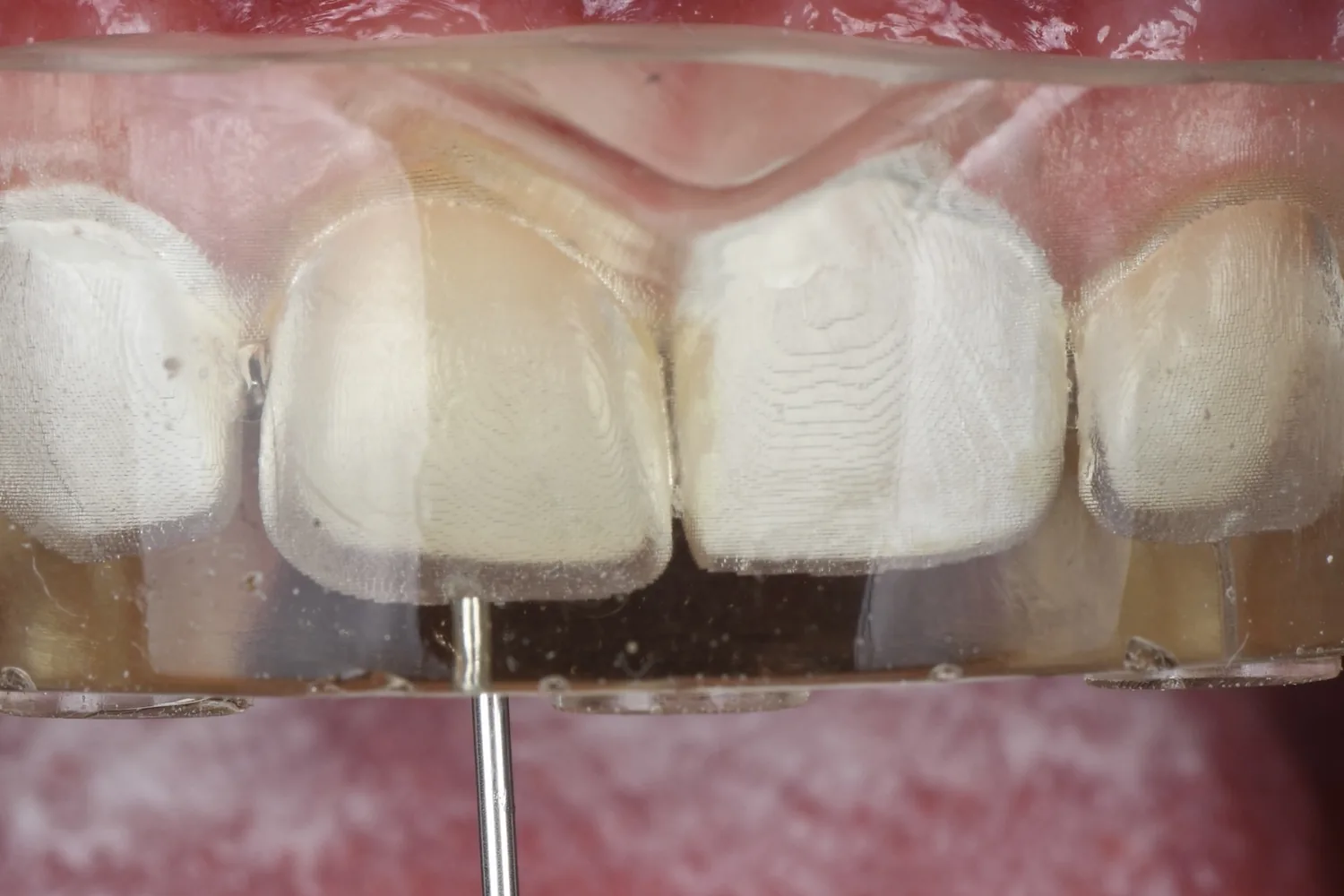
Two things need to be distinguished. The injection technique, in which the composite is transferred into the mouth through a transparent key, is recent: the studies specific to it are case reports with two years of follow-up and a one-year study of 84 restorations, in which more than 90% received the highest score on every criterion. They say nothing yet about ten years.
For that timescale, we look at direct composites on the front teeth, of which the injection technique is a variant. In a study of 667 composite build-ups on front teeth, 92% were still in place at ten years and 78% at fifteen years; counting minor repairs, the tooth remained restored in 99% of cases. In a practice that followed more than a thousand composite veneers for ten years, around 4% a year needed a repair or replacement, compared with just over 1% for ceramic veneers. The page on injection-moulded composite reviews the studies on front-tooth composites and what they cannot tell us.
One reservation is specific to the technique: the flowable composite it uses is slightly less resistant to wear than a conventional paste composite. That is a reason to reserve the technique for situations where the stresses remain moderate, and to advise against it when grinding is not under control.
What wears first?
The shine, first. The polish achieved at the end of the appointment fades with brushing and chewing, at a pace that depends on your habits; the surface then picks up stains more easily. Then the edge: the margin between the composite and the tooth can become slightly stained, and a thin edge can chip under a contact that is too heavy. Fracture of a piece of composite is the main reason for further treatment in the studies; it happens more often in the first year, then becomes rarer.
The shape also changes, very slowly: a biting edge that does a lot of work wears a little, as an enamel edge does. What does not change, as a rule, if the bonding was done in good conditions, is how well the composite stays attached to the tooth.
Does composite turn yellow?
It stains on the surface more than it yellows throughout. In a study that followed 163 front-tooth composites for seven years, staining was markedly more frequent in people who drank coffee, tea or a fizzy drink at least once a day. Smoking has the same effect. This surface staining can largely be removed by re-polishing.
A shade that has changed deep within the material cannot be corrected: in that case, the composite is redone. Unlike ceramic, which keeps its colour, composite therefore means expecting a few cosmetic touch-ups over the years. The article comparing composite and ceramic sets the two side by side.
How do you look after it day to day?
Like natural teeth, with two precautions. An ordinary fluoride toothpaste with low abrasiveness: “whitening” and charcoal toothpastes scratch composite and dull its polish faster than they clean it. And a soft toothbrush, used without pressing hard.
Cleaning between the teeth matters even more here than elsewhere: plaque builds up at the edge of the restoration, and that is where decay or staining can set in. Floss or interdental brushes, depending on the space.
Beyond that, it comes down to habits you would avoid anyway: biting into a whole apple with rebuilt incisors, chewing your nails, a pen or ice, or opening packaging with your teeth. And if you clench or grind your teeth at night, the night guard is not optional: the article on bruxism explains why.
What can be repaired if the composite gets damaged?
Almost anything that affects the surface or the edge. A chip can be repaired in one appointment: the area is cleaned and lightly roughened, an adhesive is applied, and fresh composite is added, then polished. The restoration is not removed and the tooth itself is not touched. A stained margin is treated in the same way, over a few tenths of a millimetre.
Repairing is not a stopgap. In a trial that followed repaired and replaced composites for ten years, both performed in the same way. An analysis of more than 8,500 restorations comes to the same conclusion: a repaired restoration lasts as long as one that has been redone, and the tooth benefits, since nothing is removed from it.
What cannot be repaired: a composite whose shade has changed deep within, a fracture that takes away most of the restoration, or debonding. The restoration is then redone, and the cause is looked for: a chip that keeps coming back in the same place signals a contact that is too heavy or grinding, not a defect in the material.
How often should it be checked, and what happens at a check-up?
Generally once a year, at your usual check-up. We check the margins, the contacts with the opposing and neighbouring teeth and the condition of the surface, and look for any chips or cracks. Re-polishing restores the shine and removes surface stains.
It is worth knowing what re-polishing does and does not do. Studies that compared composites re-polished regularly with composites left as they were find a better surface just after re-polishing, but no difference in lifespan at ten years. Re-polishing maintains the appearance; it does not extend the life of the restoration. What does extend it is spotting a contact that is too heavy, or an edge that is starting to open, at an early stage.
When does it need redoing, and with what?
When the shade is no longer right, when a repair would not hold, or when the restoration has been in place long enough that its margins are no longer reliable. Redoing injection-moulded composite remains a simple procedure: the old composite is removed, and the tooth underneath is roughly as it was, since composite placed without preparation took nothing away from it. A redo is never entirely without effect on the tooth’s surface, but it does not commit the tooth the way a preparation would.
It is also the moment to reconsider the choice of material. Composite placed without preparation leaves the enamel in place: if shade stability or longevity matter more than they did at the start, a ceramic veneer remains possible on the same tooth. A case from the practice shows a smile treated with composite; the choice between the two is explained in the article comparing composite and ceramic.
Frequently asked questions
Do you have to give up coffee and tea?
No. Frequency is what counts: drinking them every day stains faster, drinking them occasionally much less so. Rinsing your mouth with water afterwards, and relying on re-polishing at check-ups, is enough in most cases.
Can you whiten your teeth if you have injection-moulded composite?
The teeth, yes; the composite, no: whitening does not change its shade. If whitening is being considered, it is done before the composite, and we wait until the colour has stabilised before choosing the shade. The article on teeth whitening explains this in more detail.
Can injection-moulded composite suddenly come off?
It is rare when the bonding was done on healthy, dry enamel. Complete debonding points instead to a bite contact that is too heavy, or to bonding carried out in poor conditions; the restoration is redone once the cause has been looked for.
What should you do if a small piece breaks off?
Stay calm and make an appointment: a chip can be repaired in a single visit, without redoing everything. In the meantime, avoid biting with that tooth, and let us know about any sharp edge.
References
- Shui Y, Wu J, Yin Z, Yu H. Clinical outcomes of anterior diastema closures with resin injection technique using a 3D printed template: a clinical study. J Prosthet Dent. 2026;136(2):422-429. doi:10.1016/j.prosdent.2026.04.040
- Geštakovski D. The injectable composite resin technique: minimally invasive reconstruction of esthetics and function. Clinical case report with 2-year follow-up. Quintessence Int. 2019;50(9):712-719. doi:10.3290/j.qi.a43089
- Frese C, Wohlrab T, Soliman S, et al. A multicenter trial on the long-term performance of direct composite buildups in the anterior dentition: survival and quality outcome. J Adhes Dent. 2020;22(6):573-580. doi:10.3290/j.jad.a45514
- Mazzetti T, Collares K, Rodolfo B, da Rosa Rodolpho PA, van de Sande FH, Cenci MS. 10-year practice-based evaluation of ceramic and direct composite veneers. Dent Mater. 2022;38(5):898-906. doi:10.1016/j.dental.2022.03.007
- Tzimas K, et al. Highly filled flowable composite resins as sole restorative materials: a systematic review. Materials (Basel). 2025;18(14):3370. doi:10.3390/ma18143370
- Lempel E, et al. Direct resin composite restorations for fractured maxillary teeth and diastema closure: a 7 years retrospective evaluation of survival and influencing factors. Dent Mater. 2017;33(4):467-476. doi:10.1016/j.dental.2017.02.001
- Fernández E, Martín J, Vildósola P, et al. Can repair increase the longevity of composite resins? Results of a 10-year clinical trial. J Dent. 2015;43(2):279-286. doi:10.1016/j.jdent.2014.05.015
- Kanzow P, Wiegand A. Retrospective analysis on the repair vs. replacement of composite restorations. Dent Mater. 2020;36(1):108-118. doi:10.1016/j.dental.2019.11.001
- Fernández E, Vildósola P, Bersezio C, et al. Does refurbishing composites lead to short-term effects or long-lasting improvement? Am J Dent. 2015;28(4):203-208.