
Key points
- Inlays, onlays and overlays are made outside the mouth and then bonded, and they cover only what needs covering. A crown, by contrast, surrounds the whole tooth and requires it to be reduced on every side.
- The tooth decides: the thickness of its remaining walls, whether or not it has been root-treated, the forces it bears and the enamel available for bonding. A root-treated back tooth is lost much sooner when its cusps, the raised points of its chewing surface, are left unprotected.
- Studies find similar lifespans: around 9 in 10 ceramic inlays and onlays are still in place after ten years, and 92 to 97 crowns in 100 after five years. The most common reason for redoing them is fracture; decay is rarely the cause.
What are we talking about?
A back tooth, whether a premolar or a molar, has raised areas on its chewing surface called cusps: these are its points. Between them are grooves. The four restorations discussed here differ in how much of these cusps and grooves they cover.
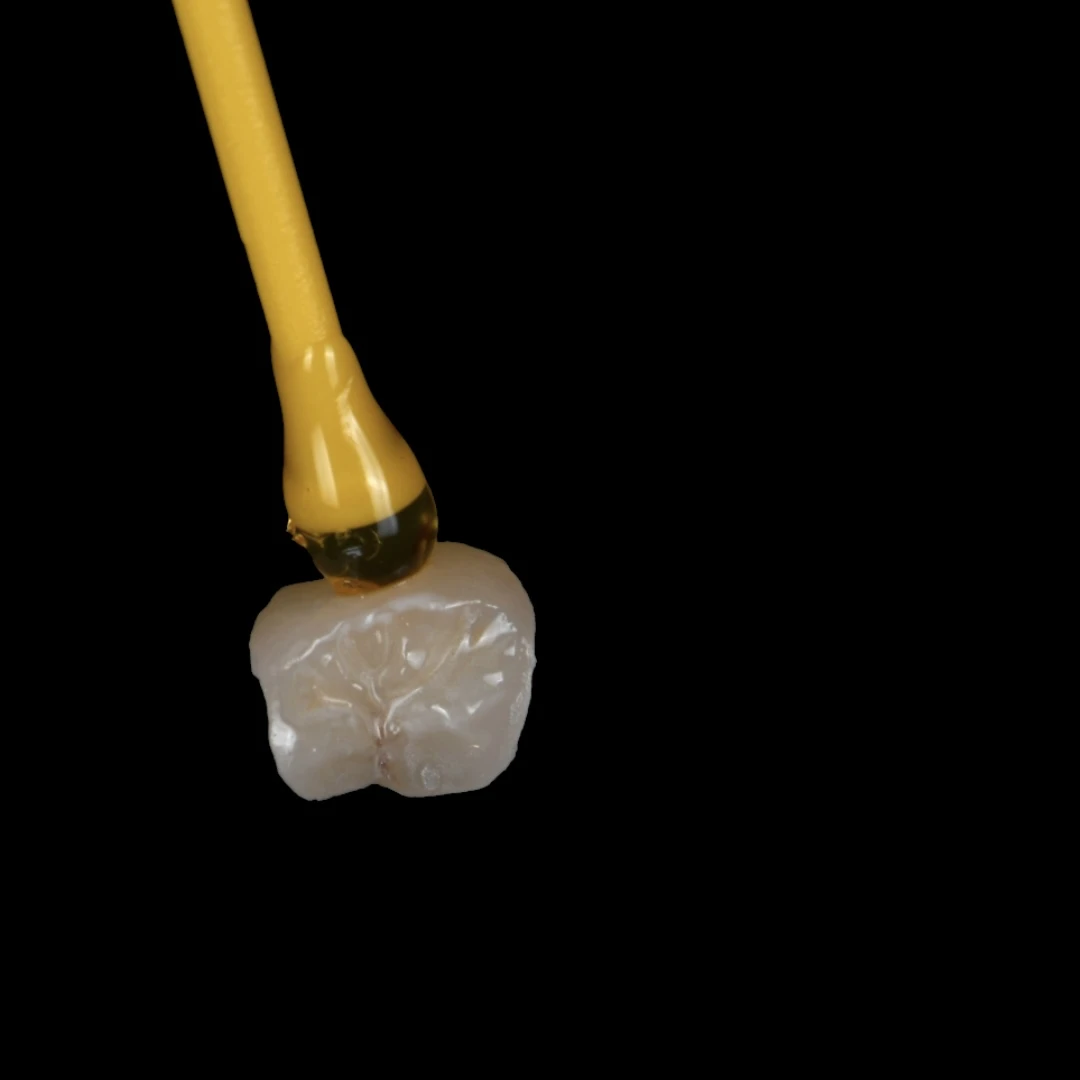
An inlay is a restoration that fits inside the tooth, between the cusps, filling the space left by decay or an old filling. An onlay fits inside the tooth and also covers one or more weakened cusps. An overlay covers all the cusps: the whole chewing surface is rebuilt, but the sides of the tooth are preserved. A crown is a cap that surrounds the whole tooth, sides included, which means reducing it all the way round.
The first three are made outside the mouth, in a laboratory or by milling from a digital impression, most often in ceramic and sometimes in composite, then bonded to the tooth. A crown is also made separately, then bonded or cemented. The page on inlays, onlays and overlays describes the thinking behind these partial restorations.
What decides between them?
What remains of the tooth, and in what condition. A thin wall, or a cusp that is cracked or undermined by old decay, will not hold up on its own under chewing: it is covered. A thick, healthy wall is kept. The rule is therefore the same in every case: cover what is fragile, keep what is sound.
Other factors come into the decision. A root-treated tooth, frequently badly broken down, more often needs its cusps covered. Forces matter: in someone who clenches or grinds their teeth, a partial restoration breaks more often. And bonding has its conditions: enamel at the margins, and a tooth that can be kept isolated from saliva while the restoration is placed.
A crown is not an “extra” to be chosen just to be on the safe side. It removes more of the tooth, from surfaces that often have nothing wrong with them. It still has its indications, described below; elsewhere, a bonded partial restoration does the same job while keeping more of the tooth.
Why cover the cusps rather than simply fill the tooth?
Because a weakened cusp cracks. When decay or an old filling has hollowed out the tooth, the remaining walls are thinner and taller than they appear, and they flex with every bite. Covering the cusp with the bonded restoration spreads the forces over the whole tooth, instead of concentrating them on the wall.
For root-treated teeth, the figures are clear. In a study of 203 root-treated teeth, those that had not been covered with a crown were lost six times faster than the others. In another, of 220 root-treated molars left without crown coverage, just over one in three was still in place at five years; those that had kept the most tooth structure fared better, at 78%.
This does not mean covering every tooth as a matter of course. A root-treated molar that still has broad, thick walls can be restored with a well-made composite; the examination decides, tooth by tooth.
When is a crown still the right answer?
When too little of the tooth remains to bond a partial restoration reliably, when there is no enamel left at the margins of the restoration, when an old crown needs replacing, or when the tooth supports a bridge. In someone who grinds their teeth heavily, full coverage often remains the more predictable option.
A recent trial on sixty root-treated molars that still had at least three thick walls compared crowns with direct composite: at three years, 93% of the crowns and 77% of the composites were still in place, a difference that does not reach statistical significance with this sample size. The factor that weighed most was teeth grinding. That is one reason to assess it before choosing, as the article on bruxism explains.
How long do they last?
For ceramic inlays and onlays, a meta-analysis of fourteen studies covering more than 5,800 restorations estimates that between 92 and 95% are still in place at five years, and 91% at ten years. The reasons for redoing them, in order: fracture of the restoration, 4%; a problem with the nerve, 3%; decay at the margin or debonding, 1% each. Failures are more frequent on root-treated teeth.
For single crowns, a review of 67 studies covering more than 14,000 crowns finds a five-year survival rate of 94.7% for metal-ceramic crowns and 96.6% for reinforced glass-ceramic crowns, such as lithium disilicate. The most fragile ceramics are reserved for the front teeth.
For root-treated teeth restored with a bonded onlay or overlay, a recent meta-analysis reports 4% failures between two and four years, and around 10% beyond seven years; most of these failures can be repaired without losing the tooth. These figures cannot be compared like for like, because the teeth and the length of follow-up differ from one study to another; above all, they show that a well-indicated partial restoration is not a second-rate solution.
Composite or ceramic for the restoration?
Ceramic holds up better over time, keeps its surface finish and rarely needs re-polishing; lithium disilicate, which is strong and can be bonded, is now the most common material for these restorations. A thickness of at least two millimetres on the chewing surface reduces the risk of fracture.
Composite, whether as a laboratory-made restoration or sculpted directly in the tooth, is easier to repair and costs less. Trials comparing a laboratory-made composite inlay with a composite placed directly in the mouth find no difference in survival at five and at eleven years; it is the extent of the defect, when several cusps are involved, that makes a custom-made restoration preferable.
How does treatment work, and how much does it cost?
Most often, two appointments. At the first, the tooth is cleared of decay or of its old restoration and prepared only where necessary, then a digital impression is taken; a temporary restoration protects the tooth. At the second, the final restoration is tried in, then bonded with the tooth isolated, away from saliva, and the bite is checked: the way the tooth meets the opposing tooth is adjusted if needed.
Bonding is the step that holds everything together. It requires a clean, dry tooth, treatment of the restoration’s surface, and time. Once bonded, the restoration becomes one with the tooth: it is the tooth and restoration together that bear the forces of chewing.
At the practice, a ceramic onlay or overlay costs €720 to €850, and an all-ceramic crown €900 to €1,400, depending on complexity. A written quote is provided after the examination, before any decision. Full details are on the fees page.
Afterwards: care, check-ups and repairs
A bonded restoration is cared for like a natural tooth: brushing, cleaning between the teeth, where decay can form at the margin, and regular check-ups. The check-up examines the margins and the contacts, and looks for any cracks.
A ceramic chip can often be polished or repaired in the mouth; a larger fracture means remaking the restoration, generally without touching the rest of the tooth. If you clench or grind your teeth, a night guard protects the restoration as well as the neighbouring teeth.
Frequently asked questions
Is an onlay weaker than a crown?
Not when it is indicated. Studies report similar lifespans, though in different teeth and situations. An onlay is held by bonding to what remains of the tooth; it is when what remains is too weak that a crown regains the advantage.
Can an inlay or an onlay be placed on a root-treated tooth?
Yes, and it is common. On a root-treated tooth, the cusps are more readily covered, with an onlay or an overlay, because they are more fragile. The choice depends on how much of the tooth remains.
What happens if the restoration fractures?
A small chip can be polished or repaired. A larger fracture requires a new restoration, made from a new impression, generally without removing any more of the tooth.
References
- Morimoto S, Rebello de Sampaio FB, Braga MM, Sesma N, Özcan M. Survival rate of resin and ceramic inlays, onlays, and overlays: a systematic review and meta-analysis. J Dent Res. 2016;95(9):985-994. doi:10.1177/0022034516652848
- Abduo J, Sambrook RJ. Longevity of ceramic onlays: a systematic review. J Esthet Restor Dent. 2018;30(3):193-215. doi:10.1111/jerd.12384
- Sailer I, Makarov NA, Thoma DS, Zwahlen M, Pjetursson BE. All-ceramic or metal-ceramic tooth-supported fixed dental prostheses (FDPs)? A systematic review of the survival and complication rates. Part I: single crowns (SCs). Dent Mater. 2015;31(6):603-623. doi:10.1016/j.dental.2015.02.011
- Aquilino SA, Caplan DJ. Relationship between crown placement and the survival of endodontically treated teeth. J Prosthet Dent. 2002;87(3):256-263. doi:10.1067/mpr.2002.122014
- Nagasiri R, Chitmongkolsuk S. Long-term survival of endodontically treated molars without crown coverage: a retrospective cohort study. J Prosthet Dent. 2005;93(2):164-170. doi:10.1016/j.prosdent.2004.11.001
- Dioguardi M, Alovisi M, Comba A, et al. The influence of indirect bonded restorations on clinical prognosis of endodontically treated teeth: a systematic review and meta-analysis. Dent Mater. 2022;38(8):e203-e219. doi:10.1016/j.dental.2022.06.018
- Abu-Awwad M, et al. Direct restorations versus full crowns in endodontically treated molar teeth: a three-year randomized clinical trial. J Dent. 2025;156:105699. doi:10.1016/j.jdent.2025.105699
- Angeletaki F, Gkogkos A, Papazoglou E, Kloukos D. Direct versus indirect inlay/onlay composite restorations in posterior teeth. A systematic review and meta-analysis. J Dent. 2016;53:12-21. doi:10.1016/j.jdent.2016.07.011
- Politano G, Van Meerbeek B, Peumans M. Nonretentive bonded ceramic partial crowns: concept and simplified protocol for long-lasting dental restorations. J Adhes Dent. 2018;20(6):495-510. doi:10.3290/j.jad.a41630