
Key points
- Bruxism is jaw-muscle activity, by day or at night: clenching, grinding, holding the jaw tense. In an otherwise healthy person, it is not a disease but a behaviour, one that can damage the teeth and restorations.
- Worn teeth do not prove current bruxism: wear is the sum of a lifetime, and acids or brushing contribute to it. In studies that record muscle activity at night, people with worn teeth do not necessarily show more of it.
- Before veneers or composite restorations, bruxism is assessed: in people who grind their teeth, veneers break considerably more often. A night guard protects the teeth; it does not stop bruxism, and nothing stops it completely.
What is bruxism?
Activity of the jaw muscles: grinding the teeth, clenching them, or simply holding the jaw tense without the teeth touching. The international consensus, which is the reference on the subject, distinguishes two forms according to when it occurs: sleep bruxism, which often alternates rhythmic contractions with sustained clenching, and awake bruxism, which mostly involves clenching or tensing the jaw, often without the person being aware of it. Having one does not mean having the other.
The same consensus makes a useful point: in an otherwise healthy person, bruxism is not a disease. It is a common behaviour that can become a risk factor for the teeth, restorations and jaw joints, and that may, in some situations, play a protective role. So the aim is not to “cure” it; it is to find out whether it is there, and what it is doing.
It is common. In surveys, between one adult in four and one in three say they clench their teeth during the day, and around 13% say they often grind their teeth at night. These figures are based on what people report; many are unaware of it, especially at night.
Does bruxism inevitably wear the teeth down?
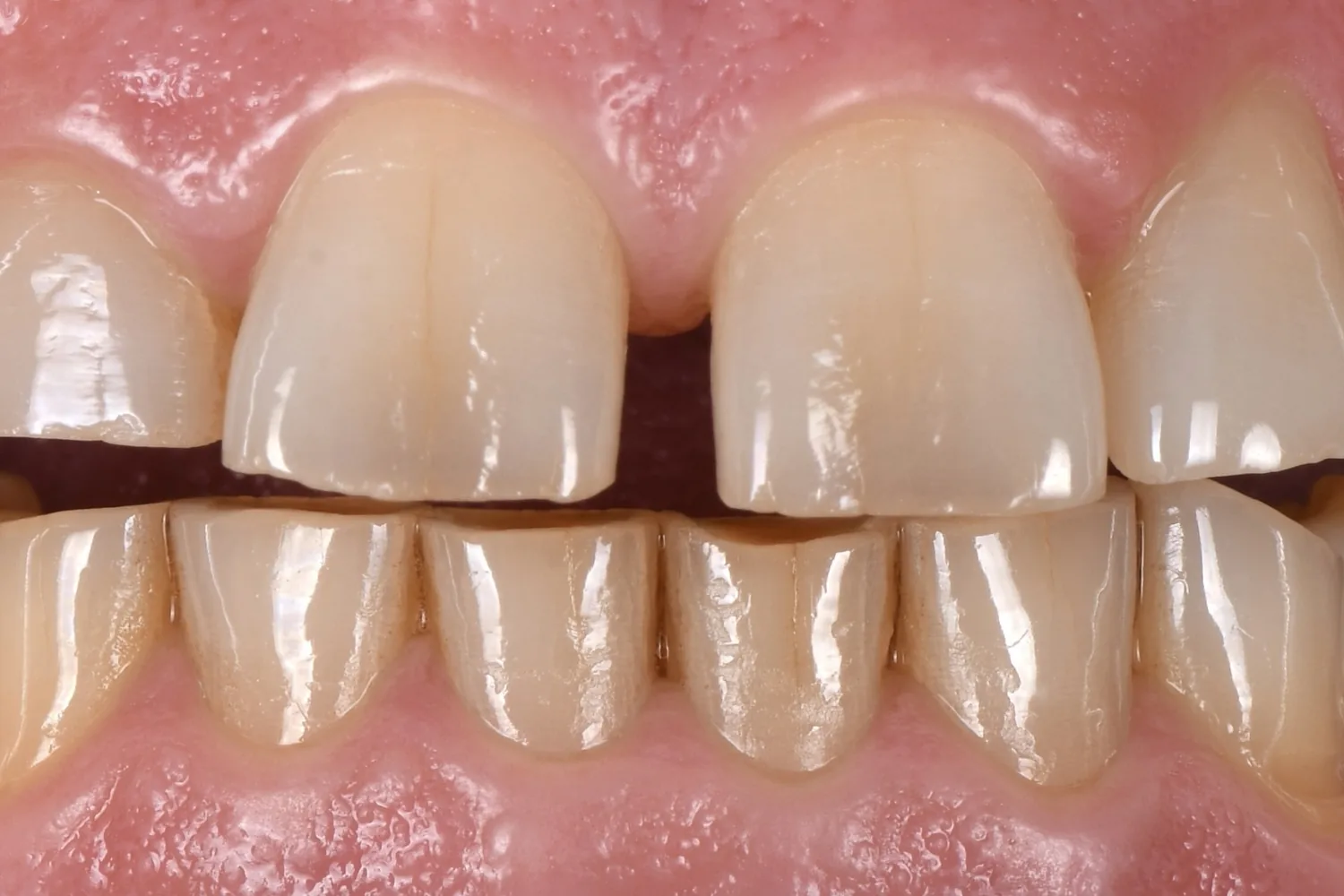
It can. When the teeth slide forcefully against each other, the enamel wears away tooth against tooth: the edges of the incisors flatten, the tips of the canines become blunt, and flat wear facets appear that fit exactly against those on the opposing tooth. This is what is called attrition.
But the link is not proportional. Some people who grind a great deal have little wear; others, who grind little, have marked wear, because other causes add to it: acids, which soften the enamel and make it much easier to wear away, brushing too hard, a low flow of saliva. The article on erosion describes the part played by acids. The wear you can see is the sum of all of this, over the years.
Do worn teeth prove bruxism?
No. The surfaces keep a record of what has happened, without saying when. Marked wear may reflect a period long past, grinding during adolescence for example, just as much as activity that is still going on.
Studies that have recorded muscle activity during sleep show this. In young adults, those with clear wear had no more night-time activity than those whose teeth were intact, even though they more often reported grinding and a tired jaw on waking. In another study, wear did distinguish people who grind from those who do not, but said nothing about how intense the grinding was. The absence of wear makes significant bruxism unlikely; its presence does not confirm it.
Getting it wrong is costly either way. Wrongly attributing wear to grinding leaves another cause, such as reflux, to act unrecognised. Dismissing the possibility without examining it means placing restorations under forces that are likely to break them.
How does the dentist assess it?
By bringing together the signs that point the same way. First, what you report: a heavy or painful jaw on waking, tension in the temples, a grinding noise reported by the person who sleeps next to you, teeth that are sensitive to cold in the morning, composite restorations or veneers that chip again and again, a habit of clenching your teeth when you concentrate. Then, what the examination shows: wear facets that fit together, enlarged or tender chewing muscles in the cheeks, marks along the edge of the tongue or on the inside of the cheeks, cracks in the enamel.
The international consensus grades the result at three levels: possible bruxism, when you report it; probable, when the examination finds signs of it; definite, when a recording of the muscles or of sleep measures it. This recording is not needed in routine practice; it is useful when the answer would genuinely change the decision.
What the examination cannot establish is better stated than guessed: probable bruxism remains probable. The decision to restore takes it into account as a risk, not as a certainty.
What makes it more likely?
Stress and anxiety come first in the studies, although the evidence is of modest quality. Next come alcohol, tobacco and high doses of caffeine, which reviews find increase the likelihood of grinding at night. Some antidepressants, such as paroxetine, venlafaxine or duloxetine, are associated with sleep bruxism in studies; others are not. If you take one, the answer is not to stop it, but to talk about it with the doctor who prescribes it.
Two common beliefs deserve to be set aside. The first: “it’s because my teeth don’t fit together properly”. Reviews find no evidence that the way the teeth meet causes bruxism, or that correcting it makes bruxism go away. The second: “it’s linked to sleep apnoea”. The link has been suggested, but the most recent meta-analysis does not find a clear association. Snoring, frequent waking and daytime tiredness still warrant a sleep assessment, in their own right.
What difference does it make before teeth are restored?
A great deal. In people who grind their teeth, ceramic veneers break far more often: in a series of 318 veneers followed for up to twenty years, the risk of failure was multiplied by nearly eight; a meta-analysis finds a risk two and a half to seven times higher. Composite restorations chip more, and so do bonded restorations on the back teeth.
So the assessment comes before the decision. Depending on what it shows, a stronger material may be chosen, or a restoration design that leaves the edges less exposed; the plan may be postponed while the situation is stabilised; or things may simply be monitored more closely. And the night guard is planned from the outset, rather than after the first chip. The page on tooth wear places this factor among the other mechanisms, and in the order in which decisions are made.
The night guard: what it does, and what it does not do
It places a surface between the teeth that wears instead of them. Worn at night, it protects the teeth and restorations from the forces of grinding: that is its role, and a logical one, even though no randomised trial has directly measured the wear it prevents.
It does not stop bruxism. Studies that record muscle activity find a reduction in some people, but it is modest, variable and not shown to last over the long term; the Cochrane review on the subject concludes that the evidence is not sufficient to say that it treats grinding. It is worn for what it protects, not for what it might cure.
A night guard is custom-made from an impression, and it needs monitoring: it wears, it can become distorted, and its fit is checked at your visits. Whether you need one, and which type, depends on the situation; both are decided at the examination.
Can it be made to go away?
Not completely, and no treatment promises that. What is possible: reducing what keeps it going (alcohol, tobacco, coffee late in the day, irregular sleep); learning to notice daytime clenching and to relax the jaw, which simple exercises or a regular reminder can help with; protecting the teeth at night. Medication and botulinum toxin have been studied, with conflicting results and effects that are limited in time: they are for particular situations, not for routine management.
A final word on what bruxism is not: a problem to be solved before you can live normally. Many people grind their teeth all their lives without significant damage. What matters is knowing about it before making a choice that depends on it.
Frequently asked questions
My partner hears me grinding at night: should I see a dentist?
Yes, though there is no urgency. A partner’s account is one of the most useful signs. The examination will look for other signs pointing the same way, and decide whether there is anything to protect.
Does bruxism damage veneers and composite restorations?
It clearly increases the risk of breakage: in studies, veneers fail several times more often in people who grind their teeth. That is why bruxism is assessed beforehand, and why restorations are protected with a night guard. The article on how long veneers last gives the figures.
Does correcting the bite stop bruxism?
No. Reviews find no evidence that the way the teeth meet causes bruxism, or that changing it makes bruxism stop. Reshaping the teeth for this purpose removes enamel with no proven benefit.
Is a night guard bought at a pharmacy good enough?
It puts a layer of material between the teeth, but it is not fitted to your teeth, and nobody checks it. A night guard made from an impression stays in place better, spreads the forces more evenly and is checked at your follow-up visits. If you wear one bought over the counter, mention it at the examination.
References
- Lobbezoo F, Ahlberg J, Raphael KG, et al. International consensus on the assessment of bruxism: report of a work in progress. J Oral Rehabil. 2018;45(11):837-844. doi:10.1111/joor.12663
- Manfredini D, Winocur E, Guarda-Nardini L, Paesani D, Lobbezoo F. Epidemiology of bruxism in adults: a systematic review of the literature. J Orofac Pain. 2013;27(2):99-110. doi:10.11607/jop.921
- Jonsgar C, Hordvik PA, Berge ME, Johansson AK, Svensson P, Johansson A. Sleep bruxism in individuals with and without attrition-type tooth wear: an exploratory matched case-control electromyographic study. J Dent. 2015;43(12):1504-1510. doi:10.1016/j.jdent.2015.10.002
- Abe S, Yamaguchi T, Rompré PH, De Grandmont P, Chen YJ, Lavigne GJ. Tooth wear in young subjects: a discriminator between sleep bruxers and controls? Int J Prosthodont. 2009;22(4):342-350.
- Bertazzo-Silveira E, Kruger CM, Porto De Toledo I, et al. Association between sleep bruxism and alcohol, caffeine, tobacco, and drug abuse: a systematic review. J Am Dent Assoc. 2016;147(11):859-866.e4. doi:10.1016/j.adaj.2016.06.014
- Melo G, Dutra KL, Rodrigues Filho R, et al. Association between psychotropic medications and presence of sleep bruxism: a systematic review. J Oral Rehabil. 2018;45(7):545-554. doi:10.1111/joor.12633
- Lobbezoo F, Ahlberg J, Manfredini D, Winocur E. Are bruxism and the bite causally related? J Oral Rehabil. 2012;39(7):489-501. doi:10.1111/j.1365-2842.2012.02298.x
- Błaszczyk B, et al. Sleep bruxism (SB) may be not associated with obstructive sleep apnea (OSA): a comprehensive assessment employing a systematic review and meta-analysis. Sleep Med Rev. 2024;78:101994. doi:10.1016/j.smrv.2024.101994
- Beier US, Kapferer I, Burtscher D, Dumfahrt H. Clinical performance of porcelain laminate veneers for up to 20 years. Int J Prosthodont. 2012;25(1):79-85.
- de Souza Melo G, Batistella EÂ, Bertazzo-Silveira E, et al. Association of sleep bruxism with ceramic restoration failure: a systematic review and meta-analysis. J Prosthet Dent. 2018;119(3):354-362. doi:10.1016/j.prosdent.2017.07.005
- Macedo CR, Silva AB, Machado MA, Saconato H, Prado GF. Occlusal splints for treating sleep bruxism (tooth grinding). Cochrane Database Syst Rev. 2007;(4):CD005514. doi:10.1002/14651858.CD005514.pub2
- Manfredini D, Ahlberg J, Winocur E, Lobbezoo F. Management of sleep bruxism in adults: a qualitative systematic literature review. J Oral Rehabil. 2015;42(11):862-874. doi:10.1111/joor.12322
- Goldstein G, DeSantis L, Goodacre C. Bruxism: best evidence consensus statement. J Prosthodont. 2021;30(S1):91-101. doi:10.1111/jopr.13308