
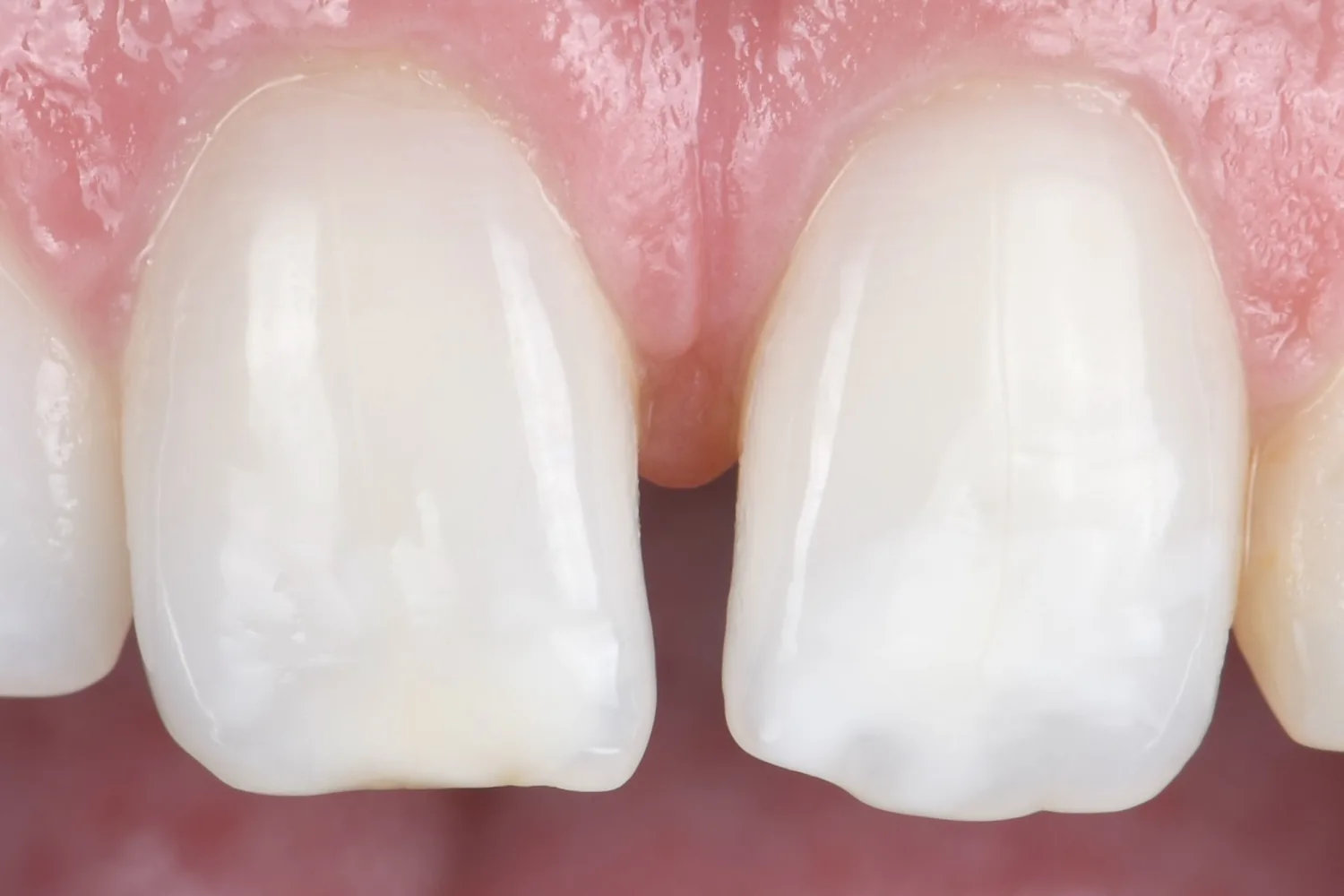
If it bothers you, several options can be considered. Orthodontic treatment is not always necessary: in some situations, adding composite can change the shape of the teeth and reduce the gap. In others, moving the teeth is more appropriate than widening them.
The choice depends on the cause of the gap, the proportions of the teeth, the gums and the way the teeth meet.
Key points
- A gap between two teeth is called a diastema.
- It can be closed by moving the teeth, by changing their shape, or by combining the two.
- A gap that has appeared recently or is getting wider should be examined first: masking it is not enough to treat its cause.
Why is there a gap between the teeth?
Two gaps that look alike can correspond to different situations.
The teeth may be relatively small for the space available. A narrow lateral incisor, for example, can leave a gap even though the teeth as a whole are correctly positioned.
The gap may also be linked to the position of the teeth, a missing tooth or certain functional factors. The upper lip frenum, the fold of tissue that attaches the lip to the gum, can play a part in some situations, but its appearance alone is not enough to decide on treatment.
The history of the gap also matters: has it been there for a long time? Did it reopen after orthodontic treatment? Did it appear gradually in adulthood?
A gap that has appeared recently can, in particular, be associated with disease of the tissues that support the teeth (periodontal disease). If it is getting wider, if your gums bleed or if a tooth seems loose, an assessment is needed before any aesthetic correction is considered.
Moving the teeth or changing their shape: what is the difference?
Orthodontics acts on the position of the teeth. It can bring them closer together, correct their inclination or distribute the spaces more evenly.
Composite and veneers act on their shape. They can reduce a gap by increasing the width of certain teeth, without moving their roots.
This distinction is essential. If two incisors are already a harmonious width, widening them further to fill a gap can give a disproportionate result. Conversely, if a tooth is too narrow, moving it does not, on its own, correct its shape.
So the question is not only: “How can the gap be closed?” It is also: “What proportions and what position do we want to achieve?”
When can a gap be closed with composite?
Composite is a tooth-coloured resin bonded to the surface of the teeth. It can be used to reshape certain contours by adding material.
This approach can be considered when the size of the gap is compatible with widening the teeth by a reasonable amount, when their position is satisfactory and when health and function allow it.
In favourable situations, the material can be added without any mechanical preparation of the enamel. This does not mean that every situation can be managed without any reshaping, nor that a return to exactly the original state could be promised if the composite were later removed.
Composite can be shaped directly in the chair, or placed using a transparent key made from a plan prepared in advance. The choice between layering and the injection technique depends in particular on the number of teeth involved and the shapes to be rebuilt.
The aim is not simply to fill a space. The result must keep natural proportions, a suitable contact area between the teeth and contours that allow cleaning without irritating the gums.
An example from the practice: a patient bothered by the gaps between his upper teeth, and above all by his canines, which he found too pointed. Orthodontic correction alone would not have met his whole request, which also concerned the shape and proportions of the teeth. After whitening, six injection-moulded composite veneers were made from canine to canine, by adding material; only the tips of the canines were slightly reshaped. The steps are set out in the clinical case of the six injection-moulded composite veneers.
What are the limits of composite?
Composite can lose its shine, stain or chip. Check-ups, polishing or a repair may be needed over time.
Being able to repair it locally is one of the advantages of this material. It does not remove the need for follow-up, and it cannot ensure the same lifespan for every patient.
Finally, adding composite does not treat the cause of tooth movement that is still under way. That cause must be identified and treated.
When is orthodontics more suitable?
Orthodontics is worth considering when the teeth need to be repositioned: teeth whose axes diverge, spaces spread over several areas of the mouth, a mismatch between the upper and lower dental arches, or proportions that would become excessive if material were added.
It can close the gap without restoring the visible surfaces of healthy teeth. Depending on the diagnosis, treatment may use brackets (fixed braces) or clear aligners; the appliance is chosen after an orthodontic assessment.
Orthodontics and composite are not always mutually exclusive. It is sometimes preferable to move the teeth first to distribute the spaces better, then to correct the shape of a tooth that is too narrow with a limited addition of material.
After orthodontic treatment, a retainer is generally needed to maintain the position achieved. How it is worn and followed up is agreed with the practitioner, because teeth can continue to move throughout life.
Where do ceramic veneers fit in?
Ceramic veneers may be considered when the gap comes with other indications: shapes to correct, certain changes in shade or existing restorations that need redoing.
They are not an automatic answer to a simple gap between two healthy teeth.
Their benefits must be weighed against any preparation that may be needed, the cost, the options for repair and the follow-up. Depending on the situation, composite or orthodontic correction may be more suitable.
The colour stability of ceramic is not, on its own, enough to justify this choice.
What if the gap looks like a black triangle near the gum?
A small dark space between the teeth, near the gum, is not necessarily a typical diastema. The teeth may touch nearer their biting edges, while the gum between them does not completely fill the space up to that point of contact.
The shape of the teeth, their position and the condition of the supporting tissues then need to be assessed.
Adding composite can sometimes reduce this space, but it must still let cleaning aids pass and respect the health of the gums. Filling the area excessively would not be a satisfactory solution.
How is the treatment decided at the practice?
The consultation starts with your request: what bothers you, since when, and what you would like to keep in your smile.
The examination assesses the width and shape of the teeth, how the spaces are distributed, the condition of the gums and the contacts between the upper and lower teeth. Further examinations are prescribed if the situation requires them.
Photographs and, when useful, a digital impression (scan) are used to study the proportions. Depending on the plan, a simulation or a trial in the mouth can help you understand what adding material would change.
The options are then compared: not intervening, moving the teeth, changing their shape or combining several steps.
A written quote sets out the proposed treatment. The number of appointments depends on the option chosen and on any treatment needed beforehand.
Seeing a dentist near Paris 17 about a gap between the teeth
If you live or work in the 17th arrondissement of Paris, you can see Dr Jérémy Haccoun at the practice at 119 rue du Président Wilson, in Levallois-Perret, right next to the 17th.
The first consultation assesses whether your request calls for adding composite, an orthodontic opinion or a different approach. It may also conclude that no treatment is needed.
Access information is on the practice page. What happens at the first appointment is explained on the page about the aesthetic consultation.
Conclusion
Closing a gap between the teeth is not just a matter of bringing two outlines together. Treatment must take into account the cause of the gap, the proportions of the smile and the health of the tissues. The aim is to choose a suitable correction while preserving the natural teeth as far as possible.
Frequently asked questions
Can a gap between the front teeth be closed without braces?
Yes, in some situations. Adding composite can be considered if the gap, the shape of the teeth and the clinical conditions allow it. If the problem lies mainly in the position of the teeth, orthodontics may be preferable. The choice is made after an examination.
Do the teeth on both sides of the gap need to be treated?
Not necessarily. How the added material is distributed depends on the shape and symmetry of the teeth. Working on a single tooth is sometimes enough; in other situations, spreading the correction out makes it easier to respect the proportions.
Can the gap reopen after treatment?
Yes, things can still change if the teeth move or if the original cause persists. After orthodontic treatment, a retainer helps to maintain the result. With restorations, the contacts between the teeth and the condition of the materials also need to be checked.
Should the lip frenum be cut?
Not as a matter of course. The frenum needs to be assessed as part of the clinical situation as a whole. Whether any procedure is carried out, and when, depends on the diagnosis; such a procedure does not automatically replace the other stages of treatment.
How much does it cost to close a gap between the teeth?
The cost depends on the technique, the number of teeth involved, the work needed to prepare the plan and any treatment required before the correction. An individual written quote is given after the examination. You can consult the practice’s fees page for the procedures listed there.
Is it all right to keep the gap?
Yes. A gap that is stable and compatible with good oral health does not need correcting just because it is visible. Your preference is part of the decision.
References
- Gkantidis N, Kolokitha OE, Topouzelis N. Management of maxillary midline diastema with emphasis on etiology. J Clin Pediatr Dent. 2008;32(4):265-272. Review article on the causes of diastema. doi:10.17796/jcpd.32.4.j087t33221771387
- Korkut B, Türkmen C. Longevity of direct diastema closure and recontouring restorations with resin composites in maxillary anterior teeth: a 4-year clinical evaluation. J Esthet Restor Dent. 2021;33(4):590-604. Retrospective study, with composite placed using a direct technique. doi:10.1111/jerd.12697
- Herrera D, Sanz M, Kebschull M, et al. Treatment of stage IV periodontitis: the EFP S3 level clinical practice guideline. J Clin Periodontol. 2022;49(Suppl 24):4-71. Guideline of the European Federation of Periodontology. doi:10.1111/jcpe.13639
- British Orthodontic Society. Retainers. Patient information, bos.org.uk/patients/retainers (accessed 14 October 2026).